
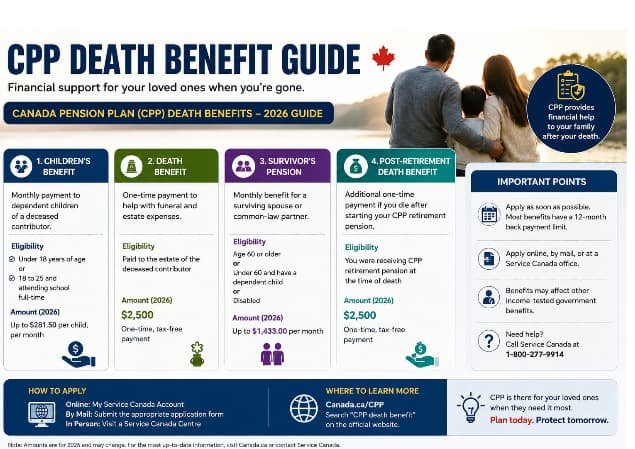
Losing someone you truly cared about can feel emotionally brutal, and then dealing with financial duties afterwards, it can pile on even more pressure. In Canada, the Canada Pension Plan (CPP) Death Benefit provides a one-time payment, so the estate or specific eligible people can assist with expenses that show up after a contributor passes away. This CPP Death Benefit Guide goes through how the benefit works, which individuals might qualify, what amount of money families may end up receiving, and what steps to take to apply successfully, even while you are already going through a hard stretch.
Still, a lot of families do not know they might qualify for this payment, or they are unclear about how the request or application process works. If you get a handle on the rules, the eligibility conditions, the documents you need, and the key timelines, it usually feels easier to access this helpful government benefit.
This CPP Death Benefit Guide breaks down what Canadians should know about the program. It covers who can apply, what amount is paid, and the best way to submit an application without unnecessary issues.
What Is the CPP Death Benefit?
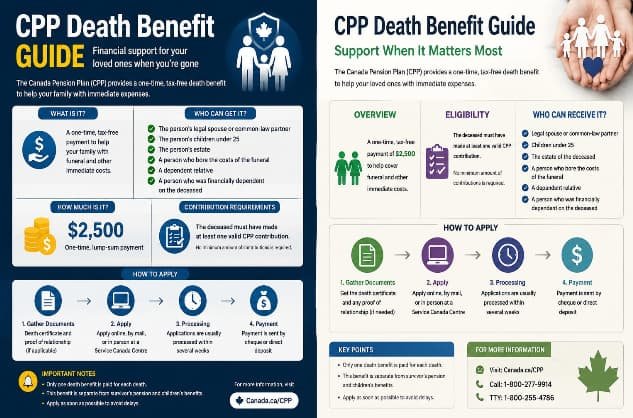
The CPP Death Benefit is a one-time lump-sum amount paid by the Government of Canada. It is meant to help with expenses after the death of someone who paid into the Canada Pension Plan.
Unlike monthly CPP retirement benefits or survivor benefits, the death benefit is paid only once. It is designed to provide financial assistance to the deceased person’s estate, or to an eligible applicant, during a difficult span of time.
This payment works independently from other CPP related programs, including:
- CPP Survivor’s Pension
- CPP Children’s Benefits
- CPP Retirement Pension
Families may be able to receive several CPP benefits, depending on what is going on in their case.
You can learn more about related benefits by reading our guide on “CPP Survivor Benefits “
CPP Death Benefit Guide: How Much Is the CPP Death Benefit in Canada?
The CPP death benefit provides a maximum payment amount of $2,500.
The exact amount depends on the deceased contributor’s CPP contribution history , and their eligibility status. In many cases , the payment is issued as a lump sum after the application has been approved.
The CPP Death Benefit amount is not meant to cover absolutely every funeral expense or estate cost. Instead, it offers financial support that can ease certain expenses, for example:
- Funeral arrangements
- Burial or cremation charges
- Unpaid bills
- Administrative costs connected to settling the estate
Since funeral costs can be considerable, families should submit the paperwork as soon as possible after the death happens.
For a broader explanation of how these major Canadian senior benefits differ, readers can review OAS vs CPP vs GIS Comparison to understand the purpose and eligibility of each program.
Who can receive the CPP Death Benefit?
Eligibility largely depends on whether the deceased person paid enough into the Canada Pension Plan.
In general, the deceased person needed to have made proper CPP contributions during their working years to qualify.
The CPP Death Benefit may be paid to :
- The estate of the deceased person
- The individual handling the funeral expenses
- An eligible person who applies when there is no estate representative
- The estate typically gets priority if an executor or legal representative is in place
However, when there is no estate, Service Canada may still look at applications from other people who paid funeral costs or who handled the last arrangements for the deceased
CPP Death Benefit Guide: CPP contribution requirements for the death benefit
To qualify for the CPP Death Benefit, the deceased contributor has to meet certain contribution conditions
- In general, the person must have
- Contributed to CPP during the working years
- Paid into CPP for at least the required minimum period
- Had enough valid CPP contributions, following the CPP rules
- The exact contribution requirement can change depending on the person’s work background and particular situation
If you are not sure whether the deceased person paid in enough, you can still submit an application. Service Canada will check the CPP file and decide if you meet eligibility
CPP Death Benefit Guide: Who can apply for the CPP Death Benefit?
The person who applies sort of depends on the situation around the estate really, even though it might feel the same.
Estate Representative
If the deceased person had a will, and an executor or estate administrator has been appointed, that person can apply for the estate.
Examples could be :
- Executor named in a will
- Estate administrator appointed by the court
- Legal representative
Family Member or another Individual
If there is no estate representative available, another individual can apply, as long as they meet the requirements.
This might involve someone who:
- covered funeral costs
- handled the last arrangements
- had responsibility for the deceased person’s affairs
CPP Death Benefit Guide: How to Apply for the CPP Death Benefit
Applying for the CPP Death Benefit means submitting an application to Service Canada.
Applicants may apply:
- online through their Service Canada account
- by completing a paper application form
- by sending documents through approved government routes
The application process usually asks for personal information about :
- The departed contributor
- The person applying
- The estate
- Payment particulars
Applicants should look over every detail before sending in the form, to prevent holdups.
If you are already managing other Service Canada benefits, it can also be useful to understand the difference between government online accounts. For example, our article My Service Canada Account vs CRA My Account explains what each online service is used for.
Documents Required for a CPP Death Benefit Request
If you have the right documents in hand the whole thing tends to move with less friction.
Common items usually are:
Details About the Deceased Person
- Social Insurance Number (SIN)
- Birth date
- Date of death
- CPP contribution records
Details About the Applicant
- Name and ways to reach you
- Your connection to the deceased
- Identity evidence
- Banking details for direct deposit
Estate Related Documents
If you are applying as an estate representative, you may need
- Will records
- Proof you are the executor
- Estate administration forms
Other papers might be requested depending on the circumstances.
If you are also managing the deceased person’s tax affairs, understanding CRA records and account information can be helpful. Our guide on How to Read Your CRA Account Statement can help readers understand important information shown in a CRA account.
CPP Death Benefit Guide: How much time does the CPP death benefit take?
Timeline can differ, based on how many requests are in the queue, and on whether every required piece is included.
Apps with full details tend to get looked at faster than ones that need extra papers, or at least that is usually how it plays out.
- To avoid holdups, try doing these things early
- Submit your application as soon as you can
- Make sure every part has correct and precise information
- Attach every required document, no gaps
- If Service Canada asks for more information respond promptly, even if it feels minor
Also, Families should keep copies of everything that was submitted, just for their own records.
Is the CPP Death Benefit Taxable?
Yes, the CPP Death Benefit is treated as taxable income.
In most cases, the payment shows up on a tax slip, and you have to report it when you file your taxes.
Depending on the circumstances, the benefit may be reported as
- Income on the deceased person’s final tax return
- Estate income
- Under the relevant tax rules
Because the estate and tax details can differ, families sometimes choose to speak with a tax professional when they are dealing with the deceased person’s financial affairs.
For readers dealing with outstanding tax obligations, our article CRA Payment Arrangements Explained provides useful information about options for managing certain tax debts with the Canada Revenue Agency.
Difference Between CPP Death Benefit and CPP Survivor Benefits
A lot of Canadians mix up the CPP Death Benefit with survivor benefits, but they really do the job in different ways.
Benefit | Purpose | Payment Type
| Benefit | Purpose | Payment Type |
|---|---|---|
| CPP Death Benefit | Financial assistance after death | One-time payment |
| CPP Survivor Pension | Supports surviving spouse/partner | Monthly payment |
| CPP Children’s Benefit | Supports dependent children | Monthly payment |
- A CPP Death Benefit payment,
- A monthly CPP survivor pension
- And other government benefits if eligible.
Common Mistakes When Applying for the CPP Death Benefit
A lot of applications end up delayed because of things that could have been avoided, like small errors that feel harmless.
Common issues are usually like this
Missing Documents
If the application is incomplete, it may be sent back for extra checking.
Incorrect Information
Mistakes in names, dates, or banking details can delay the final review.
Waiting Too Long
If families apply early, they often receive support sooner, which helps with the timing.
Not Checking Other Benefits
Some people focus only on the death benefit, and then miss other CPP programs they could actually use too.
Can You Apply for the CPP Death Benefit Online?
Yes. If you are eligible, you may be able to apply online through government digital services.
Online options can be more practical since they let applicants
- Send details electronically
- See updates on progress
- Use less paper work
Still, before you begin, applicants should make sure they have everything needed for the application.
What Happens After the CPP Death Benefit Is Approved?
After it’s approved, the payment gets issued in line with the applicant’s payment information, so that part is handled, basically.
The applicant should:
- Confirm the payment details
- Keep benefit records
- Save tax documents linked to the payment
If the payment is sent to the estate, the executor has to manage the funds following the estate responsibilities that apply there.
Final Thoughts: Understanding the CPP Death Benefit Guide
The CPP Death Benefit Guide basically helps Canadian families grasp a key financial support option that is available after a CPP contributor passes away.
Even if the payment is a one-time benefit, it can provide real assistance during a hard stretch. When families know who qualifies, which paperwork is needed, and how to submit the request, it helps avoid delays that happen for no reason.
Families should apply as soon as they can, keep accurate records, and also look into other CPP survivor benefits they might be eligible for.
Understanding which government supports exist can make it easier to manage financial responsibilities during a time of loss.

Pingback: CPP Early vs Late Retirement Guide for 2026
Pingback: What Happens to GIS After a Spouse Dies | 2026