

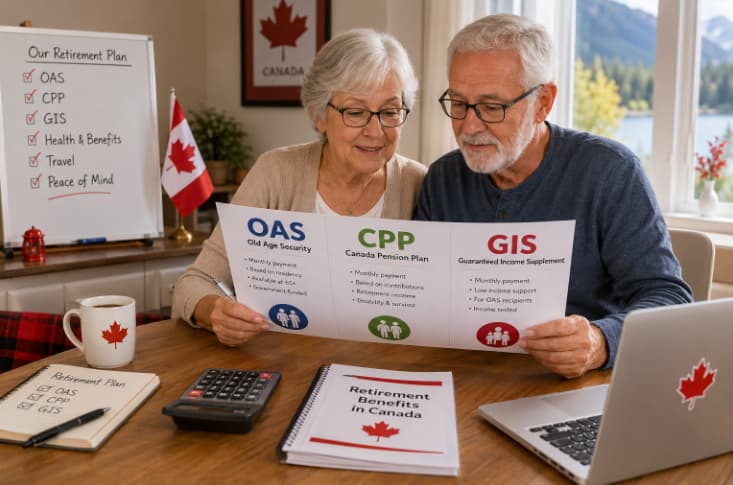
Planning for retirement in Canada can feel a bit tangled especially when you’re trying to compare Old Age Security (OAS), the Canada Pension Plan (CPP), and the Guaranteed Income Supplement (GIS). This OAS vs CPP vs GIS comparison, kind of lays out the main ways each program works, who is eligible, how the amount is figured, and how the three are meant to fit together to support Canadians once they stop working. When you see the differences more clearly it becomes easier to choose wisely and stretch your retirement income further.
If you are getting close to retirement, or you help a family member map out the future, learning the OAS vs CPP vs GIS comparison is essential. When you know how they work together, you can improve your retirement income, sidestep frequent mistakes, and make smarter choices about when to apply for benefits.
In this guide, we will break down the key differences between OAS, CPP, and GIS, explain who qualifies for each one, outline how the payments are worked out, and show how these benefits can combine to support Canadian seniors during retirement.
What Are OAS, CPP, and GIS?
Even though all three programs provide financial help to seniors, the way they are funded is not the same, and the eligibility rules can differ. If you look at the OAS vs CPP vs GIS comparison it becomes easier to see how each benefit works, who might qualify , and how those retirement supports can actually work together to help protect your financial security during retirement.
Old Age Security (OAS)
Old Age Security (OAS) is a monthly payment paid for by the Government of Canada using general tax revenue. In contrast with CPP, you do not have to have worked, or made contributions to be able to receive OAS.
To be eligible, the focus is mostly on:
- Age,
- Canadian residency,
- Legal status in Canada
For most people, eligibility begins at age 65, but payments can be postponed until age 70 for a larger monthly amount.
Canada Pension Plan (CPP)
The Canada Pension Plan (CPP) is a pension built around earnings. People contribute to CPP during their working years and the eventual retirement payment depends on things like:
- Employment income
- How many years of contributions there were
- Average earnings
- The age you start taking benefits
Unlike OAS, CPP is not automatically granted. If you never paid into CPP during your career, you generally would not be able to receive CPP retirement benefits.
Guaranteed Income Supplement (GIS)
The Guaranteed Income Supplement , GIS, is built for low-income seniors who already receive OAS. It gives extra monthly payments that help cover day-to-day essentials when retirement money is limited.
Compared with CPP and OAS, GIS works with an income test. So, payments can go up or down each year. Also, the support can end if your income goes past the allowed level.
Quick Comparison: OAS vs CPP vs GIS
| Feature | OAS | CPP | GIS |
|---|---|---|---|
| Based on Employment? | No | Yes | No |
| Based on Contributions? | No | Yes | No |
| Income Tested? | Recovery tax only | No | Yes |
| Minimum Age | 65 | 60 | 65 |
| Maximum Age to Delay | 70 | 70 | Cannot delay |
| Taxable | Yes | Yes | No |
| Monthly Benefit | Government pension | Pension from contributions | Income supplement |
This quick comparison helps explain why many retirees end up receiving more than one payment at the same time.
How These Programs Work Together
One big misunderstanding is that seniors have to choose between OAS, CPP, and GIS.
In real life, a lot of Canadians who qualify end up getting all three benefits at the same time, not just one of them.
For instance:
- CPP gives income tied to your work record.
- OAS gives a universal retirement pension mainly linked to how long you have been living in Canada.
- GIS adds to your retirement income when your yearly income stays under certain caps.
Taken together, these benefits can make retirement income feel more steady, especially for seniors with limited savings.
If you’re unsure how your Old Age Security pension is determined, read our guide on How OAS Is Calculated to understand how residency, age, and deferral affect your monthly payment.
Understanding what each benefit is really for
Every program is aimed at a different kind of financial pressure during retirement.
OAS Supports Long-Term Canadian Residents
Old Age Security counts years of residency in Canada instead of focusing on employment history.
This means people who lived in Canada for many years might qualify, even if they had some job gaps or time away from the paid workforce.
CPP and Workforce Participation
CPP is meant to replace a part of your work income after you retire.
If lifetime earnings were higher, and CPP contributions were steady, you usually end up with larger monthly payments.
People who contributed for decades often get a meaningfully larger CPP retirement pension than those with a shorter contribution record.
GIS Supports Low Income Seniors
GIS works like an extra financial backstop.
Since a lot of retirees lean mainly on government pensions, GIS helps ease financial pressure by giving eligible low income seniors tax free monthly money.
What you receive depends on
- Your annual income
- Your marital situation
Whether a spouse receives OAS or Allowance benefits
Who Qualifies for Each Program?
Understanding who qualifies is one of the most important steps in any OAS vs CPP vs GIS comparison. If you do not get the eligibility part right, it gets harder to judge which program will matter most.
OAS Eligibility
To even be considered for OAS, people generally need to:
- Be at least 65 years old
- Be a Canadian citizen or a legal resident when the application gets approved
- Have been living in Canada for at least 10 years after turning 18, (if you are a resident who lives in Canada)
Also, there are extra residency expectations for Canadians who are living abroad, so the rules can feel less straightforward.
CPP Eligibility
For CPP retirement benefits, the typical requirements are:
- You must be at least 60 years old
- You must have paid in at least once through a valid CPP contribution via work, or self-employment
- What you receive is tied more closely to lifetime contributions instead of residency alone
GIS Eligibility
For GIS, applicants usually must:
- Be receiving Old Age Security
- Be 65 years of age or older
- Stay within the annual income thresholds set by the Government of Canada
Since GIS is income-tested, eligibility is checked every year using information from your income tax return.
To learn which types of earnings count toward GIS eligibility, see our article What Income Affects GIS? for a detailed explanation of included and excluded income sources.
OAS vs CPP vs GIS Comparison: Funding Sources: Where Does the Money Come From?
A lot of retirees tend to believe all three programs are financed in the exact same manner, but that’s not really how it works.
OAS Funding
Old Age Security is funded straight from general federal government revenues, those gathered from taxpayers.
There are no payroll withholdings that are specifically tied to OAS.
CPP Funding
CPP is supported by required contributions from employees, employers, and self employed Canadians during the working years.
Those payments are invested by the Canada Pension Plan Investment Board (CPPIB) in order to help maintain the program for people after retirement.
GIS Funding
Similarly to OAS, GIS is financed using general federal tax revenues instead of employee contributions.
Since the program is aimed at lower income seniors, the payments are recalibrated every year depending on what you report as income, not on what happened in earlier jobs.
Can you get OAS, CPP, and GIS all together at the same time?
Yes. In many cases , qualifying retirees can receive the three programs at once.
For instance, a retiree might be able to:
- Get CPP based on their years working.
- Start receiving OAS once they meet the age, plus residency requirements.
- Qualify for GIS as long as their income stays under the yearly ceiling.
Getting CPP does not stop you from receiving OAS, but CPP income can reduce the GIS amount you can receive, because GIS is tested against your income.
How Are Payment Amounts Determined?
One of the most important pieces in the OAS vs CPP vs GIS comparison is figuring out how each benefit is actually computed. Even if all three are meant to support retirement income, the amount you receive gets set in pretty different ways.
OAS Payment Amounts
Your Old Age Security payment is mainly determined by:
- Your age
- The number of years you lived in Canada after you turned 18
- Whether you decide to delay your pension
- Your yearly income, which affects the OAS recovery tax
If you lived in Canada for less than 40 years after turning 18, you might get a partial OAS pension rather than the full amount. Also, delaying OAS past age 65 can raise your monthly payment by as much as 36%, but only if you wait until age 70.
If you want the full picture, check our guide, OAS Deferral Explained, where we cover the benefits and the drawbacks of postponing those payments.
CPP Payment Amounts
Unlike OAS, CPP is guided by your employment history and the contributions you made.
Monthly CPP retirement pension, is gonna depend on a few things like, how much you actually paid in over the years, meaning total CPP contributions across your career. Also, the number of contribution years you have, and then your average earnings during your working life.
On top of that theres the age you decide to start getting benefits. If you begin CPP before 65, your monthly amount will be permanently reduced. If you wait until 70 to start, your pension can go up.
GIS Payment Amounts
For GIS, the calculation leans on things such as your annual household income, plus your marital situation, and whether your spouse receives OAS or other similar related benefits. Since GIS gets reviewed every year, what you receive can rise, drop, or even end, based on the income you reported for the previous tax year.
OAS vs CPP vs GIS Comparison: Are These Benefits Taxable?
Tax treatment is another big difference between them.
| Benefit | Taxable? |
|---|---|
| Old Age Security (OAS) | Yes |
| Canada Pension Plan (CPP) | Yes |
| Guaranteed Income Supplement (GIS) | No |
OAS and CPP payments count as taxable income, so you need to report them on your annual income tax return. GIS is not taxable.
GIS, however, is tax-free. Even though it is not taxable, it is still used for determining your eligibility for certain government programs.
Can Working Affect Your Benefits?
Many Canadians keep working after 65, either full-time or part time. If you understand how employment earnings factor into each benefit, you can avoid surprise reductions later on.
OAS
Employment income generally does not reduce your standard OAS payment unless your total yearly income goes beyond the government’s recovery tax threshold. If you are in a higher bracket, you might need to repay some, or all, of your OAS through the OAS recovery tax (often called the OAS clawback).
CPP
Working after you start receiving CPP will not halt your pension. If you are under age 70 and you continue working, you may still be able to keep contributing to CPP, which can support your future retirement income through post-retirement benefits.
GIS
GIS is pretty sensitive to employment and other income. Any extra earnings might cut down your GIS payment, even though certain employment income exemptions can still apply, depending on the current rules
If you’re concerned about income affecting your supplement, read our article What Income Affects GIS? to better understand how employment, pensions, and investments are treated.
Common Misconceptions About OAS, CPP, and GIS
A lot of retirees misunderstand how these programs work in real life. Below are some of the myths people repeat most often.
Myth 1: OAS and CPP Are the Same Program
Not true.
OAS leans on age and residency , while CPP depends on the contributions made during your working years.
Myth 2: Everyone Receives GIS
Incorrect.
GIS is only available for eligible low-income seniors who already get OAS and also meet the annual income limits.
Myth 3: You Must Stop Working to Receive CPP
No.
Many Canadians receive CPP while continuing to work.
Myth 4: OAS Depends on Employment History
False.
Your work history does not determine OAS eligibility , Residency is the primary requirement.
Myth 5: You Can Delay GIS like OAS
False .
Unlike OAS and CPP, GIS cannot be put off to increase later payments.
Tips for Maximizing Your Retirement Benefits
To get the most from Canada’s retirement income programs, think about these approaches:
- Apply for benefits on time to avoid avoidable delays.
- Send in your income tax return every year even if you have very little or no income , because GIS eligibility is based on tax records.
- Check whether delaying OAS or CPP makes sense for your finances.
- Keep your personal information, banking details, and mailing address current with Service Canada.
- Track your annual income if you receive GIS, so you understand how changes can influence what you get.
With careful planning, you may be able to obtain the maximum benefits you qualify for.
Frequently Asked Questions
Can I receive OAS, CPP, and GIS at the same time?
Yes. If you meet the eligibility requirements, you can end up receiving all three benefits at the same time , at least in many cases.
Is CPP mandatory?
Yes. Most employees, and self-employed Canadians too, contribute to CPP while working. This is generally true, subject to contribution rules.
Does CPP reduce OAS?
No. Getting CPP does not directly lower your OAS pension. However, if your total income is high, the OAS recovery tax could be triggered, so that part can feel like a reduction.
Is GIS automatically included with OAS?
Not always. Eligible seniors usually have to qualify using income based criteria. Even then, many people are automatically assessed after they file their income tax return.
Should I delay OAS or CPP?
It depends on what you actually need financially, your health, your expected life span, and the retirement plan you are following. Delaying can raise your monthly payments, but it is not the best move for every person.
Final Thoughts
Getting clear on the OAS vs CPP vs GIS comparison is important for setting up a safe retirement plan in Canada. Even though these three programs are often mentioned together, each one serves a different role and goal.
- Old Age Security (OAS) gives a government funded pension, mostly tied to how old you are and where you’ve lived.
- The Canada Pension Plan (CPP) tends to reward time worked and the contributions made during employment.
- Guaranteed Income Supplement (GIS) adds extra tax free help for seniors who meet the low-income requirements.
A lot of retirees end up qualifying for multiple programs, and when you put them together they can create a solid base for retirement cashflow. If you review the eligibility terms, the way payments are worked out, and what it means for taxes, you can make more grounded choices that protect your long term financial wellbeing.
Pingback: What Happens to GIS After a Spouse Dies | 2026
Pingback: CPP Death Benefit Guide: Eligibility & How to Apply