
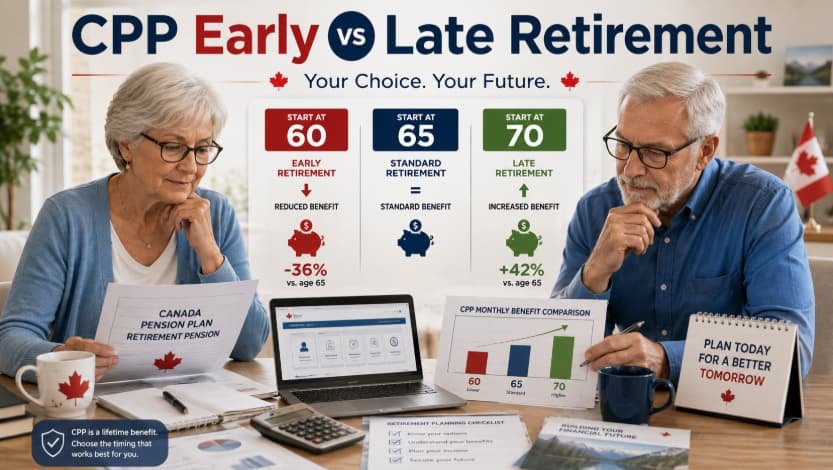
Picking the right moment to start getting your Canada Pension Plan CPP retirement pension is one of the most important money calls you’ll face during retirement. Getting the difference between CPP Early vs Late Retirement really matters, because most Canadians can begin taking CPP as early as age 60, while some people prefer to postpone it until they reach 70. This choice can change your monthly retirement income for years, and not in a small way. Whether you decide to take CPP early for steadier cash flow, or you wait longer for a stronger monthly amount, taking time to compare CPP Early vs Late Retirement options can guide you toward the best path, based on your financial situation, your health, and the long term retirement plan you have in mind.
For a lot of Canadian seniors, there isn’t really a one size fits all answer. Your health, retirement savings, work plans, tax situation, and your life expectancy all matter, together, when you’re trying to figure out if taking CPP early, or waiting a bit longer, is the smarter money move.
This 2026 guide walks through how CPP works. It compares taking it early versus later, lays out the upsides and downsides of each, and helps you decide which path matches your retirement objectives best.
What Is the Canada Pension Plan (CPP)?
The Canada Pension Plan (CPP) is a public retirement pension system, paid for with contributions that employees, employers, and self-employed people make while they are working. If you want to understand CPP Early vs Late Retirement, you first need to grasp how the whole program works, because what you receive depends on your contribution record, your earnings, and the age when you decide to start taking the pension. Whether you claim CPP at 60, 65, or delay until 70, that choice will end up affecting your monthly retirement income, for a long time, likely beyond what you expect.
When you finally qualify, CPP pays a monthly taxable amount, meant to replace a portion of your working income after you retire.
To be eligible, you usually need to:
- Be at least 60 years old
- Have made at least one valid CPP payment
- Submit an application for the CPP retirement pension
Different from Old Age Security (OAS), CPP payments depend on your:
- Contribution history
- Earnings across your career
- Count of years with contributions
- Age when you decide to start receiving
CPP retirement age options
People in Canada have three main routes for when they begin CPP.
Retirement age Monthly benefit
| Retirement Age | Monthly Benefit |
|---|---|
| Age 60 | Reduced permanently |
| Age 65 | Standard benefit |
| Age 70 | Increased permanently |
In general, if you start earlier, your monthly checks will be smaller, yes. If you delay it, up to age 70, the monthly pension becomes larger.
This permanent change is built to even out life time benefits when retirement happens at different times.
If you’re planning your retirement income, it’s also important to understand How to Apply for Old Age Security 2026.
How CPP Early Retirement Works
You can start receiving CPP as early as age 60, yes.
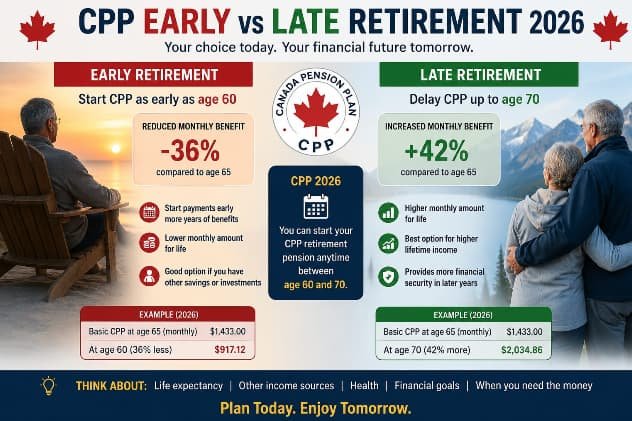
Still, each month before your 65th birthday lowers your payment by 0.6%.
Biggest drop:
60 months × 0.6%
= 36% reduction
For example
If your normal CPP amount at age 65 would have been
$1,000 per month
then starting at age 60 would bring it down to about
$640 per month
And yes, that lowered figure stays with you for the rest of your life.
Advantages of Taking CPP Early
A lot of Canadians choose CPP early because it fits their situation better.
Some reasons look like this:
- Get Income Sooner
If you retire early, employment earnings usually pause or end.
CPP can act as a bridge, with steady monthly payments.
- That can ease stress on
- RRSP withdrawals
- Personal savings
- Investments
- Better for Poor Health
If you have real health concerns, or you think your life expectancy might be less than average, then starting CPP earlier could mean you end up collecting more total payments across your lifespan.
- More Flexibility
Starting CPP early can give you extra cash flow for, travel, home upgrades, debt payoff, or helping family members. A lot of retirees enjoy that additional money while they are still very active.
- Reduce Investment Risk
Instead of depending fully on investment income during slow periods, CPP gives you dependable monthly cheques that are supported by the Canadian government. It helps you steady the budget when markets wobble.
Before deciding when to start your pension, it’s helpful to understand the CPP Death Benefit you may be eligible to receive.
Disadvantages of Taking CPP Early
Even if taking it sooner seems attractive, there are trade-offs.
Permanent Reduction
The biggest downside is the pension gets reduced, and that reduction stays in place. You will keep receiving a smaller amount for the rest of your life.
If you live well into your 80s or 90s, then waiting to take CPP could lead to much higher total lifetime income.
Less Protection Against Inflation
CPP benefits get a yearly cost of living bump.
Since your starting amount is smaller, each later inflation update builds on that smaller benefit, so it can feel less generous.
Possible tax impact
If you keep working while you receive CPP, your employment earnings plus CPP payments could end up in a higher tax tier.
Taking time to plan your retirement income carefully can limit taxes you would rather not pay.
How CPP late retirement works
Instead of starting CPP at 65, some Canadians can push the start date until 70.
For every month you wait, your pension rises by 0.7%.
Largest increase:
60 months × 0.7%
= 42% increase
Example:
Regular CPP at 65:
$1,000 per month
If you wait until 70:
About $1,420 per month
That larger amount stays in place, for life.
Why delaying CPP helps
Lots of money planners recommend delaying CPP when you can.
Here are a few why.
Bigger dependable income
A larger CPP payment gives you steadier, more predictable retirement support.
Unlike other investments, CPP payments carry on even if market performance is not great.
Better Protection Against Longevity
Canadians are living longer now.
A bigger CPP pension can help shield you from the danger of running out of retirement savings.
If you make it into your late 80s or 90s, delaying CPP might bring more financial comfort.
Increased Inflation Adjustments
Each year, CPP tends to rise based on what you were actually paid.
So if your starting pension is higher, the later inflation adjustments can be higher too.
Less Dependence on Investments Later
As retirees age, it can be harder to manage investments.
With a larger guaranteed CPP pension, you may rely less on personal savings during the later stretch of retirement.
Drawbacks of Delaying CPP
Holding off until age 70 is not always the best choice.
Some downsides are:
- You get no CPP payments during the waiting stretch.
- You’ll need enough savings to cover living costs.
- Unexpected health issues could lower the number of years you end up receiving those higher payments.
If you delay, that might not help people with shorter life expectancy, and yes you may feel the math is less friendly.
CPP Early vs Late Retirement: Side by Side Comparison
| Feature | Start at 60 | Start at 65 | Start at 70 |
|---|---|---|---|
| Monthly Benefit | Lowest | Standard | Highest |
| Permanent Adjustment | -36% | None | +42% |
| Lifetime Income Potential | Lower if you live longer | Moderate | Higher for long life expectancy |
| Best For | Early retirees, health concerns | Average retirement | Healthy seniors with savings |
| Requires Personal Savings | Less | Moderate | More before age 70 |
Things to keep in mind before you decide
Every retirement story is unique. Before deciding when to claim CPP, check the following
Your health
If you expect to enjoy a longer retirement, delaying CPP can provide larger lifetime payments.
If you have serious health concerns, claiming CPP sooner may provide more value, for your household needs.
Your work plans
Are you planning to keep working after age 60 ?
If you’re still earning a substantial income, postponing CPP may help reduce taxes now, while giving you bigger future payments.
Retirement Savings
Take a look at your RRSPs, RRIFs , TFSAs workplace pensions, and any non-registered investments.
People with solid savings may end up finding it simpler to delay CPP until age 70.
if you’re also deciding when to start your Old Age Security pension, be sure to read our guide on OAS Deferral Explained to understand how delaying OAS compares with delaying CPP.
How CPP Fits Into Your Overall Retirement Plan
CPP should not be treated like it lives on its own. It works alongside other retirement income streams, like Old Age Security (OAS), the Guaranteed Income Supplement (GIS) for eligible lower-income seniors, workplace pensions, RRSPs, RRIFs, and Tax-Free Savings Accounts (TFSAs). The “best” moment to start CPP usually depends on how all of these pieces work together in your plan.
For example, if someone has a generous workplace pension maybe they can wait on CPP until age 70 so the monthly payment becomes higher, and still stays guaranteed. But then again retirees who have limited savings might opt to start CPP earlier, so they can cover everyday living costs, while keeping other money and investments intact .
To better understand how government retirement programs work together, read our comparison article on GIS vs OAS and learn how these benefits complement CPP for eligible Canadian seniors.
Tax Considerations for CPP Retirement Benefits
One important thing many retirees miss is that CPP retirement benefits are completely taxable. Your CPP payment gets added to your other taxable income, and that might be from OAS , a workplace pension, RRIF withdrawals, employment income, or even investment income. If your retirement income ends up on the higher side, getting CPP earlier while you’re still working could raise your overall tax amount.
Because of that, some retirees decide to delay CPP until they finish working. The idea is to keep taxable income lower during those top earning years. Also, it can be smart to ask for voluntary tax deductions from your CPP cheques, so you are not left owing money when you complete your annual return.
How CPP Works with Old Age Security (OAS)
CPP and OAS get mentioned in the same conversation a lot, but they are really quite distinct.
Canada Pension Plan (CPP) Old Age Security (OAS)
| Canada Pension Plan (CPP) | Old Age Security (OAS) |
|---|---|
| Based on employment contributions | Based primarily on years of Canadian residency |
| Can begin at age 60 | Usually begins at age 65 |
| Monthly payment depends on contributions | Monthly payment is generally the same for eligible seniors |
| Fully taxable | Taxable and may be subject to the OAS Recovery Tax (Clawback) for higher-income seniors |
Since these programs use different rules for who qualifies and how benefits are figured, deciding about CPP timing does not automatically tell you when to begin OAS
If you’re unsure how your government retirement benefits are calculated, read our article on How OAS Is Calculated to understand what affects your Old Age Security payments.
Can You Keep Working While Getting CPP?
Yes
A lot of Canadians keep working while receiving CPP
If you are under age 70 and keep paying CPP as you work, you might qualify for the Post-Retirement Benefit (PRB), and that can boost later CPP payments
Working while you receive CPP may give you:
- More work related earnings
- Ongoing pension growth through PRB
- More retirement flexibility
Also remember that both employment income and CPP payments are taxable, so it helps to think ahead about how much you will make, and when.
Common pitfalls to avoid
If you make the wrong CPP choice, the consequences can last a long time because the adjustment is usually permanent. Below are a few common mistakes Canadian seniors should watch for, and try not to repeat.
- Taking CPP just because friends did
Every retirement plan is different. Your health, your nest egg, and your financial priorities are personal, so it is better to avoid decisions that only follow what other people selected.
- Not considering life expectancy
People in Canada are living longer than before. If you expect a longer retirement stretch, postponing CPP can create meaningfully higher lifetime income.
- Overlooking taxes
Getting CPP while you are still earning employment income can raise your taxable income, and that may lower your take-home retirement income, after tax.
- Failing to check other retirement income
Before you apply for CPP, review all income streams, such as:
- Workplace pensions
- RRSPs
- RRIF withdrawals
- Investment earnings
- OAS
- GIS if eligible
When you look at your full retirement picture you can make a more informed, decision
- Waiting Without a financial plan
Delaying CPP can increase your monthly benefit , but you’ll need enough savings to cover day to day living costs before payments start. A retirement income plan can help you see if delaying CPP is financially sustainable for you.
Frequently Asked Questions
Is age 65 the best time to start CPP?
Not always. Age 65 is the standard retirement age, but the best timing depends on your health, your financial requirements, your expected lifespan, and your retirement objectives.
Is delaying CPP always better?
No. Yes, delaying CPP raises your monthly payment, but that doesn’t automatically mean it is the best path for everyone. If your savings are limited, or you have health concerns, you might be better served by starting CPP earlier.
Can I change my mind after starting CPP?
You can cancel your CPP retirement pension within a limited window right after the payments kick in, as long as you satisfy the program requirements and also pay back any amounts already received. After that time ends, your choice is generally fixed, and you will not be able to reverse it.
Does CPP go up every year?
Yes. CPP payments are reviewed each year to help maintain purchasing power, using inflation tracking based on changes in the Consumer Price Index (CPI).
Can I take CPP and OAS at the same time?
Yes. Lots of Canadian seniors qualify for both CPP and OAS, assuming they meet the entry rules for each benefit program.
Final Thoughts
Deciding between starting CPP Early or Late Retirement is one of the biggest retirement choices Canadian seniors will make in 2026. If you start CPP at age 60, you get income sooner but your monthly payments are reduced permanently. If you wait until age 70, your pension grows a lot more, but you need other financial sources to bridge the years before the benefits begin.
The correct move depends on your personal circumstances, including your health, the length you expect retirement to be, your savings, your tax situation, and your broader financial objectives. Taking a little time to assess these pieces, and re-check your full retirement income plan, can help you strengthen your financial safety during the retirement years.
Before you apply, it can help to look at your projected CPP amount through your My Service Canada Account, and if something is unclear, speak with a qualified financial advisor to figure out the claiming strategy that will align best with your retirement plans.
Internal Linking Suggestion: Before you lock in your final retirement choice, you might also enjoy our guide on Apply for Old Age Security (2026) so you can understand when and how to start receiving your OAS pension alongside CPP.
Pingback: OAS While Living Outside Canada: Rules & Eligibility
Pingback: OAS Deferral Explained: Delay Your Benefits Wisely