
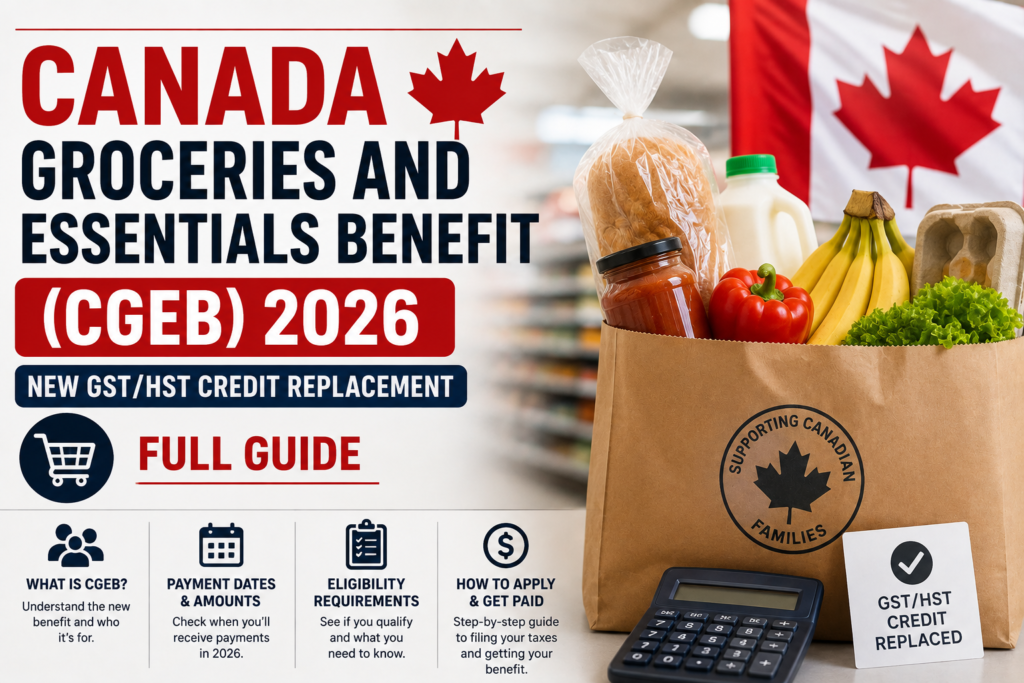
If your GST/HST Credit deposit suddenly showed up under a different name this year, you’re not imagining things. Starting July 2026, the Canada Revenue Agency replaced the long-running GST/HST Credit with a new, permanently larger payment called the Canada Groceries and Essentials Benefit (CGEB). Millions of Canadians are still confused about what changed, how much more they’ll get, and whether they need to do anything differently. This guide breaks down everything confirmed so far, straight from CRA and Department of Finance sources.
What Is the Canada Groceries and Essentials Benefit?
The CGEB is a tax-free quarterly payment from the CRA that helps low- and modest-income individuals and families offset the rising cost of groceries and everyday essentials. It isn’t a brand-new benefit built from scratch — it’s the GST/HST Credit under a new name, with the same delivery system, the same CRA infrastructure, and largely the same eligibility rules, but a permanently richer payment formula.
Prime Minister Mark Carney first announced the program on January 26, 2026, and it received Royal Assent under Bill C-19 on February 12, 2026. The federal government backed the change with $11.7 billion in additional support over six years, with $3.1 billion of that made available immediately.
Timeline: How the Switch from GST/HST Credit to CGEB Happened
- January 26, 2026 — CGEB officially announced by the federal government.
- February 12, 2026 — Bill C-19 receives Royal Assent, making the CGEB law.
- June 5, 2026 — A one-time top-up payment issued, equal to 50% of your annual 2025–26 GST/HST Credit value, delivering $3.1 billion in immediate relief to existing recipients.
- July 3, 2026 — The first official CGEB quarterly payment lands, replacing the GST/HST Credit permanently, along with a 25% increase in benefit amounts.
If you were already receiving the GST/HST Credit, this transition happened automatically — there was nothing to apply for. If you’re still trying to work out why your January or April payment doesn’t match what you’re reading about now, that’s because those two payments were issued under the old GST/HST Credit name before the switch took effect. For the full breakdown of those earlier payments and amounts, see our guide on Canada GST/HST Credit Payment Dates 2026.
How Much Can You Get Under the CGEB?
Your CGEB amount is recalculated every July based on your previous year’s tax return, and each payment period runs from July to the following June. Based on your 2025 tax return, for the July 2026–June 2027 period, you could receive up to:
| Household Situation | Maximum Annual Amount |
|---|---|
| Single individual | $679 |
| Married or common-law couple | $890 |
| Per eligible child under 19 | $234 |
This reflects the structural 25% increase that applies to CGEB payments every year from 2026 through 2031 — not a one-time bump. Compare that to the old GST/HST Credit, where a couple with two children could receive up to roughly $1,066 combined; under the CGEB formula, that same family now qualifies for a meaningfully larger total. If you want to see how the numbers compared before this change, our earlier post on the GST/HST Credit Increase 2026: New Amounts & Eligibility is a useful reference point.
Your exact amount also depends on your adjusted family net income (AFNI) — the CGEB phases out above set income thresholds, which for the 2025 base year sit at $60,012 for a single person with no children, rising to $82,952 for larger families, and slightly higher thresholds for couples. The CRA’s child and family benefits calculator can estimate your exact payment.
Who Is Eligible for the CGEB?
Eligibility mirrors the old GST/HST Credit almost exactly. You qualify if you meet all of the following:
- You are a resident of Canada for tax purposes, both in the month before and at the start of the month a payment is made
- You are at least 19 years old, or you’re under 19 but have (or had) a spouse/common-law partner, or you are (or were) a parent living with your child
- You have filed your income tax and benefit return, even if you had no income
There’s no separate application for existing tax filers — the CRA determines eligibility automatically once you file. Newcomers to Canada need to submit Form RC151 (GST/HST Credit Application for Individuals Who Become Residents of Canada) to get into the system for the first time.
Parents with shared custody arrangements can receive half of the CGEB amount for a child, calculated the same way shared custody works under the Canada Child Benefit.
Roughly 12 million Canadians are expected to benefit from the enhanced program, with about 500,000 additional households becoming newly eligible thanks to the redesigned formula.
CGEB Payment Dates for 2026
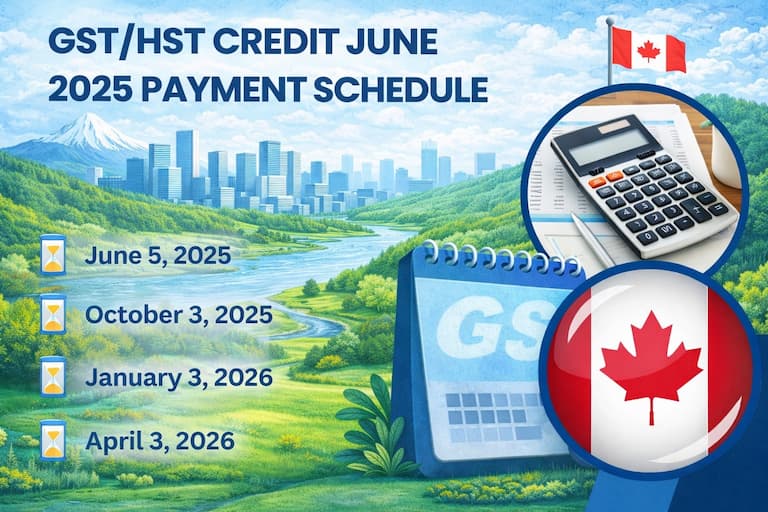
Because the switch happened mid-year, 2026 is a transition year with two payments issued under each name:
| Payment Date | Program Name |
|---|---|
| January 5, 2026 | GST/HST Credit |
| April 2, 2026 | GST/HST Credit |
| July 3, 2026 | CGEB (first payment, +25%) |
| October 5, 2026 | CGEB |
From the July 2026 cycle onward, all four quarterly payments each year will be issued as the CGEB. If your quarterly amount works out to less than $50, the CRA pays your full annual entitlement as a single lump sum in July instead of splitting it across the year.
CGEB vs. the One-Time Canada Grocery Benefit — Don’t Confuse the Two
A separate, unrelated program — the Canada Grocery Benefit 2026 — was a one-time financial aid payment aimed at helping households cope with food costs. The CGEB is different: it’s a permanent, structural replacement for the GST/HST Credit that pays out every quarter, indefinitely, at a 25%-higher rate through 2031. If you’ve seen both names floating around and assumed they were the same thing, they aren’t — one was a temporary top-up, the other is now the permanent backbone of Canada’s GST-related benefit system.
What If You Didn’t Get Your Payment?
Since the CGEB runs on the exact same CRA infrastructure as the old credit, the most common reasons for a missing or reduced payment haven’t changed — outdated banking or address details, an unfiled tax return, or a change in marital or custody status. If your July or October CGEB deposit didn’t show up as expected, our troubleshooting guide on Why Didn’t I Get My GST/HST Credit in 2026? still applies directly to the CGEB, since it’s the same underlying system under a new name. As a rule, wait 10 business days past your expected payment date before contacting the CRA.
Frequently Asked Questions
Is the CGEB the same as the GST/HST Credit?
Yes, functionally. The CGEB replaced the GST/HST Credit in July 2026 under a new name, with the same eligibility rules and delivery system, but a 25% higher payment amount for five years.
Do I need to apply for the CGEB separately?
No, if you already file your taxes each year, the CRA automatically assesses and pays you. Only new residents of Canada need to submit Form RC151.
Will the 25% increase last forever?
No — it’s confirmed for five years, from 2026 through 2031, based on current legislation.
What happens to my provincial or territorial benefit that used to ride along with the GST/HST Credit?
Related provincial and territorial programs continue to be assessed and paid alongside the CGEB the same way they were with the GST/HST Credit.
This article is for informational purposes only and does not constitute financial or tax advice. Payment amounts, thresholds, and dates may be updated by the CRA without notice — always confirm your specific entitlement through your CRA My Account.
Pingback: GST/HSTC Notice Explained: What It Means