
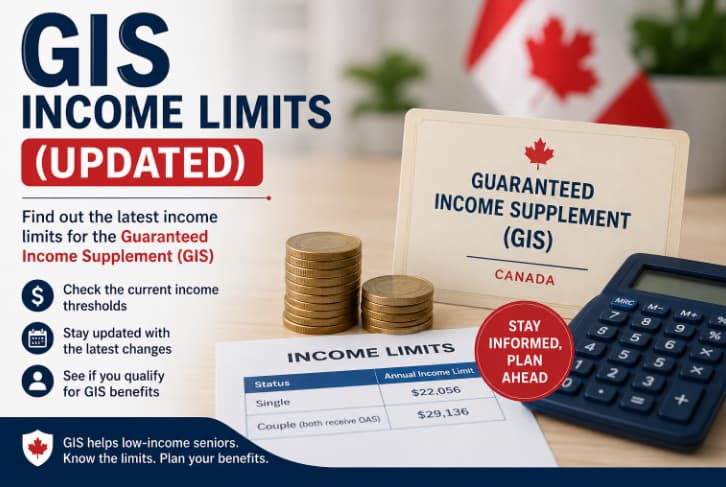
The GIS Income Limits (Updated) are among the most important numbers Canadian seniors should understand, because they directly decide eligibility for the Guaranteed Income Supplement , GIS. Every year, the Government of Canada reviews income thresholds and benefit amounts, so lower-income seniors keep receiving financial support that matches shifting economic conditions
If you already receive Old Age Security (OAS) or plan to apply soon, knowing the newest GIS income limits can help you estimate what you will get and avoid surprise reductions. Since GIS is income tested, even tiny changes in your yearly income may influence the payment amount you receive.
This guide goes over how the updated GIS Income Limits (Updated) work, which income counts, how the benefit is computed, and a few practical ways to keep your eligibility intact.
What Is the Guaranteed Income Supplement (GIS)?
The Guaranteed Income Supplement (GIS) is a monthly, non-taxable benefit given to eligible low-income seniors who also receive Old Age Security (OAS) .
Now, unlike OAS, which is mostly about age and the number of years you’ve lived in Canada, GIS depends almost entirely on your income. So, when your income is lower, your GIS amount can be higher .
The GIS program is meant to help seniors pay for everyday essentials, like:
- Housing, Groceries
- Prescription medications, Utilities
- Transportation, daily living costs too
Because your income can shift from year to year, GIS eligibility gets checked again every year. This review uses your income tax return information.
Why Are GIS Income Limits Updated?
Each year, the Government of Canada updates the:
- Maximum GIS amounts
- Income thresholds
- OAS payment rates
- Benefit calculations
These changes are made to reflect inflation, cost of living increases, plus wider economic conditions. There are also federal benefit updates that need to line up with the current reality .
As a result, someone who qualified last year might end up with a totally different payment this year, because there are changes in income, or because the thresholds get updated.
How GIS income limits work
These newer GIS income limits mostly decide if you qualify for the benefits, and also how much you receive.
In general:
- Lower income means higher GIS payments.
- Higher income gradually decreases those GIS benefits.
- Once your income goes beyond the limit that applies to you, the GIS payments stop.
And unlike a lot of other government benefits, GIS does not just vanish at a single figure. Instead, it gets reduced in stages as income rises until it finally reaches zero.
Who can apply for GIS?
Usually, to qualify for GIS you need to:
- Be 65 years of age or older.
- Receive Old Age Security (OAS).
- Reside in Canada.
- Meet the yearly income conditions.
- Submit your income tax return each year.
If you do not file your income tax return, your GIS payments could stop, since Service Canada cannot verify your income.
If you are applying for retirement benefits for the first time, read our guide on How to Apply for Old Age Security (2026) to understand the application process before checking your GIS eligibility.
What Income Counts for GIS?
One of the most common misunderstandings is what income is included, in the first place.
In general, the government looks at:
- Employment income
- Pension income
- CPP and QPP benefits
- RRSP withdrawals
- RRIF withdrawals
- Investment income
- Rental income
- Foreign income
- Certain taxable benefits
Some categories of income get special treatment or exemptions, and others can reduce your GIS payments in a noticeable way.
Since every financial setup is unique, reviewing your full yearly income matters a lot.
Does Employment Income Affect GIS?
Yes, but not always the same.
A lot of seniors keep working part time after retirement, even if they stop full time work.
In response, the government offers employment income exemptions so some seniors can bring in employment income before it starts clawing back or lowering GIS payments.
But if your earnings go beyond the exemption amount, the extra income can reduce your monthly GIS payment.
That’s why retirement income planning feels extra important for seniors who continue working.
Does CPP Affect GIS?
Yes.
Canada Pension Plan, CPP income is included when they figure out GIS eligibility.
So if your CPP payments rise, your GIS payment might fall, because your total annual income also rises.
Still, this does not automatically mean your overall retirement income is lower. GIS simply recalculates based on total income.
Does OAS Affect GIS?
Interestingly, Old Age Security, OAS itself is not counted as income for GIS calculations.
Many seniors assume receiving OAS reduces GIS automatically.
But instead:
- OAS eligibility comes first, or at least thats what you should check right away.
- GIS is calculated separately , so it uses its own method and rules.
- OAS payments themselves generally do not count toward GIS income calculations, so dont mix those figures together.
This distinction is important when you estimate your retirement income.
Income Limits change based on your family situation
The GIS Income Limits (Updated) can look a little different depending on how your household is arranged, and yes it may feel confusing at first.
You may face different income thresholds if you are:
- Single
- Widowed
- Divorced
- Married
- Common-law
The government also checks whether your spouse gets, for example
- OAS
- GIS
- Allowance
- No federal retirement benefits
Since every home has its own financial realities, these income limits are not the same across the board for everyone.
Annual Income Review
GIS eligibility gets reviewed each year in July, usually.
Service Canada typically pulls data from the tax return you filed last year.
For example:
- You file your tax return this year
- They review your benefits
- A new payment amount starts in July
So, that is why filing early can help you avoid annoying payment delays.
What happens when your income changes
During retirement income can change pretty drastically, at times
Some common situations include
- Stopping work
- Job loss
- A spouse passes away
- Divorce
- Lower pension income
If your current income is much lower than the income shown on your tax return, you might be able to request a GIS reassessment.
This could raise your GIS payments before the next annual review, too
Filing Taxes Is Essential
Many seniors think they do not need to file taxes if they owe no income tax
Still, not filing can end up interrupting GIS payments.
A tax return gives the government a way to check, basically
- Income
- Marital status
- Eligibility
- Benefit calculations
Even if someone has very little income, they should usually file every year.
Our guide on How to Read Your CRA Account Statement explains how to review your tax information and ensure your income records are accurate before GIS is calculated.
Common reasons GIS payments change
There are a few things that can influence your monthly amount, sometimes it changes without warning. Like for example, certain situations that happen in your personal life or paperwork.
Higher income
If your employment income or pension rises, it can reduce your GIS amount.
Lower income
If your income drops, it may increase your GIS.
Changes in marital status
Getting married, separating, divorcing, or becoming widowed can affect whether you still qualify.
Tax filing delays
If your tax returns are late or not sent, payments may stop, then restart later.
Government updates
Each year, benefit amounts are reviewed and your payment might go up or down.
Tips to help keep your GIS eligibility
You cannot always control your retirement income, but you can lower the chances of interruptions. A few practical steps help a lot, including:
- File your taxes every year
- Tell Service Canada about major life events quickly
- Keep your income records organized and easy to find
- Watch for CRA and Service Canada mail
- Check your benefit statements regularly
- If your income falls a lot, notify Service Canada right away
These small actions should help you keep receiving the correct benefit amount, with less stress.
Common Mistakes Seniors Make
A lot of seniors, unintentionally mess up their GIS eligibility because they make mistakes that couldve been avoided.
Some common situations look like this:
- They forget to file tax returns.
- They assume OAS automatically brings in GIS.
- ignore changes in marital status.
- They do not report reduced income.
- believe every income type gets treated the same.
- They misunderstand annual reassessments.
Learning how GIS is built and how it operates can stop payment interruptions from happening.
How GIS Fits Into Retirement Planning
GIS should not be treated like a standalone benefit.
It works together with things like:
- Old Age Security
- Canada Pension Plan
- workplace pensions
- RRSP withdrawals
- RRIF income
- personal savings
- investment income
When seniors understand how these streams influence each other, they can make better retirement choices.
For instance, withdrawing large amounts from a registered retirement account in a single year can push taxable income higher, and that may lower GIS eligibility.
Taking time to plan withdrawals in a careful way may help keep benefits steadier over time.
If you want to better understand how your retirement benefits work together, read our article on GIS vs OAS: what’s the Difference, and then look at How OAS Is Calculated too , so you see how residency and age influence your OAS pension.
Frequently Asked Questions
Do GIS income limits change every year?
Yes. The Government of Canada reviews the income thresholds and the related benefit amounts each year .
Is GIS considered taxable?
No. GIS payments are non taxable.
Can GIS stop entirely?
Yes, payments can stop if your income passes the limit that applies to you, or if you do not submit your income tax return.
Can I get OAS without also getting GIS?
Yes. Many seniors receive OAS but do not qualify for GIS because their income is above the threshold that applies.
What happens if my income drops during the year?
You may be able to request a reassessment if your current income is meaningfully lower than the income used to calculate your GIS.
Final Thoughts
Getting a handle on the GIS Income Limits (Updated) really matters for each Canadian senior who relies on retirement benefits. Since the GIS is tied to income, even small annual shifts in your earnings, pension income, or household situation can change your eligibility plus the amount you end up receiving.
One of the smartest protections for your benefits is to submit your tax return on time each year, tell the program about major life changes quickly, and double-check your income before every yearly reassessment. Keeping up with the newest GIS income limits also helps you plan your retirement better and makes sure you get the financial support you are owed under Canada’s retirement income system.