
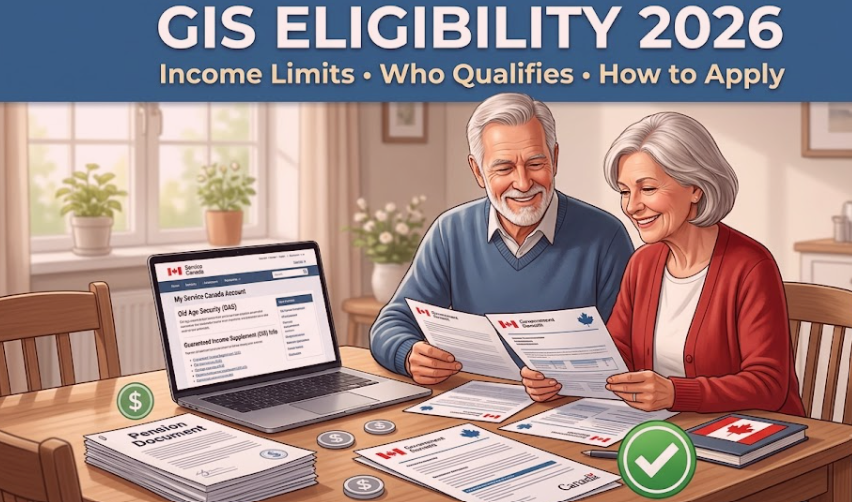
The Guaranteed Income Supplement (GIS) Eligibility 2026 is crucial knowledge for all Canadian seniors relying on government benefits to supplement their retirement income.
The GIS makes monthly, non-taxable payments to eligible low-income seniors who also get OAS pensions from the government. It’s one of Canada’s most valuable income supports for seniors, given rising costs of things like housing, groceries, healthcare, etc.
Every year, thousands of eligible Canadians miss out on this benefit either due to not applying or confusion over what’s considered acceptable income under the GIS rules. Understanding how to access GIS benefits ensures that seniors know if they qualify.
This guide explains everything you need to know about Guaranteed Income Supplement (GIS) Eligibility 2026, including who qualifies, how income affects eligibility, how much you could receive, and the steps to apply successfully.
What Is the Guaranteed Income Supplement (GIS)?
The Guaranteed Income Supplement (GIS) Eligibility 2026 is a monthly, non-taxable benefit paid by the Government of Canada to eligible seniors with low incomes.
While the Old Age Security (OAS) pension is based primarily on your age and residency, GIS is an income-tested benefit. This means that the amount you get from the GIS also depends on your annual income and marital status.
The GIS helps senior citizens with covering their basic needs of life, such as housing costs, groceries, utility bill payment, prescription medication purchases, transportation expenses, and other daily expenses.
Also, since this assistance program pays benefits to the applicants that are non-taxable, they don’t have to pay income taxes on these GIS payments.
Who Is Eligible for the Guaranteed Income Supplement (GIS) in 2026?
In general, there are some conditions set forth by the Government of Canada that you have to fulfill to be eligible for GIS in 2026.
You may qualify if you:
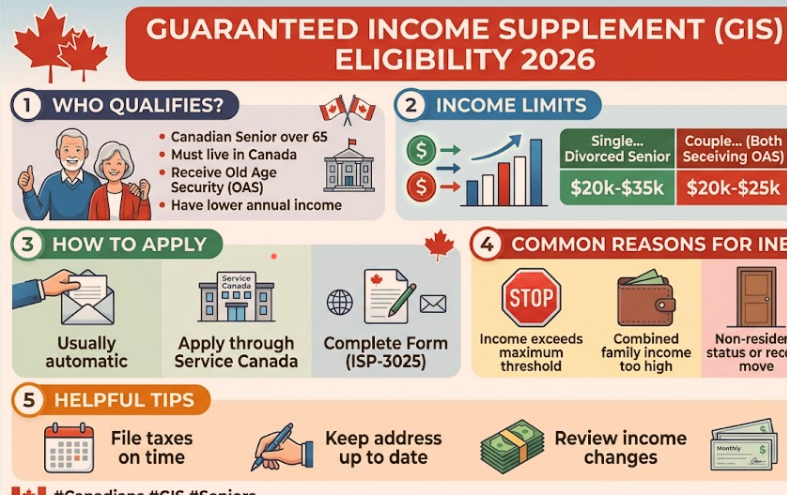
- Are 65 years of age or older.
- Receive the Old Age Security (OAS) pension.
- Live in Canada
Meet the annual income requirements based on your family situation.
Note that, unlike most other government benefits, GIS eligibility mainly depends on your income. After reviewing your income tax return each year, the government will review your eligibility for the program.
Basic Eligibility Requirements
Every application will be considered on its own merits, but all applicants should bear the following in mind:
- You Must Be Receiving Old Age Security (OAS)
This supplement is only paid to seniors who receive an Old Age Security pension.
If you haven’t applied for your OAS pension or aren’t sure when you’ll start receiving payments, read our guide on Canada Old Age Security (OAS) Payment Dates 2026 to learn everything about the OAS payment dates and what to know when receiving your pension.
- You Must Be 65 or Older
GIS is targeted at seniors aged 65 years or older who are eligible for Old Age Security. Individuals under 65 generally can’t receive GIS unless they qualify under specific government provisions.
- You Must Live in Canada
To qualify for GIS, you usually have to reside in Canada during the time you get the benefits.
Eligibility can change if you spend an extended amount of time outside Canada, depending on how long you are away from Canada and other factors.
- Your Income Must Be Below the Annual Threshold
Your income is one of the most important factors in determining your eligibility for the GIS.
Every year, the Government of Canada establishes income thresholds depending on whether you’re single, married or in a common-law relationship, and whether your spouse receives OAS, GIS or Allowance.
Your income must be below the applicable threshold for you to get either a reduced benefit or a GIS. You can find the current thresholds here (in Swedish).
GIS Income Limits for 2026
This supplement is specifically dedicated to the population of seniors living in poverty.
Eligibility is determined based on your annual income, which will be processed by the government once you have submitted your income tax return.
You must meet an income limit that will vary depending on your particular family context.
For example, different limits apply if you are:
- Are you single, widowed, or divorced?
- Do both spouses receive Old Age Security (OAS)?
- Does only one spouse get OAS?
- Is married, but your spouse gets the Allowance?
Keep in mind that our income limits are reviewed periodically. Always check the Government of Canada’s latest guidance before making any key financial decisions based on the numbers provided below.
What counts as income toward GIS eligibility?
Most seniors think that their GIS benefits are based solely on their employment income.
In fact, there are many different kinds of income the government will consider when figuring out how much GIS you qualify for.
Income that may be included includes:
- Your employment income
- self-employment income
- pension income
- investment income
- rental income
- foreign income
- certain taxable benefits
We use your net annual income as well as your spouse’s (if you have one) to determine your eligibility, says the Government of Canada.
Does CPP Affect GIS Eligibility?
Yes.
Canada Pension Plan (CPP) benefits generally count as income when determining GIS eligibility.
If your CPP income increases, your GIS payment may decrease depending on your overall annual income.
If you’re receiving CPP retirement benefits, our Canada Pension Plan (CPP) Payment Dates 2026 guide explains when payments are issued throughout the year.
How does my employment income impact my GIS?
It depends on how much you earn.
Yes. Your employment income may affect your GIS benefits.
Some employment earnings might be given special consideration according to current GIS income rules. Eligible seniors can make money up to a certain point before it starts to affect their GIS benefits.
Just because someone works part-time doesn’t mean they’ll be denied GIS. But keep in mind that your total annual income plays a significant role in how much money you’ll receive through GIS.
How Much Can You Receive Through GIS?
The amount you will receive also varies depending on some other variables.
These include your annual income, your marital status, your spouse’s income (where relevant), government benefits adjustments, etc. So, although some senior citizens are qualified to receive the highest monthly benefit, some get lower amounts because of their earnings.
How Is Your GIS Payment Calculated?
The Government of Canada will periodically review these payments to ensure they are taking into account changes in the cost of living and your financial situation.
Information considered in calculating your GIS payment includes:
- Net income that you report on your tax return
- Your OAS eligibility
- Your marital status
- The spouse’s income (where relevant)
- Our current program rules
We also want to remind everyone that as every person’s financial situation is unique, it can mean that even though two seniors have the same income, they can actually get different GIS amounts.
Why Filing Your Taxes Is So Important
Many seniors think that they do not have to file their own tax return since they may owe very little (or nothing) in taxes. But filing your taxes every year is one of the most important things you can do to continue receiving your GIS.
The Government of Canada relies on your annual income tax return to:
- Determine your eligibility
- Calculate your payment amount
- and review your continued entitlement
If you don’t file your tax return, your GIS payments may be delayed or interrupted.
How GIS Differs From Old Age Security (OAS)
Although GIS and OAS are often discussed together, they are different programs.
| Old Age Security (OAS) | Guaranteed Income Supplement (GIS) |
|---|---|
| Based primarily on age and residency | Based on income |
| Taxable benefit | Non-taxable benefit |
| Available to most eligible seniors | Only available to eligible low-income seniors |
| Not income-tested for eligibility | Income-tested every year |
Understanding this distinction helps seniors determine which benefits they may qualify for.
If you’re concerned about income affecting your Old Age Security pension, our OAS Clawback 2026 guide explains how higher income may reduce OAS payments and how it differs from GIS eligibility.
Can you get GIS if you are married?
Yes!
Many married (or common-law) couples also qualify.
However, the government considers:
- Is the combined family income?
- Does either (or both) of you get Old Age Security?
- Does either of you get the Allowance?
Remember that since family income can affect whether you are eligible for GIS, your payment could be affected by your spouse’s income.
When Are GIS Payments Made?
Generally speaking, eligible seniors receive GIS payments on the same schedule as their Old Age Security pension.
If you are already approved for GIS, check out our GIS Payment Dates 2026 guide below to find out what date you expect your next GIS payment to be and all of the relevant dates featured throughout the year. We also provide some key updates related to GIS payments, included here too.
How to Apply for the Guaranteed Income Supplement (GIS) in 2026
In general, if you qualify, you do not necessarily need to apply separately. In most situations, Service Canada automatically enrols seniors who are eligible for the Guaranteed Income Supplement based on information they have on file.
You might not be automatically enrolled, though – so then you’ll need to apply before starting to receive payments.
Step 1: Confirm Your OAS Eligibility
You need to qualify for the Old Age Security (OAS) pension before applying for GIS.
Note that you have to apply for OAS before applying for GIS if you’re not starting to get payments from OAS already.
Step 2: Gather the Required Information
Please ensure you have all the following before starting your application process.
- Social Insurance Number (SIN)
- Proof of identity
- Banking information (for direct deposit)
- Most recent income tax information, Spouse or Common Law Partner income info (where applicable)
Providing complete & accurate information will help to minimize processing time delays.
Step 3: Submit Your Application
If you’re applying manually, you’ll typically be able to:
- Apply online if you are eligible
- Mail your completed application to Service Canada
- Visit a Service Canada Centre for help.
Make sure your application is complete when you submit it.
Step 4: Wait for Processing
After receiving your application, Service Canada reviews:
- your age
- residency
- eligibility for Old Age Security (OAS) payments
- annual income
- marital status
If we need more information to make this determination, we’ll contact you.
Automatic Enrollment vs. Manual Application
Many seniors have been automatically enrolled in GIS. If you qualify, Service Canada may send you a letter confirming:
- Your eligibility
- estimated payment amount
- and payment start date
If you did not receive an enrollment letter but feel that you qualify, please contact Service Canada or apply.
Do I need to reapply every year?
No.
As long as you file your annual income tax return on time, Service Canada can assess your eligibility for benefits automatically every year.
You’ll have to provide more information in some cases, such as when:
- You change
- your marital status (e.g., married or divorced)
- Your spouse dies
If you see a significant change in your income, Service Canada asks you to update certain documents
Common Reasons You May Not Qualify for GIS
Some seniors were expecting to get GIS on top of their SSI, but when they find out that they aren’t eligible for it anymore, they may be upset or confused about what happens now.
Here are some of the most common reasons why you might no longer qualify for GIS:
Your Income Exceeds the Limit
The GIS program provides financial assistance to seniors with low incomes.
However, if your income surpasses the applicable limit, you might receive fewer benefits or lose eligibility altogether.
You Haven’t Started Receiving OAS
You will generally need to be receiving the Old Age Security (OAS) pension to qualify for GIS.
Unless you’re currently receiving OAS benefits, your GIS payments can’t start until then.
You Didn’t File Your Income Tax Return
Your annual tax return helps the government determine:
- Will you be eligible?
- Will your payment amounts stay the same?
- Should your payments continue?
You may experience an interruption of your GIS payments if you miss a tax filing deadline
Your Residency Status Has Changed
Eligibility may be affected by moving outside of Canada on an extended basis. You should always notify Service Canada when there’s a change to your residency status.
Your Personal Information Is Outdated
Incorrect information about your:
- Address
- Banking information
- Marital status
This could delay your payments or impact your eligibility.
If you’ve recently moved, our How to Change Address With CRA in 2026 guide explains how to update your address quickly so government records remain accurate.
How to Check Your GIS Status
You may also be able to keep track of this information from your government account, or you might want to contact Service Canada.
You can typically check:
- Your payment status
- The benefit amount that you are receiving
- Your personal information
- Your tax information that affects your eligibility
It’s important to keep all of your account information up to date in order to help us avoid delays with your benefits.
What if my income changes?
Because we’re income-tested for GIS, our payment could go up or down based on changes in income annually.
Income changes may occur because of:
- Retirement
- Part-time employment
- Pension income
- Investment income
- Loss of income
- Death of a spouse
Let us know about any major changes as soon as possible to make sure we keep your payment right.
How to Continue Receiving GIS
You don’t get guaranteed payments of the same size every year just because you received GIS last year.
To help continue receiving your benefit:
File Your Tax Return Every Year
Annual income tax return. This is one of the most important requirements as well.
As mentioned earlier, the government will use this form to reassess their eligibility.
Keep Your Information Updated
Notify Service Canada whenever you change:
Address, Marital status, Banking information
Keeping updated records prevents payment delays.
Use Direct Deposit
Direct deposit is the fastest and easiest way to get your GIS payments. Find out how to sign up for direct deposit for government benefits with our CRA Direct Deposit Setup Guide 2026.
Review Government Letters
Read all your letters from Service Canada carefully as they might ask for more documents or inform you of changes to your benefit.
Other Government Benefits You May Qualify For
Many seniors who qualify for GIS may also be eligible for additional federal or provincial support programs.
Old Age Security (OAS)
OAS provides a monthly pension to eligible seniors.
For payment schedules and important updates, read our Canada Old Age Security (OAS) Payment Dates 2026 guide.
Canada Pension Plan (CPP)
Eligible retirees may receive CPP retirement benefits based on their contributions during their working years.
Our Canada Pension Plan (CPP) Payment Dates 2026 article explains when payments are issued.
Medical Expense Tax Credit
Many seniors can reduce their taxes by claiming eligible medical expenses.
Learn more in our Medical Expense Tax Credit Canada 2026 guide.
Canada Caregiver Credit
If you support an eligible family member with a physical or mental impairment, you may qualify for the Canada Caregiver Credit 2026, which can help reduce your income tax.
To explore additional financial assistance programs available to older Canadians, see our comprehensive Top Government Benefits for Seniors in Canada 2026 Guide.
Frequently Asked Questions
Is the Guaranteed Income Supplement Taxable?
The GIS is not taxable.
Generally, the payment is non-taxable.
Can I get both OAS and GIS at once?
Yes.
Eligible seniors will receive GIS on top of their Old Age Security pension.
Do I need to apply every year?
No – usually not. If you have filed an income tax return annually and are still eligible, we will review your entitlement automatically.
Does CPP Affect GIS?
Yes. CPP benefits are usually taken into consideration while computing your annual income, hence can impact the GIS you receive.
Will my GIS payment decrease or cease if my income goes up?
Yes – Depending upon the applicable income thresholds, your GIS payment may either decrease or cease if you earn more.
Can married couples get GIS?
Yes. Your eligibility for support will be determined by your spouse’s and your family’s income and circumstances.
Final Thoughts
Guaranteed Income Supplement (GIS) ensures low-income seniors receive extra financial support along with their Old Age Security pension. Understanding the GIS Eligibility criteria and requirements will help you know if you’re eligible for additional monthly payments and how to apply for them.
By filing your income tax return every year, ensuring your personal information stays up-to-date, and being aware of GIS Eligibility Updates via Service Canada, you’ll stay informed about maintaining your eligibility for these payments as an aging senior citizen. And if you do meet all the GIS Eligibility conditions and are already getting OAS, then this supplement could give you much-needed financial assistance during retirement years.
Pingback: Guaranteed Income Supplement (GIS) Eligibility 2026 – benefitspulsehub
Pingback: GIS Income Limits (Updated) for Canadian Seniors