

Wondering if you qualify for the Canada Pension Plan retirement pension, or how starting age affects your payment? This guide covers exactly who’s eligible for CPP in 2026, how the amount is actually calculated, real-world examples, and the most common mistakes that cost people money.
Who Is Eligible for CPP in 2026?
Qualifying for the CPP retirement pension is more accessible than most people expect. You’re eligible if you:
- Are at least 60 years old
- Have made at least one valid CPP contribution during your working years
A valid contribution comes from employment or self-employment income earned in Canada above the Year’s Basic Exemption ($3,500), up to the Year’s Maximum Pensionable Earnings ($74,600 in 2026) — or from CPP credits received through a divorce or separation (credit splitting).
There’s no minimum number of contribution years required to qualify at all. Even a single valid contribution, decades ago, is enough to make you eligible. However, more years of contributions at higher earnings increase your eventual monthly amount significantly — CPP is designed as an earnings-replacement program, not a flat universal benefit like OAS.
How CPP Contributions Actually Work
Understanding what you (and your employer) pay in explains why your eventual pension is what it is. CPP has two layers in 2026:
Base CPP (CPP1):
- Contribution rate: 5.95% each for employee and employer
- Applies to earnings between the $3,500 basic exemption and the Year’s Maximum Pensionable Earnings (YMPE) of $74,600
- Maximum employee/employer contribution: $4,230.45 each
- Self-employed workers pay both portions (11.9% combined), maxing out at $8,460.90
Enhanced CPP2:
- Applies to earnings between the YMPE ($74,600) and the Year’s Additional Maximum Pensionable Earnings (YAMPE) of $85,000
- Contribution rate: 4% each for employee and employer (8% combined for self-employed)
- Maximum employee/employer contribution: $416 each
An employee earning $85,000 or more in 2026 contributes up to $4,646.45 total across both layers; a self-employed person paying both sides maxes out at $9,292.90.
Quebec residents: CPP does not apply in Quebec — workers there contribute to the Quebec Pension Plan (QPP) instead, administered by Retraite Québec. QPP eligibility rules and contribution rates are broadly similar to CPP but not identical, and QPP has its own separate application process through Retraite Québec rather than Service Canada.
How Your Start Age Affects Your CPP Amount
This is the single biggest factor most people underestimate when planning their retirement:
| Start Age | Monthly Amount (Max) | Change vs. Age 65 |
|---|---|---|
| 60 | $964.90 | −36% |
| 62 | approx. $1,171.95 | −22.2% |
| 65 (standard) | $1,507.65 | Full amount |
| 68 | approx. $1,832.30 | +21.5% |
| 70 | $2,140.86 | +42% |
- Starting before 65: your payment is reduced by 0.6% for every month early, or 7.2% per year — a maximum reduction of 36% if you start at exactly 60.
- Starting after 65: your payment increases by 0.7% for every month you delay, or 8.4% per year, up to a maximum increase of 42% at age 70. There’s no benefit to delaying past 70 — CPP doesn’t keep growing after that age.
There’s no universally “right” answer — it depends on your health and family longevity, whether you have other retirement income to bridge the gap, and how long you realistically expect to draw the pension. A common rule of thumb: if you expect to live well into your 80s and can afford to wait, delaying tends to pay off; if you need the income sooner or have health concerns, starting earlier can make more sense.
How Much CPP Will You Actually Receive?
Very few Canadians receive the maximum amount. Reaching it requires close to 39 years of contributions at or above the earnings ceiling — a bar most careers don’t clear due to time spent studying, part-time work, career breaks, or years earning below the maximum pensionable earnings threshold.
Most people land closer to the average. The average monthly amount for new beneficiaries starting at 65 is $925.35 — roughly 58-65% of the maximum. Some illustrative examples:
- A worker who contributed at or near the maximum for 35+ years: close to the full $1,507.65/month.
- A worker with a mixed career — a few years of part-time work, a couple of years out of the workforce, followed by steady full-time contributions: often somewhere between $900 and $1,300/month, depending on how those gap years are handled by the drop-out provisions below.
- A worker who only contributed for a decade or two at modest income: a smaller monthly amount, but still a lifetime, inflation-indexed payment — even a modest CPP amount adds up meaningfully over a 20-30 year retirement.
Your amount is based on your average earnings across your entire contributory period (generally age 18 until you start CPP), with a few provisions that can work in your favour:
- General drop-out: CPP automatically excludes up to 8 years (17%) of your lowest-earning months from the calculation — no application needed, it’s applied automatically when your pension is calculated.
- Child-rearing provision (CRDO): If you were the primary caregiver for a child under age 7, those low-or-no-income years can be excluded from your calculation entirely. Unlike the general drop-out, you must specifically request this when you apply — it is not automatic, and many parents (disproportionately mothers) miss out on a meaningfully higher pension simply because they didn’t know to ask for it.
- Disability drop-out: Months during which you received a CPP disability pension are excluded from your retirement pension calculation, so a period of disability doesn’t permanently drag down your eventual retirement amount.
These provisions apply in a specific order — child-rearing and disability drop-outs are applied first, then the general 17% drop-out is applied to whatever periods remain.
Checking Your Own Contribution History
Before you rely on any estimate, it’s worth checking your actual Statement of Contributions through My Service Canada Account. This shows your full year-by-year contribution history and gives you an estimate of your CPP amount at 60, 65, and 70 based on your real earnings record — far more accurate than any general table. Reviewing it periodically also lets you catch employer reporting errors while there’s still time to correct them, since disputing decades-old missing contributions gets harder the longer you wait.
Common Eligibility Mistakes
- Assuming you need a minimum number of contribution years — you don’t. Even a single valid contribution technically qualifies you, though your monthly amount will be small.
- Not applying for the child-rearing provision — it’s not automatic, and skipping it can meaningfully lower your monthly amount for the rest of your life.
- Starting at 60 without running the numbers — the 36% permanent reduction is significant and lasts for the rest of your life; it’s worth comparing your personal break-even age (typically around your late 70s to early 80s) before deciding.
- Applying too close to your intended start date — apply about 6 months in advance to avoid payment delays, since processing can take several weeks.
- Forgetting that CPP is fully taxable — unlike some savings vehicles, every dollar of CPP is taxed as income at your marginal rate, which is worth factoring into how much you’ll actually keep.
- Not reviewing your Statement of Contributions before applying — an uncorrected employer reporting error can permanently lower your pension.
How to Apply
- Sign in to My Service Canada Account (MSCA) — not CRA My Account, which is a separate system used for taxes and CRA-administered benefits like the Canada Child Benefit.
- Complete the online CPP application.
- Upload any required supporting documents (identity verification, and marriage/common-law documentation if applying for related provisions).
- Submit — processing generally takes several weeks, so apply roughly 6 months before your intended start date.
For the complete monthly payment schedule and full program details, see our CPP Payment Dates 2026 guide.
CPP Eligibility vs. OAS Eligibility
CPP and OAS have different qualifying rules and are frequently confused, even though many retirees end up receiving both:
| CPP | OAS | |
|---|---|---|
| Based on | Your own contributions | Years of Canadian residency |
| Funded by | Workers and employers | General government revenue |
| Minimum age | 60 | 65 |
| Requires work history | Yes | No |
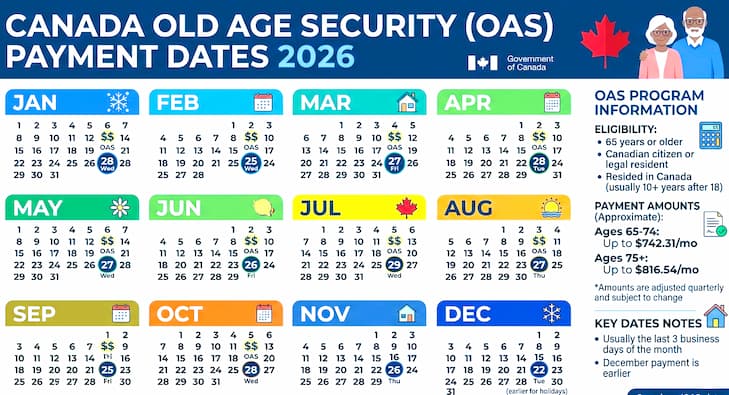
| 2026 maximum (age 65) | $1,507.65/month | $751.97/month (65-74) |
Most retirees qualify for both, and you must apply for each separately — qualifying for one doesn’t automatically enroll you in the other. If you haven’t started your OAS application, see our step-by-step How to Apply for Old Age Security 2026 guide, and our OAS vs CPP vs GIS Comparison if you’re trying to understand how all three federal retirement programs work together.
Working While Collecting CPP
If you’re under 70 and continue working after starting your CPP retirement pension, your ongoing contributions build toward a Post-Retirement Benefit (PRB) — a smaller additional lifetime payment added each following January, worth up to roughly $54.69/month for a full year of maximum contributions. Between 65 and 70 you can elect to stop contributing by filing form CPT30 with the CRA if you’d prefer to keep your full paycheque instead.
If You Become Disabled or Pass Away
CPP eligibility extends well beyond standard retirement. If you become disabled before 65 with a condition that’s both severe and prolonged, you may qualify for CPP Disability Benefits instead of, or before, your retirement pension — see our full CPP Disability Benefits 2026 guide for eligibility details. If a CPP contributor passes away, their spouse, common-law partner, or dependent children may be eligible for survivor benefits, a one-time death benefit, and a children’s benefit — all covered in our Canada Survivor Benefits 2026 guide.
Receiving CPP If You Live Outside Canada
CPP eligibility isn’t lost if you move abroad after qualifying. Payments continue by direct deposit to an eligible international bank account, and Canada has tax treaties with many countries that help prevent double taxation on your pension income — worth checking with a tax professional in your destination country before you relocate.
Frequently Asked Questions
What’s the minimum age to receive CPP?
60, though your monthly amount is permanently reduced if you start before 65.
Do I need a minimum number of contribution years to qualify?
No. Even a single valid CPP contribution makes you eligible — though more years at higher earnings substantially increase your monthly amount.
Can I qualify for CPP if I’ve never worked full-time?
Yes, as long as you have at least one valid contribution from employment or self-employment income exceeding the Year’s Basic Exemption.
Does CPP eligibility differ in Quebec?
Yes. Quebec residents contribute to the Quebec Pension Plan (QPP) instead of CPP, administered separately by Retraite Québec, with broadly similar but not identical rules and its own application process.
Can I receive CPP while still working?
Yes, and if you’re under 70, your continued contributions can boost your pension through the Post-Retirement Benefit.
Is CPP taxable?
Yes, CPP is fully taxable income at your marginal rate — there’s no tax-free portion.
What happens to my CPP eligibility if I move outside Canada?
Your eligibility and payments continue by direct deposit; tax treatment depends on tax treaties between Canada and your country of residence.
This article is for informational purposes only. Confirm your specific eligibility and estimated amount through My Service Canada Account.
Pingback: Canada Benefit Increase 2026 | Benefits Pulse Hub