
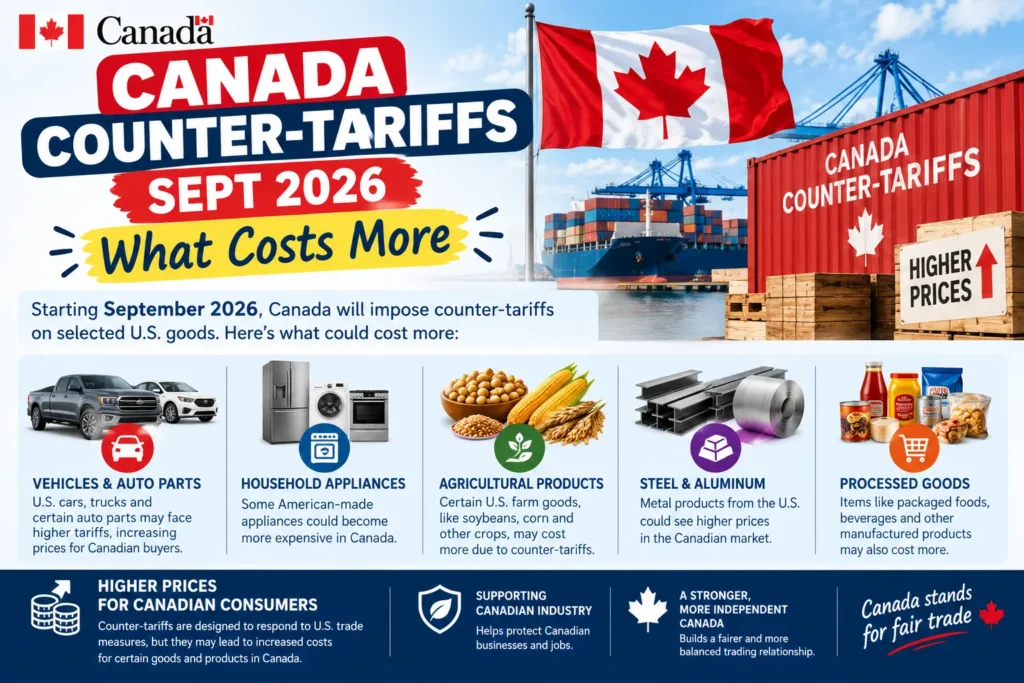
If your grocery bill or next appliance purchase feels a little steeper this month, there’s a real reason for it. The Canada counter-tariffs September 2026 took effect at 12:01 a.m. on September 8, applying new duties of 15%, 25%, or 50% on roughly 650 categories of U.S.-made goods. Here’s exactly what’s affected, why it happened, and a few practical ways to soften the impact on your household budget.
What Happened: A Quick Recap
This didn’t come out of nowhere. On August 22, 2026, the United States imposed a 50% tariff under Section 338 on $27.6 billion worth of Canadian exports. Canada’s response, announced by the federal government on August 25 and confirmed by Finance Minister François-Philippe Champagne, was a dollar-for-dollar countermeasure: matching tariffs on an equivalent $27.6 billion of U.S. imports into Canada, effective September 8, 2026.
The government has been clear that the goal is to match the U.S. action item-for-item and rate-for-rate, targeting the sectors it says were hit hardest by the American tariffs, rather than applying a blanket tax across all U.S. imports.
Which Sectors Are Affected
The Canada counter-tariffs September 2026 list focuses on six main sectors:
- Steel and aluminum
- Dairy products
- Household appliances
- Agricultural equipment
- Pulp and paper products
- Electronics
Furniture and clothing/apparel were also added to this round — notably, these categories weren’t part of Canada’s earlier counter-tariff measures, so if you’re shopping for either, this is new territory.
The Three Tariff Bands, and What’s in Each
50% Tariff Band (the highest rate)
- Steel and aluminum products — ingots, bars, rods, wire, structural steel, pipes and tubes (up from a previous 25% rate)
- Furniture
- Clothing and apparel — cotton T-shirts, knitted pullovers, women’s dresses and trousers, men’s wool suits and blazers, jackets, gloves, and garments made from coated or laminated fabrics
- Certain paper and household products, including disposable paper tablecloths and serviettes
- Natural honey and molasses
- Baking mixes and prepared doughs containing butterfat
25% Tariff Band
- Appliances
- Dairy products, including essentially every variety of cheese — cheddar, mozzarella, brie, gouda, provolone, Swiss, parmesan, havarti, romano, and processed cheese
- Certain steel and aluminum derivative products
- Toilet paper and paper towels
15% Tariff Band
- Electronics — smartphones, monitors, video game consoles
- General tools and other consumer electronics
Agricultural equipment, pulp and paper, and plastics and construction materials appear across more than one band depending on the specific item, so two products in the same general category won’t necessarily carry the same rate.
Does This Affect Groceries Broadly?
Not as a whole category — this is an important distinction. Specific U.S.-imported dairy products, like cheese, are affected, but groceries in general aren’t blanket-taxed under this measure. If you’re trying to figure out whether a specific product is affected, checking the official Department of Finance list is more reliable than assuming an entire aisle got more expensive.
How Many Products Are Actually on the List?
You’ll see slightly different totals depending on the source — figures ranging from roughly 629 to about 700 tariff items have been reported, since the list has been revised more than once since its initial publication on August 25. The safest approach is to check the official, currently published list on canada.ca rather than relying on any single reported total, since the count can shift as items are added or clarified.
What This Means for Your Household Budget
For most households, the practical impact shows up gradually rather than all at once — retailers don’t necessarily reprice existing inventory overnight, and the effect ripples through supply chains over weeks rather than a single day. That said, a few categories are worth watching if you’re planning a purchase:
- Back-to-school or seasonal clothing shopping — with apparel now at the 50% band, U.S.-imported clothing brands may see the most noticeable price movement.
- Home renovation or appliance purchases — steel, aluminum, and appliances are squarely in the higher tariff bands.
- Specialty cheese and dairy — if you regularly buy U.S.-imported cheese specifically, expect that particular line item to cost more, even though groceries overall aren’t broadly affected.
How Benefit Payments Can Help Offset Rising Costs
If rising prices are squeezing your budget, it’s worth double-checking that you’re actually receiving every benefit you’re eligible for, since several federal programs are specifically designed to offset exactly this kind of cost-of-living pressure. The Canada Groceries and Essentials Benefit (CGEB) pays a permanently higher quarterly amount than the GST/HST Credit it replaced — see our full guide to the Canada Groceries and Essentials Benefit (CGEB) 2026 for current amounts and payment dates. Working households may also want to check their eligibility for the Canada Workers Benefit (CWB) Payment Dates 2026, which pays advance instalments throughout the year rather than making you wait until tax time. For the complete monthly calendar of every benefit currently landing in your account, see our Canada Benefit Payment Dates 2026 guide.
Frequently Asked Questions
When did the Canada counter-tariffs for September 2026 take effect?
At 12:01 a.m. on September 8, 2026.
Why did Canada impose these counter-tariffs?
In direct response to a 50% U.S. tariff under Section 338 on $27.6 billion of Canadian exports, effective August 22, 2026. Canada’s countermeasure matches that value dollar-for-dollar.
What are the three Canada counter-tariff rates for September 2026?
15%, 25%, and 50%, applied depending on the specific product category — steel, aluminum, furniture, and clothing carry the highest 50% rate.
Are groceries broadly affected by the September 2026 tariffs?
No. Specific U.S.-imported dairy products like cheese are affected, but groceries as a whole category are not blanket-taxed under this measure.
How many products are on the Canada counter-tariff list?
Reported figures range from roughly 629 to about 700 items, since the list has been revised more than once — check the official Department of Finance list for the current, authoritative count.
Will these tariffs make my benefit payments go up too?
Not automatically or immediately. Benefit amounts like the CGEB and CCB are indexed annually for inflation rather than adjusted in direct response to a specific tariff announcement, though sustained price increases can influence future indexation calculations.
Conclusion
The Canada counter-tariffs September 2026 measures are a targeted, dollar-for-dollar response rather than a blanket tax on everything from the U.S. — but the sectors they do cover, especially clothing, steel, appliances, and dairy, are ones most households interact with regularly. If your budget is feeling the squeeze, checking that you’re receiving every benefit you qualify for is one of the most direct ways to offset the difference.
This article is for informational purposes only. Always check the official Department of Finance Canada list for the current, authoritative tariff schedule before making purchasing decisions.
Stay updated with the latest Canada government benefits, payment dates, and CRA news — explore more guides at Benefits Pulse Hub.