
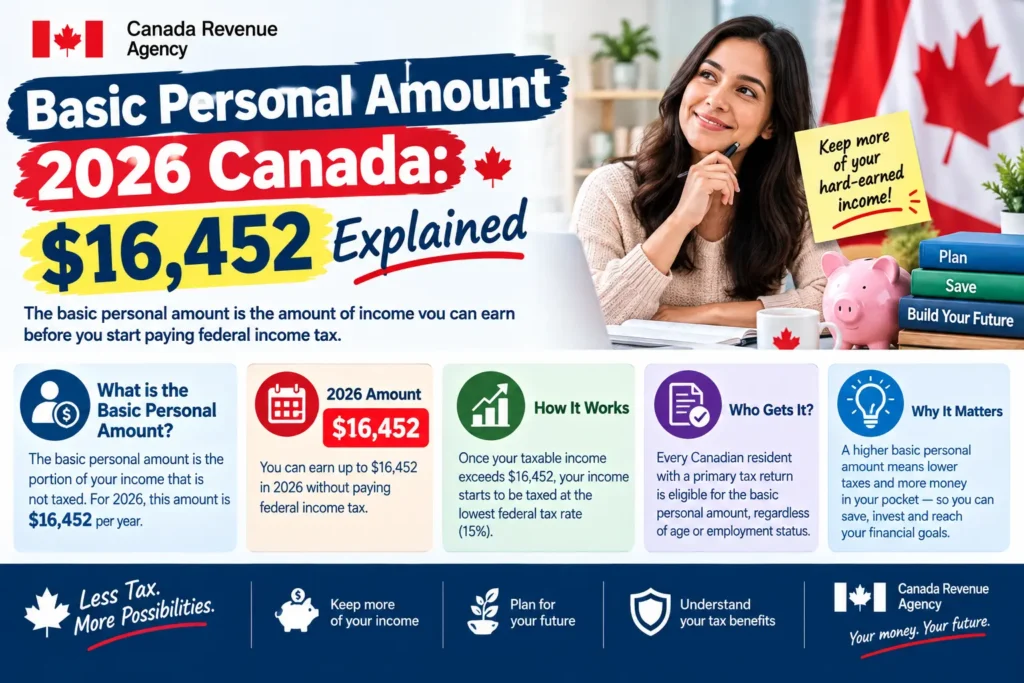
If you’ve ever wondered exactly how much you can earn in a year before the government starts taking a cut, the Basic Personal Amount 2026 is the number you’re looking for. Every Canadian resident gets this built-in tax-free buffer, and for 2026 it’s bigger than it’s ever been. Here’s exactly how it works, what it’s worth in real dollars, and how it interacts with everything else on your tax return.
What Is the Basic Personal Amount?
The Basic Personal Amount (BPA) is a non-refundable tax credit every Canadian resident can claim, and it effectively makes a slice of your income tax-free at the federal level. It isn’t a deduction that lowers your taxable income directly — instead, the CRA multiplies the BPA by the lowest federal tax rate, and that result comes straight off the tax you’d otherwise owe.
For 2026, the federal Basic Personal Amount is $16,452 — up from $16,129 in 2025. You claim it on line 30000 of your T1 return, and it applies automatically; there’s no separate application required.
How Much Is the Basic Personal Amount 2026 Actually Worth?
This is where a lot of people get confused. The $16,452 figure isn’t money that lands in your pocket directly — it’s the size of the tax-free slice of income. The actual dollar value of the credit depends on the lowest federal tax rate, which dropped to 14% for 2026 (down from 14.5% in 2025 following a mid-year rate cut).
So the real math is: $16,452 × 14% = $2,303 in actual federal tax savings for most taxpayers. That’s the amount taken directly off your federal tax bill, not the amount of income that disappears from your return.
Does Everyone Get the Full $16,452?
No — and this is the part most casual summaries skip entirely. Since 2020, the federal BPA has worked on a two-tier system:
| Net Income | Federal BPA | Credit Value (14%) |
|---|---|---|
| $181,440 or less | $16,452 (full “enhanced” amount) | $2,303 |
| $181,440 to $258,482 | Gradually reduced | Declining |
| $258,482 or more | $14,829 (base amount) | $2,076 |
If your net income falls between $181,440 and $258,482, your BPA shrinks in a straight line as your income rises within that range. Once you’re earning $258,482 or more, you’re capped at the lower $14,829 “base” amount — the same figure everyone received before the enhanced version was introduced. For the vast majority of Canadians, whose income sits well below $181,440, this distinction doesn’t matter at all — you get the full $16,452 regardless.
How the 2026 Basic Personal Amount Compares to Past Years
| Year | Enhanced BPA | Base BPA | Lowest Tax Rate | Credit Value |
|---|---|---|---|---|
| 2026 | $16,452 | $14,829 | 14% | $2,303 |
| 2025 | $16,129 | $14,538 | 14.5% | $2,419 |
| 2024 | $15,705 | $14,156 | 15% | $2,356 |
| 2023 | $15,000 | $13,520 | 15% | $2,250 |
| 2022 | $14,398 | $13,229 | 15% | $2,160 |
Notice something interesting here: even though the BPA dollar amount keeps climbing every year, the actual credit value in 2026 ($2,303) is slightly lower than 2025’s ($2,419). That’s because the lowest tax rate dropped from 14.5% to a full 14% for 2026, which shrinks the value of every credit calculated at that rate — including the BPA. A bigger BPA doesn’t automatically mean bigger tax savings if the rate it’s multiplied by has also changed.
How This Fits Into the 2026 Federal Tax Brackets
The BPA works alongside the full federal bracket structure, which was also indexed for 2026:
- 14% on income up to $58,523
- 20.5% on income from $58,523 to $117,045
- 26% on income from $117,045 to $181,440
- 29% on income from $181,440 to $258,482
- 33% on income above $258,482
Whatever bracket your income falls into, the BPA credit is still calculated at the 14% lowest rate — not at your marginal rate — since non-refundable credits are always applied at the bottom rate regardless of your overall tax bracket.
Provincial Basic Personal Amounts Are Separate
Every province and territory has its own basic personal amount, claimed separately on Form 428 against provincial tax rather than federal tax. These vary significantly — British Columbia’s 2026 BPA is $13,216, for example, while other provinces set their own figures independently. If you’re trying to estimate your total tax-free income, you need to look at both your federal BPA and your specific province’s BPA, since they’re calculated and applied independently rather than combined into one number. Quebec residents claim a separate BPA on their Revenu Québec return instead of the federal system entirely.
The Spousal Amount Connection
If you’re supporting a spouse or common-law partner with little or no income, you may be able to claim some or all of their unused BPA as a spousal amount credit. The credit shrinks as your spouse’s income rises:
| Spouse’s Net Income | Your Spousal Amount Credit |
|---|---|
| $0 | $2,303 (full credit) |
| $5,000 | $1,603 |
| $10,000 | $903 |
| $16,452 or more | $0 |
Why the Basic Personal Amount Matters Beyond Just Your Tax Bill
Understanding your BPA isn’t just about federal tax owing — it also has knock-on effects for benefit calculations. Several federal benefits use your net income (the figure the BPA doesn’t directly change, since it’s a credit rather than a deduction) as part of their eligibility formulas, so it’s worth being precise about the difference between “tax-free income” and “income that doesn’t count toward benefit calculations” — they’re not the same thing. If you’re trying to understand how your overall tax picture connects to specific benefits like the CGEB or CCB, see our CRA 2% Indexation 2026 roundup for how this year’s broader indexation changes fit together, and our Canada Groceries and Essentials Benefit (CGEB) 2026 guide for how income thresholds work for that specific benefit.
Where to Check Your Own Numbers
Your Notice of Assessment shows exactly how your BPA and other credits were applied to your specific return, and CRA My Account lets you review your full tax and benefit picture in one place. If you haven’t set up your account yet, our CRA My Account 2026 guide walks through registration and every major feature.
Frequently Asked Questions
What is the Basic Personal Amount for 2026 in Canada?
The federal Basic Personal Amount for 2026 is $16,452, up from $16,129 in 2025. It’s the amount of income most Canadians can earn before owing federal tax.
How much is the Basic Personal Amount 2026 actually worth in tax savings?
$16,452 multiplied by the 14% lowest federal tax rate equals $2,303 in actual federal tax savings for most taxpayers — not the full $16,452 itself.
Does everyone get the full $16,452 Basic Personal Amount?
No. Only taxpayers with net income of $181,440 or less get the full enhanced amount. It phases down between $181,440 and $258,482, landing at a reduced base amount of $14,829 for higher earners.
Is the Basic Personal Amount the same in every province?
No. Each province and territory sets its own separate basic personal amount, claimed on Form 428 against provincial tax. British Columbia’s 2026 amount, for example, is $13,216 — different from the federal figure.
Do I need to apply for the Basic Personal Amount?
No. It’s automatically applied when you file your tax return — there’s no separate application.
Why is the 2026 BPA credit worth less than 2025’s, even though the amount itself is higher?
Because the lowest federal tax rate dropped from 14.5% in 2025 to 14% in 2026. A larger BPA multiplied by a slightly lower rate results in a smaller actual credit.
This article is for informational purposes only and does not constitute tax advice. Confirm your specific BPA and tax credits through CRA My Account or a qualified tax professional.
Stay updated with the latest Canada government benefits, payment dates, and CRA news — explore more guides at Benefits Pulse Hub.