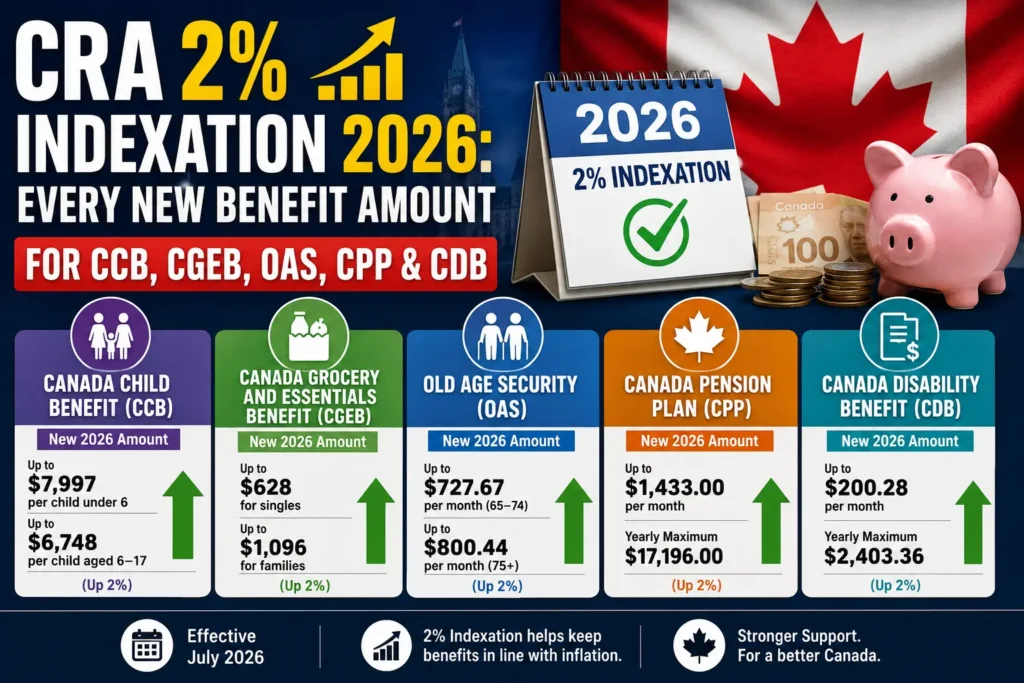
Every year, the CRA adjusts key benefit amounts and tax thresholds to keep pace with inflation — a process called indexation. For 2026, that adjustment factor is 2%, noticeably lower than the 2.7% increase applied in 2025. But “2%” doesn’t tell the whole story, because some benefits got extra boosts on top of standard indexation, and each program applies its increase on a different date. Here’s the complete picture of what actually changed, and when.
How Indexation Works
Each year, the CRA indexes tax brackets, credits, and benefit thresholds using a formula based on average inflation over the 12 months ending September 30. For 2026, that formula produced an indexation factor of 1.02, or 2%, applied to most major benefit programs and tax thresholds starting in the new benefit year. This is a routine, purely inflation-driven adjustment — separate from any policy decision to increase a specific program by more than the standard rate, which is exactly what happened with one benefit this year.
Canada Child Benefit (CCB) — +2%, Effective July 20, 2026
The CCB received its standard 2% indexation increase with the July 20, 2026 payment, raising the maximum annual amounts to:
| Child’s Age | New Maximum (Annual) |
|---|---|
| Under 6 | $8,157 |
| 6 to 17 | $6,883 |
These maximums apply to families with adjusted family net income (AFNI) below $37,487, with the benefit gradually reduced above that threshold and reduced further above $81,222. For families at the maximum, this works out to roughly $13 more per month for each younger child and about $11 more per month for each older child. Because the CCB benefit year runs July to June, this July payment was also the first calculated using 2025 tax return data — so accurate, on-time filing directly affects what you receive.
Canada Groceries and Essentials Benefit (CGEB) — +25% (Not Standard Indexation)
Unlike the other programs on this list, the CGEB increase isn’t just routine indexation — it’s a deliberate policy decision. The former GST/HST Credit was replaced by the CGEB starting July 2026, with a permanent 25% increase in payment amounts locked in for five years, on top of standard yearly indexation going forward. Combined with the regular inflation adjustment, some sources put the total increase over the old GST/HST Credit at roughly 27.5%. For a full breakdown of amounts, eligibility, and payment dates, see our complete guide to the Canada Groceries and Essentials Benefit (CGEB) 2026, and our earlier explainer on the GST/HST Credit Increase 2026 for context on how the numbers compared before the switch.
Old Age Security (OAS) — +1.2% for the July–September 2026 Quarter
OAS is indexed quarterly rather than annually, based on the Consumer Price Index. The July–September 2026 quarter brought a 1.2% increase, pushing the maximum monthly payment to approximately $751.97 for seniors aged 65 to 74, and $827.17 for those 75 and older. The OAS Recovery Tax (clawback) threshold for 2026 also moved up alongside this indexation, now sitting at $95,323 in net income — see our OAS Clawback 2026 guide for the full threshold breakdown.
Canada Pension Plan (CPP) — +2%, Applied Once Annually in January
Unlike OAS, CPP is indexed only once per year, in January, using the 12-month average Consumer Price Index. The 2% increase that took effect in January 2026 set the maximum CPP retirement pension at age 65 to $1,507.65 per month — though the average new beneficiary at 65 receives closer to $925.35, since the maximum requires a full contribution history. This January-set rate stays fixed all year and won’t change again until January 2027. Full monthly dates are in our CPP Payment Dates 2026 guide.
Canada Disability Benefit (CDB) — +2%, Effective July 2026
The Canada Disability Benefit increased from $200 to $204.20 per month with the July 2026 indexation. For related disability support programs, see our guide to CPP Disability Benefits 2026.
Quick Reference: What Changed and When
| Benefit | Increase | Effective Date | Type |
|---|---|---|---|
| Canada Child Benefit | +2% | July 20, 2026 | Standard indexation |
| CGEB (was GST/HST Credit) | +25% (5-year policy) | July 3, 2026 | Policy increase |
| Old Age Security | +1.2% | July–Sept 2026 quarter | Quarterly indexation |
| Canada Pension Plan | +2% | January 2026 | Annual indexation |
| Canada Disability Benefit | +2% (to $204.20) | July 2026 | Standard indexation |
What Didn’t Change
Not everything moves with the July indexation. RRSP contribution room for 2026 sits at $33,810 and TFSA room at $7,000 — both set independently of benefit indexation and unaffected by this year’s 2% adjustment.
See These Amounts in Action
Curious how the new CPP and OAS amounts actually land in your account? Several of these payments arrive together on the same date each month for seniors — see our guide on August 27, 2026 Payment Stacking: CPP, OAS & GIS Explained to see exactly how it plays out.
Why This Matters If You Receive Multiple Benefits
If you receive several of these benefits together — which is common for seniors and families — all of them recalculate around the same July timeframe, based on your 2025 tax return. That means a single missed filing, or an unusually high withdrawal in 2025, can quietly reduce more than one benefit at once. For a broader view of every payment stacking together, see our Canada Benefit Payment Dates 2026 calendar, and if you’re a senior receiving several of these programs together, our Top Government Benefits for Seniors in Canada — 2026 Guide is a useful starting point to see how they all fit together.
Frequently Asked Questions
Why is the 2026 increase lower than 2025’s?
Indexation is based on average inflation over the 12 months ending September 30 each year. For 2026, that calculation produced 2%, down from 2.7% used to set 2025 amounts, reflecting slower inflation over that period.
Is the CGEB’s 25% increase part of the standard 2% indexation?
No. The CGEB’s 25% increase is a separate five-year policy decision layered on top of the program’s regular indexation, not the standard annual adjustment applied to other benefits.
Do all these benefits change on the same date?
No. CCB and CDB updated July 2026, OAS updates quarterly (its next review is October 2026), and CPP only updates once a year in January.
Does filing my taxes late affect these new amounts?
Yes. Most of these benefits are recalculated using your most recent tax return, so late or missing filings can delay or reduce your payment even after the new rates take effect.
This article is for informational purposes only and does not constitute financial or tax advice. Confirm your exact entitlement through CRA My Account or My Service Canada Account.