

Planning for retirement isn’t only about choosing a date when you stop working, it also includes the decision of when to start receiving government benefits. This OAS Deferral Explained guide helps Canadian seniors figure out if it’s best to start collecting Old Age Security (OAS) at 65 or delay those payments so they can get a permanently higher monthly amount later on in retirement.
This OAS Deferral Explained guide goes through what you need to know about postponing your Old Age Security pension, including how the process works, who might benefit, how much your payments could rise, and which practical points you should weigh before making your final choice.
What Is Old Age Security (OAS)?
Old Age Security (OAS) is a monthly pension funded by the Government of Canada for eligible seniors, typically those aged 65 and older. Unlike the Canada Pension Plan (CPP), OAS is not tied to your employment history, or to the amount you paid in during your working years.
Eligibility is mostly a function of your age, your legal status and your years of residence in Canada after you turn 18.
What Does OAS Deferral Actually Mean?
OAS deferral lets qualified Canadians put off receiving their Old Age Security pension after 65.
Instead of starting payments right away at 65, you can decide to postpone the pension for as much as five years, so you can begin collecting any time between 65 and 70.
As a trade for waiting, your monthly OAS amount permanently goes up.
That higher amount stays for as long as you keep receiving OAS.
How Much Will Your OAS Grow?
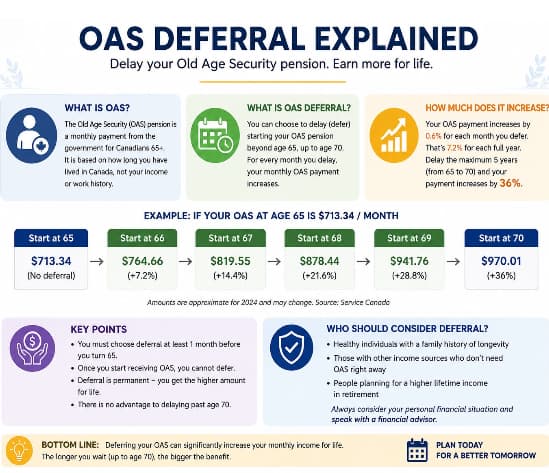
Each month you delay your OAS after 65, your monthly payment rises by 0.6%.
So it works out to:
- 7.2% if you wait one year
- 14.4% after two years
- 21.6% after three years
- 28.8% after four years
- Up to 36% if you hold off until age 70
This rise is lasting, it applies across your lifetime.
OAS Deferral Explained: Why Do Some People Choose to Delay OAS?
There are a few reasons why postponing OAS might actually make financial sense, even if it feels a bit counterintuitive at first
Greater Lifetime Income
If you think you’re going to live well into your eighties, or even past that point, the larger monthly amounts could mean a better overall payoff across your life.
You’re Still at Work
Many Canadians stay employed after age 65. If you already get employment income, then delaying OAS can add up to a bigger pension amount once you finally step back from work.
Other Retirement Income
If you have savings, a workplace pension, or investment income that covers your day to day spending in a steady way, you might prefer to delay OAS so you receive stronger future payments later on.
Tax Strategy
Some retirees choose to wait on OAS so they can fine tune how much taxable income shows up early in retirement, that way they can keep certain outcomes in check.
If you are comparing when to start your retirement benefits, it is also worth reviewing CPP Early vs Late Retirement to understand how starting CPP earlier or delaying it can affect your monthly retirement income.
OAS Deferral Explained: When Does Deferring OAS Really Fit?
Deferring OAS can work well when you
- Keep working full time
- Have solid retirement savings
- Anticipate a lengthy retirement
- Do not need the OAS cash flow right now
- Care about getting larger, dependable monthly payments later in life
Every financial situation is different, so the best choice depends on your retirement goals, health, and how much cash you truly need.
If you plan to retire outside Canada, review our guide on OAS While Living Outside Canada to understand how living abroad can affect OAS payments and eligibility.
When Taking OAS at 65 might be better
Starting OAS right away can be the better option if you:
- Need income for daily expenses.
- Have modest retirement savings.
- Plan to retire before age 65.
- Have health matters that could shorten your retirement horizon.
- Prefer to start receiving payments sooner rather than later.
Taking OAS earlier gives you money sooner, even if the monthly amount is smaller compared to what you would get by waiting.
How to defer your OAS pension
If you qualify for automatic enrolment, Service Canada may contact you before your 65th birthday.
If you want to postpone, you must follow the steps in your notice, and tell Service Canada that you want to delay your OAS payments.
If you are not automatically enrolled, you can apply whenever you decide to begin receiving benefits.
Can you change your mind?
In some cases, you might end up changing your decision before your pension actually begins.
However once your OAS payments have started, you generally cannot keep raising the amount by waiting longer.
So, you should think about this decision carefully, before picking the start date, even if it feels easy at first.
How OAS deferral affects other benefits
Putting off OAS can also play with other public programs.
For instance :
- Guaranteed Income Supplement (GIS) eligibility may be postponed, because GIS is generally available only to people already receiving OAS.
- Your retirement income planning may also shift.
- Your taxable income can be different during retirement.
Getting a clear view of how these benefits connect is an important part of planning.
If your retirement income is relatively high, you should also understand the OAS Clawback 2026 rules because the recovery tax can reduce OAS payments at higher income levels.
OAS Deferral Explained: Factors to consider before deferring
Before you make the call, ask yourself a few key questions.
Your Health
If you expect a lengthy retirement, larger monthly payments may offer better long term value.
Your Retirement Income
Do you have enough savings to comfortably put off starting OAS?
Inflation
OAS payments are reviewed regularly, to help protect purchasing power, even if you begin your pension at a later time or earlier.
Family Situation
Your marital status, survivor benefits, and household income can affect how you plan for retirement.
Common Misunderstandings About OAS Deferral
Myth: Everyone Should Delay OAS
Not really.
Pausing OAS can be a smart choice for some retirees but it isn’t the right fit for everybody.
Myth: You’ll Lose Your Benefits
No.
Choosing to defer OAS does not mean giving up your pension. It just changes when the money starts coming in.
Myth: The Increase Is Temporary
It is permanent, and it keeps going through retirement.
OAS Deferral Explained: Advantages of Deferring OAS
Some of the key advantages include, higher monthly payments that last.
- More steady, guaranteed retirement income.
- Improved financial security later in life.
- More room for retirement timing and decisions.
- Possible tax planning opportunities.
Potential Drawbacks
There are also possible disadvantages.
First, you give up payments during the deferral window, even if you still planned to rely on them.
Second, it may take several years before you recover the payments you postponed.
If you need cash flow immediately, the postponing can cause financial strain sooner than you expect.
Delaying OAS may also delay your eligibility for certain income-tested programs and other supports.
You should carefully weigh the present value of receiving payments now against the long-term gain from larger monthly benefits later.
Example of OAS deferral
Imagine Sarah reaches 65 but keeps working full-time for another four years.
Instead of starting OAS right away, she delays her pension until age 69.
Since she postponed payments for four years, her monthly OAS pension increases by about 28.8% .
Over her retirement years, Sarah gets larger monthly amounts than she would have received starting at 65.
Whether the choice gives more total lifetime income depends on things like longevity , and also her own financial situation.
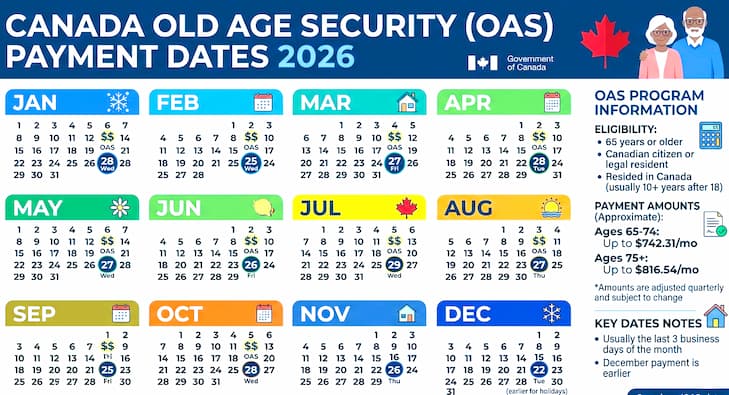
Once you begin receiving OAS, you can use our OAS Payment Dates 2026 guide to keep track of the expected monthly payment schedule.
Tips Before Making Your Decision
Before you decide whether to defer OAS
- Start by estimating your retirement costs.
- Then, check where your income is coming from.
- Also think about how long you might live.
- Make sure you understand the tax implications, fully.
- Next, evaluate your cash flow needs, in a practical way.
- Revisit your retirement plan on a regular basis.
Making a well-informed call can help your long-term financial stability, a lot.
Frequently Asked Questions
Can I delay OAS after age 65 ?
Yes. Eligible Canadians can delay their Old Age Security pension for up to five years, until they reach age 70.
Is the payment increase permanent ?
Yes. Once your pension starts, the larger monthly payment stays in place for your lifetime.
Can I delay OAS if I am still working?
Yes. A lot of Canadians who keep working after age 65 decide to defer OAS, so they can get bigger payments later, it makes sense for some people.
Will delaying OAS affect GIS?
It may. Because GIS is typically paid to people who qualify for OAS, delaying OAS can also mean you wait longer before GIS kicks in, sometimes.
Final Thoughts
Understanding OAS deferral, explained, matters a lot if you are nearing retirement in Canada. Even though postponing Old Age Security can permanently increase your monthly pension amount, it is not automatically the right move for everyone. Your health situation, day to day financial needs, retirement savings, expected lifespan, and the broader income plan should all be weighed before you decide when to begin receiving benefits.
When you look at the short term and the long term effects together, you can pick an OAS start date that aligns better with your retirement aims and gives stronger financial certainty across your retirement years.

Pingback: GIS Income Limits (Updated) for Canadian Seniors
Pingback: What Income Affects GIS? Financial Advisor Guide
Pingback: CPP Early vs Late Retirement Guide for 2026
Pingback: OAS vs CPP vs GIS Comparison for Canadian Seniors
Pingback: OAS While Living Outside Canada: Rules & Eligibility