Looking after a spouse, parent, grandparent, child, or another family member who has a physical or mental impairment can feel emotionally worthwhile, but it often comes with tricky budget issues in the real world. To help soften a few of those costs, the Canadian government has the Canada Caregiver Credit 2026 (CCC).
This Canada Caregiver Credit is a non-refundable tax credit. It may lower the income tax you owe if you support an eligible family member who relies on you because of an impairment, either in physical functions or mental functions.
A lot of Canadians do not realize they might qualify. Others are uncertain about which person actually counts as an eligible dependant. If you understand the rules well, you can aim to increase your tax savings and make sure you claim every benefit that should be available to you.
In this guide, you’ll see :
- What the Canada Caregiver Credit is
- Who can claim it in 2026
- Eligibility requirements
- Who qualifies as a dependant
- How much you may be able to claim
- How to claim the credit on your tax return
- Common mistakes to avoid, a few things people often miss
- Frequently asked questions.
Whether you are supporting an aging parent, a spouse with a disability, or a child with special needs, this guide will help you understand the Canada Caregiver Credit in 2026.
What Is the Canada Caregiver Credit (CCC)?
The Canada Caregiver Credit, often called the CCC, is a federal tax credit designed to provide financial relief to people who care for family members with physical or mental impairments.
Since the CCC is a non-refundable tax credit, it lowers the federal income tax you owe. Still, it does not pay out cash if the amount of tax you owe is already at zero.
The government introduced the Canada Caregiver Credit 2026 to make caregiver-related credits easier. Before, there were several separate credits; now they are merged into one.
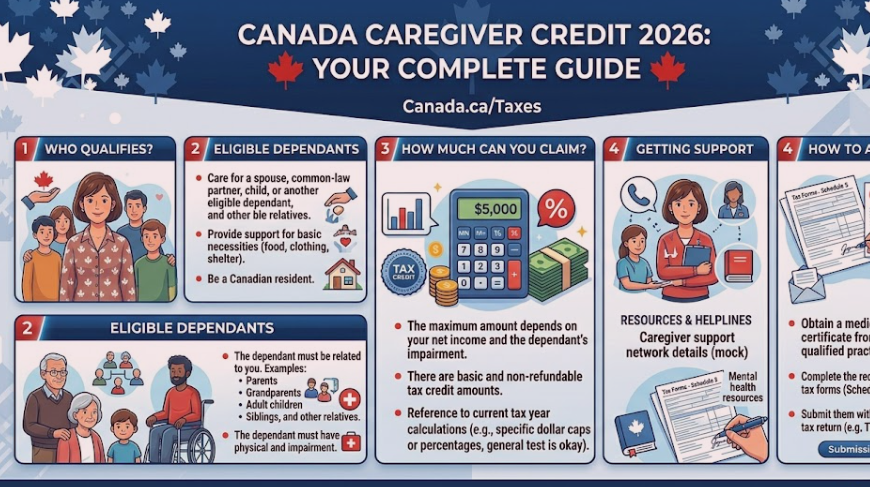
You may qualify for the credit if you provide support for,
- Your spouse or common-law partner
- Your child or grandchild
- Your parent or grandparent
- Your brother or sister
Other eligible relatives who rely on you because of a disability or impairment
Depending on your situation, you may claim the whole credit, or only a portion, on your yearly income tax return.
Why Is the Canada Caregiver Credit Important?
Lots of Canadians end up paying thousands of dollars every year to look after someone close to them, like a parent, partner, or relative.
Common caregiving expenses include:
- Daily living expenses
- Prescription medications
- Home care services
- Mobility aids
- Medical transportation
- Assistive devices
- Specialized diets
- Home modifications
The Canada Caregiver Credit (CCC) is meant to ease that financial strain because it reduces your federal income tax.
If you are already getting other government help, for example, disability-related benefits, the CCC may still add extra tax relief.
For instance, families supporting children with disabilities may also want to check our guide on the Canada Child Disability Benefit 2026, which goes over eligibility and the payment details for people caring for children with disabilities.
Who Can Claim the Canada Caregiver Credit in 2026?
You may claim the Canada Caregiver Credit if:
- You support an eligible dependant.
- The dependant has a physical or mental impairment.
- The dependent relies on you for financial, personal, or daily living support.
- You meet the CRA’s eligibility requirements.
The person you support does not necessarily need to live with you full-time, although living arrangements can affect certain claims.
The CRA evaluates each situation separately based on:
- Relationship to the dependent
- Living arrangements
- Dependency
- Nature of the impairment
- Income of the dependent
Who Qualifies as an Eligible Dependant?
One of the most confusing parts about the Canada Caregiver Credit is figuring out who counts as an eligible dependant. Honestly, it’s a bit tricky, especially when you read the CRA rules for the first time and everything feels slightly connected but not clearly.
Good news, though, because the CRA recognizes multiple family relationships. You might qualify in cases like these.
1. Spouse or Common-Law Partner
You may qualify if your spouse or common-law partner has a physical or mental impairment, and they rely on you for support. Also, you are the one providing the financial assistance, plus the help with everyday activities. This tends to be one of the most frequent CCC claims people make across Canada.
2. Parents and Grandparents
In some situations, you can claim the credit for support you provide to parents and grandparents, including:
- Mother
- Father
- Grandmother
- Grandfather
- Step-parent
- Foster parent
Many Canadians help aging parents through housing, medical appointments, daily activities, medication management, and financial assistance. The Canada Caregiver Credit could help offset at least part of those costs.
If you care for elderly parents, you may also find our article Top Government Benefits for Seniors in Canada 2026 Guide useful because it covers various programs available to seniors.
3. Children and Grandchildren
Parents might qualify if they provide support for:
- Minor children who have disabilities
- Adult children with physical impairments
- Adult children with mental impairments
- Grandchildren who lean on them because of a disability
The dependent’s age does not automatically decide eligibility. Instead, the CRA tends to focus on the severity of the impairment, and how much the dependant depends on the caregiver, plus the financial support that is provided
Families caring for disabled children should also look at our article on the Canada Child Disability Benefit 2026, because it explains tax-free payments available to families who meet the requirements
Brothers, Sisters, Aunts, Uncles, and Other Relatives
The CRA may also allow claims for:
- Brothers
- Sisters
- Aunts
- Uncles
- Nieces
- Nephews
That said, extra conditions may apply
In many cases, the dependant has to:
- Rely on you for support
- Be related by blood, marriage, common law partnership, or adoption
- Satisfy the CRA impairment criteria
What Does the CRA Mean by a Physical or Mental Impairment?
The CRA does not really share a fixed list of conditions that automatically qualify.
What they tend to do is look at whether the impairment really messes with the person’s ability to do everyday activities in a meaningful way.
So, physical impairments can include things like:
- Blindness
- Severe vision loss
- Hearing loss
- Mobility limitations
- Paralysis
- Multiple sclerosis
- Parkinson’s disease
- Cerebral palsy
Arthritis that causes severe limitations
For mental impairments, examples might be:
- Dementia
- Alzheimer’s disease
- Autism spectrum disorder
- Intellectual disabilities
- Severe depression
- Bipolar disorder
- Schizophrenia
Anxiety disorders that come with significant functional limitations
In the end, the CRA checks the medical evidence and weighs whether the condition is severe enough to meet the requirement.
Does the Dependant Need to Live With You?
Not always, no.
A lot of people think they can only claim the Canada Caregiver Credit if the dependant is in the same household, like stuck in the same place.
But that’s not always correct.
For instance
You might still qualify if:
Your elderly parent lives independently.
Your spouse temporarily stays in a care facility.
Your child attends school away from home, and you keep supporting them.
You provide financial support while the dependent lives elsewhere, too.
That said, the living arrangement can change things, because:
It can affect the amount you can claim.
It can affect which tax line applies.
It can affect whether you can claim other caregiver-related credits.
What kind of support counts?
When the CRA decides if you qualify, it looks at different forms of support, not just one thing.
Support can be like:
Financial support
For instance:
- Paying the rent
- Buying groceries
- Covering utility bills
- Paying medical expenses
- Purchasing mobility equipment
Personal care
For instance:
- Helping with bathing
- Assisting with dressing
- Preparing meals
- Medication reminders
- Transport to appointments
Emotional and daily living help
Examples include:
- Supervising someone with dementia
- Helping with managing finances
- Assisting with communication stuff
- Handling household tasks
- Giving regular care and supervision
The CRA looks at the overall dependency relationship rather than a single factor.
Can More Than One Person Claim the Canada Caregiver Credit?
Yes, more than one person can sort of claim the Canada caregiver credit.
In certain cases, several members of a family might help the same dependent, like sharing groceries, paying part of the rent, or covering medical costs in turns.
The CRA may allow more than one individual to claim some caregiver-related amounts, but not in a totally free way.
Still, there are limits. The total claim cannot go over the maximum amount allowed, even if more than one person is involved. Family members might have to coordinate and share the credit, and if the same amount is claimed twice, that can easily trigger CRA scrutiny or a review.
So, if more than one family member provides support, it helps to decide ahead of time how the credit will be split, before anyone files.
How Is the Canada Caregiver Credit Different From the Disability Tax Credit?
Lots of Canadians mix up the Canada Caregiver Credit with the Disability Tax Credit (DTC).
Even if both show up around disability and caregiving, they’re basically not the same, and they do different jobs.
Canada Caregiver Credit
- Typically claimed by the caregiver.
- Mainly lowers the caregiver’s taxes.
- It depends on whether you support an eligible dependent.
- How much you get can hinge on the dependent’s income and your relationship.
Disability Tax Credit
- Claimed by the person with the disability, or it can be moved to a family member.
- It helps reduce taxes for someone with severe and ongoing impairments.
- It usually needs medical certification.
- It can also help unlock other disability related benefits.
If you want the DTC details, you can check our guide Disability Tax Credit Canada 2026: Eligibility, Amount & How to Apply, it covers the rules more closely.
Does the Canada Caregiver Credit Affect Other Benefits?
In most cases, the Canada Caregiver Credit does not trim federal benefit payments.
So, claiming the CCC normally won’t change things like
- Canada Child Benefit (CCB)
- GST/HST Credit
- Canada Workers Benefit
- Old Age Security (OAS)
- Guaranteed Income Supplement (GIS)
Because of this, many eligible people can claim the CCC while still getting other government support.
For example, an older adult may keep receiving retirement-related payments while their caregiver claims the Canada Caregiver Credit.
Also, if you’re caring for an elderly relative, you might want to look into:
- Canada Old Age Security OAS Payment Dates 2026
- GIS Payment Dates 2026
- Canada Pension Plan CPP Payment Dates 2026
These guides lay out the payment calendars and the eligibility requirements for key senior programs.
Common wrong ideas about the Canada Caregiver Credit
A lot of Canadians end up missing the CCC because of a few usual misunderstandings, even when they might still be eligible.
Myth 1: Only parents can claim
No.
Spouses, grandparents, siblings, and other close relatives can sometimes qualify, too.
Myth 2: The dependant must live with you
Wrong.
In many situations, you can still qualify, even if the dependent lives at another address.
Myth 3: The credit is a monthly payment
No.
The Canada Caregiver Credit is a tax credit, meaning you claim it on your income tax return each year.
It is not a monthly government amount that arrives automatically.
Myth 4: Only major, severe disabilities qualify
Not always.
The CRA looks at every case one by one and takes into account how the impairment limits day-to-day life.
Also, medical paperwork matters a lot when eligibility is reviewed.
Canada Caregiver Credit Amount for 2026
The amount you can claim for the Canada Caregiver Credit (CCC) sort of depends on what’s going on in your situation
- Your relationship with the dependent
- The dependent’s net income
- Whether the dependent is your spouse or common-law partner
- Whether you claim any other credits linked to dependents
- The specific tax rules that apply to you
Since the Canada Caregiver Credit is a non-refundable tax credit, it lowers the federal income tax you owe. But it will not magically create a tax refund if your tax owing is already zero, so keep that in mind.
The federal government typically updates these tax credits every year to deal with inflation. So the maximum claim amount for 2026 might be slightly different compared to earlier years.
How does the Canada Caregiver Credit work?
The Canada Caregiver Credit doesn’t give you a monthly amount.
Instead, it kicks in by reducing your federal tax bill when you file your income tax return.
Here’s a plain example, just to make it feel more real.
Example 1
Sarah helps support her 78-year-old mother. The mother has severe arthritis, and she relies on Sarah for financial help and transportation.
Sarah:
- Helps pay part of her mother’s rent
- Drives her to medical appointments
- Assists with managing her medications
- Covers some grocery costs
If Sarah still fits the CRA eligibility rules, she may claim the Canada Caregiver Credit on her tax return, and that can reduce the amount of tax she owes.
Example 2
Michael provides care for his spouse, who has a long-term mental impairment.
His spouse:
- Can’t work full-time
- Relies on Michael financially
- Needs ongoing help with everyday tasks
Michael may qualify for the Canada Caregiver Credit, as long as he meets the CRA conditions, and the rest of the details line up.
Does the Dependant’s Income affect the Credit?
Yes.
The dependant’s income is one of those really important factors, not just “a number” kind of thing.
In general, as the dependant’s income increases, you may notice that:
- The amount you can claim decreases
- The credit may slowly phase out
- And in some situations, the credit is not available at all
The CRA uses the dependent’s net income to figure out your final claim.
So, two caregivers who support similar family members can end up getting different tax benefits, depending on where the dependent’s income sits.
Which Tax Return Lines Include the Canada Caregiver Credit?
The Canada Caregiver Credit might show up on different lines of your tax return, depending on a few things, like:
- Your relationship with the dependant
- The type of support you provide
- Whether you’re claiming your spouse or another family member
Spouse or Common-Law Partner Amount
Some common tax lines can include:
- Spouse or Common-Law Partner Amount
- You may be able to claim a caregiver amount if:
- Your spouse has an impairment
Their income is under the applicable threshold
You provide financial support
Eligible Dependant Amount
You may qualify if:
You support an eligible dependant
The dependant lives with you in qualifying situations
The dependant has a physical or mental impairment
Canada Caregiver Amount for Other Dependants
This can apply to things like:
- Parents
- Grandparents
- Adult children
- Brothers and sisters
- Other eligible relatives
The CRA then determines the final amount, based on your situation as a whole.
Can You Claim the Canada Caregiver Credit and the Disability Tax Credit Together?
Yes, you can claim the Canada Caregiver Credit and the Disability Tax Credit together.
Honestly, many Canadians qualify for both. The main difference looks like this, kind of:
- Canada Caregiver Credit
- This one is claimed by the caregiver.
- It’s tied to supporting an eligible dependant, and yes, it’s more about the caregiving role.
Disability Tax Credit
- This one is claimed by the person with the disability.
- In some cases, it can be transferred to a supporting family member.
- Also, there’s a medical certification involved.
So in certain situations, families get tax relief from both credits at the same time.
For instance, a parent who’s caring for a disabled adult child may:
- Claim the Canada Caregiver Credit
- Receive a transferred Disability Tax Credit amount
- Claim specific medical expenses too
This combo can really lower taxes for some households.
If you have not read it yet, you might want to check out our guide Disability Tax Credit Canada 2026: Eligibility, Amount & How to Apply, to understand how both credits work together.
Medical Documents You May Need
The CRA does not require every caregiver to send medical documents along with their tax return.
Still, it’s smart to keep records in case CRA asks for proof.
Helpful paperwork may include:
- Medical reports
- Physician statements
- Hospital records
- Specialist reports
- Disability assessments
- Prescription records
- Treatment history
Keeping clear and detailed records can help if the CRA reviews your claim later.
Does the Dependant Need to Receive Disability Benefits?
No.
A lot of caregivers assume the dependent must be receiving disability benefits. But this is not always true.
A dependant may qualify for the Canada Caregiver Credit even if they do not receive, for example:
- Disability pensions
- CPP disability benefits
- Provincial disability benefits
- Disability tax credit transfers
- Social assistance
When the CRA decides, they look at things like:
- The impairment
- The dependency
- The family relationship
- Income requirements
What If More Than One Person Supports the Same Family Member?
This situation is something people run into, fairly common, you know
For example
Two sisters might split the work, sort of share responsibility for looking after their elderly mother
Or
Adult children could collectively support a disabled parent, together
In many cases, the CRA may let you do things like
- Shared claims
- Partial claims, but not too much
- Different caregiver amounts, depending
But keep in mind
- The total amount you claim can’t go past the maximum amount that’s allowed
- Family members should not claim the same amount twice, ever
- The CRA might request extra details or additional info
Also, good record-keeping helps stop arguments later on
How to claim the Canada Caregiver Credit in 2026
Trying to claim the Canada Caregiver Credit is usually pretty smooth, especially if you get everything ready ahead of time and don’t leave it for later.
Step 1: Check if you qualify
Before anything else, confirm that:
- The dependent has a physical or mental impairment
- The dependant is an eligible family member (not just “someone you help”)
- You provide regular support
- The income conditions are met
If any of these parts feel unclear, it’s worth double-checking before you file.
Step 2: Collect supporting documents
Start gathering items like:
- medical certificates
- doctor’s notes
- disability assessments
- financial records
- caregiving expense records
You might not have to send the papers right away, but it’s smart to keep them on hand in case CRA asks.
Step 3: Fill out your tax return
When you file:
- Pick the correct dependent category
- Enter the caregiver amount that matches your situation
- Review the income limits closely
- Make sure every detail is correct
Most tax software walks you through the steps, but it’s still on you to verify the numbers and fields.
Step 4: Submit your tax return
You can submit:
- online using certified tax software
- through a tax professional
- by mailing a paper return
A lot of Canadians prefer online filing because
- Refunds tend to come sooner
- Mistakes are easier to spot
- CRA account links may be available
How to check your claim status
A simple way to keep an eye on your return is to use your CRA account.
In your CRA account, you can usually:
- Check return status
- See notices of assessment
- Update banking information
- review tax slips
- track benefit payments
If you get stuck signing in, our article CRA Login Guide 2026 explains the process, step by step.
And if login errors or access issues show up, CRA Login Problems 2026 can help too.
Why direct deposit matters
Most people choose direct deposit for tax refunds and other government payments.
Direct deposit can mean:
- faster payments
- more security
- less waiting around
- automatic deposits into your bank account
If you haven’t registered yet, our CRA Direct Deposit Setup Guide 2026 explains how to set up or update your banking details.
Common Errors to Steer Clear Of
Quite a few eligible Canadians end up losing part of their tax savings due to small but avoidable mistakes.
Claiming a Relative Who Does Not Qualify
Not every family member actually counts.
Before you claim:
- Make sure you understand the relationship.
- Check the dependency expectations.
- Read the CRA instructions again, slowly.
Overlooking the Income Thresholds
A dependant’s income strongly changes what you can claim.
Always double-check:
- Net income
- Taxable income
- Any other benefit amounts that get paid
- If the numbers are off, your refund can shrink.
Tossing Out Medical Paperwork
Keep your files like they are important, because they are.
Such as:
- Medical reports
- Doctor’s notes
- Prescriptions
- Specialist assessments
- Later, the CRA might ask for these papers, even if you already submitted something earlier.
Assuming Disability Benefits Are Mandatory
A dependant does not automatically need things like:
- CPP Disability Benefits
- Disability pensions
- Social assistance
What the CRA tends to weigh more carefully is:
- Impairment
- Dependency
- The relationship
- Income
Forgetting Other Possible Benefits
Many caregivers can qualify for more than one program.
You may also want to look at:
- Canada Child Disability Benefit
- Disability Tax Credit
- Canada Dental Benefit
- Canada Housing Benefit
- GST/HST Credit
Combining eligible benefits can significantly ease financial pressure.
For example:
Families supporting disabled children should review the Canada Child Disability Benefit 2026.
People caring for elderly relatives might find the Top Government Benefits for Seniors in Canada 2026 Guide helpful, even if they think they already know everything.
Low-income households may also qualify for the Canada Housing Benefit 2026 or the Canada GST/HST Credit Payment Dates 2026.
Can Caregivers Get Other Government Benefits?
Yes.
In many situations, the Canada Caregiver Credit does not generally stop you from receiving:
- GST/HST Credit
- Canada Child Benefit
- Canada Workers Benefit
- Old Age Security
- Guaranteed Income Supplement
- Canada Pension Plan benefits
So families often end up stacking benefits like:
- Tax credits
- Monthly payments
- Provincial help
- Housing support
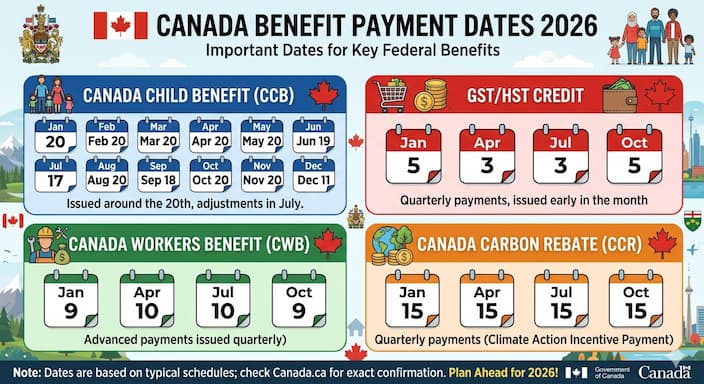
And if you want a full view of government payment timing, read our guide, Canada Benefit Payment Dates 2026, which covers major areas,
Provincial Caregiver Programs in Canada
Besides the federal Canada Caregiver Credit, a bunch of provinces have their own programs and tax credits too, kinda to help caregivers and families dealing with a loved one who has disabilities or chronic illnesses. In practice, how much help you get, and if it’s available at all, will depend on the province you’re in.
Some provincial programs might feature things like home care subsidies, disability assistance programs, caregiver tax credits, transportation support, help with medical expenses, or home accessibility grants. So if you are supporting someone in your family, it’s usually smart to check both federal and provincial options, because you can sometimes stack benefits in a way that really helps your household.
Can Seniors Benefit From the Canada Caregiver Credit?
Yes.
A lot of Canadians end up providing care to elderly parents, grandparents, or even a spouse. If the person you care for has, like,
- Dementia
- Alzheimer’s disease
- Parkinson’s disease
- Severe arthritis
- Mobility limitations
- Other long-term impairments
Then you might qualify for the Canada Caregiver Credit.
Many senior caregivers end up mixing the CCC with supports such as:
- Old Age Security (OAS)
- Guaranteed Income Supplement (GIS)
- Canada Pension Plan (CPP)
- Disability Tax Credit
- Provincial senior benefits
If you’re caring for an aging parent or spouse, you might also like these kinds of guides:
- Canada Old Age Security OAS Payment Dates 2026
- GIS Payment Dates 2026
- Canada Pension Plan CPP Payment Dates 2026
- Top Government Benefits for Seniors in Canada 2026 Guide
Taken together, these programs can bring real financial support for seniors and their families.
Can Parents Claim the Canada Caregiver Credit for Children?
In some cases, yes.
Parents caring for children with things like :
- Autism spectrum disorder
- Cerebral palsy
- Intellectual disabilities
- Severe developmental delays
- Physical disabilities
- Long-term mental impairments
may be eligible for the Canada Caregiver Credit. But the specifics matter, because eligibility is tied to the child’s impairment, how much the child relies on you, your family’s tax situation, and the CRA rules that apply to that particular claim.
Also, parents may qualify for additional
Yes, you can claim medical expenses and the Canada Caregiver Credit.
In a lot of situations, it’s possible to claim both, without them canceling each other out. For a caregiver claim, the rules are separate, but they can overlap, so generally, you’re not blocked automatically.
Examples of eligible medical expenses can include things like:
- prescription medications
- wheelchairs and similar mobility devices
- hearing aids
- hospital expenses
- physiotherapy
- home care services
- medical transportation
- specialized equipment
- assistive devices in general
The CRA does have its own medical expense rules, so you want to follow those specific requirements as well.
Lots of Canadians end up combining:
- medical expense tax credit
- disability tax credit
- Canada caregiver credit
- provincial disability benefits
Claiming all credits that actually apply to you can meaningfully lower your tax burden, sometimes a lot.
What happens if the CRA reviews your claim?
The CRA occasionally checks tax credits and deductions, just to confirm eligibility and accuracy.
That review does not necessarily mean something is wrong; it can be routine. If the CRA reviews your Canada caregiver credit claim, they might ask for:
- medical reports
- doctor’s letters
- proof of dependency
- records showing financial support
- proof of relationship
- income information
You can make that kind of process go smoother by keeping everything organized, like:
- staying on top of records
- saving medical documents
- keeping receipts and expense records
- keeping copies of your tax returns
Solid documentation often helps the CRA move faster, and it can reduce back and forth.
What if the CRA denies your claim?
Getting a denial can be very frustrating, but you still have options to respond.
Typically, you can:
Review the CRA notice and read the explanation carefully
The reason may involve things such as:
- missing documents
- income thresholds
- eligibility requirements
- Incorrect information was entered on the forms
Provide Additional Information
- In a lot of situations, sending:
- Updated medical reports
- Specialist letters
- Extra financial documents
Can help, I mean, it might support your claim too.
Ask for a Review
If you think the CRA made a mistake, you can ask for a review of the decision.
You should
- Explain your situation clearly
- Send supporting documents
- Keep copies of everything you mail out
Get Professional Advice
- When things get complicated, like
- Multiple dependants
- Shared caregiving
- Disability-related claims
- Provincial benefits
It can be really useful to get help from a qualified tax professional.
Canada Caregiver Credit 2026: Important Tips (kinda)
Before you file your tax return, try to keep these tips in the back of your mind:
Keep Medical Records
Store your:
- Medical certificates
- Physician statements
- Specialist reports
- Hospital records
The CRA might ask for them later, so don’t just toss everything in one folder.
Verify Income Amounts
Take a second and double-check:
- The dependant’s net income
- Tax slips
- Pension income
- Disability income
When the numbers match, processing usually goes smoother. If something feels off, it is usually better to fix it early.
Use CRA Online Services
With your CRA account, you can do a lot, like:
- Check notices of assessment
- View tax slips
- Track refunds
- Update personal information
- Manage direct deposit
If you need help, read our:
- CRA Login Guide 2026
- CRA Login Problems 2026
- CRA Direct Deposit Setup Guide 2026
These guides cover how to sign in and how to manage your CRA account safely.
Explore Other Benefits
Many caregivers end up qualifying for more than one government program, which feels kind of unfair… but it happens.
You might also be eligible for things like:
- Canada Housing Benefit
- Canada Dental Benefit
- Canada Child Disability Benefit
- GST/HST Credit
- Canada Workers Benefit
- Disability Tax Credit
When you understand how these programs work, it can absolutely boost your overall financial health.
For the full schedule of government payments, check out our Canada Benefit Payment Dates 2026 guide.
Frequently Asked Questions (FAQs)
Is the Canada Caregiver Credit a Monthly Payment?
No
The Canada Caregiver Credit is a non-refundable tax credit. You claim it when you file your income tax return. So no, it isn’t a monthly government benefit, it’s more like a tax time thing.
Can I Claim the Canada Caregiver Credit for My Mother?
Yes
You may qualify if:
- Your mother has a physical or mental impairment
- She relies on you for support
- You meet the CRA eligibility requirements
Can I Claim the Credit for My Father Who Lives Separately?
Possibly
In some cases, you might still qualify even if your father does not live with you. The CRA looks at stuff like:
- Dependency
- Relationship
- Financial support
- Nature of the impairment
Can Two Siblings Claim the Canada Caregiver Credit?
Yes
Though there are a few conditions:
- The total claim cannot exceed the maximum allowed
- Family members may need to split the credit
- The CRA may request extra documentation
Does the Dependant Need to Receive Disability Benefits?
No.
The dependent does not necessarily need to receive things like
- CPP Disability Benefits
- Disability pensions
- Social assistance
Instead, the CRA is really focused on:
- The impairment
- Dependency
- Income
- Relationship
Can I claim both the Canada Caregiver Credit and the Disability Tax Credit?
Yes.
A lot of Canadians qualify for both, in different situations.
The Canada Caregiver Credit helps the person who provides care, while the Disability Tax Credit supports the individual who has the disability, or a qualified family member who can claim on their behalf.
Will the Canada Caregiver Credit Lower My Other Benefits?
Usually no.
Claiming the Canada Caregiver Credit does not typically change:
- GST/HST Credit
- Canada Child Benefit
- OAS
- GIS
- Canada Workers Benefit
Do I Have to Get a Doctor’s Certificate?
Not always.
That said, you should keep:
- Medical reports
- Doctor’s letters
- Disability assessments
The CRA might ask for these documents if they review or question your claim.
Final Thoughts
The Canada Caregiver Credit 2026 is still among the more important tax credits for Canadians who look after relatives with physical or mental limitations.
Whether you are supporting:
- An elderly parent,
- A spouse with a disability
- A child with special needs
- Another qualifying relative
The Canada Caregiver Credit can help ease your tax burden and give real financial support.
If you understand the eligibility requirements, keep solid paperwork, and also check other related government supports, you can often stretch your benefits further.
Also, remember that many caregivers may be eligible for:
- Disability Tax Credit
- Canada Child Disability Benefit
- Canada Housing Benefit
- Canada Dental Benefit
- Senior supports like OAS, GIS, and CPP
Taking a bit of time to read through these programs can genuinely affect how your household finances work out.
If you think you qualify, check the rules carefully, and keep detailed records, so you can claim every benefit you’re allowed to use.