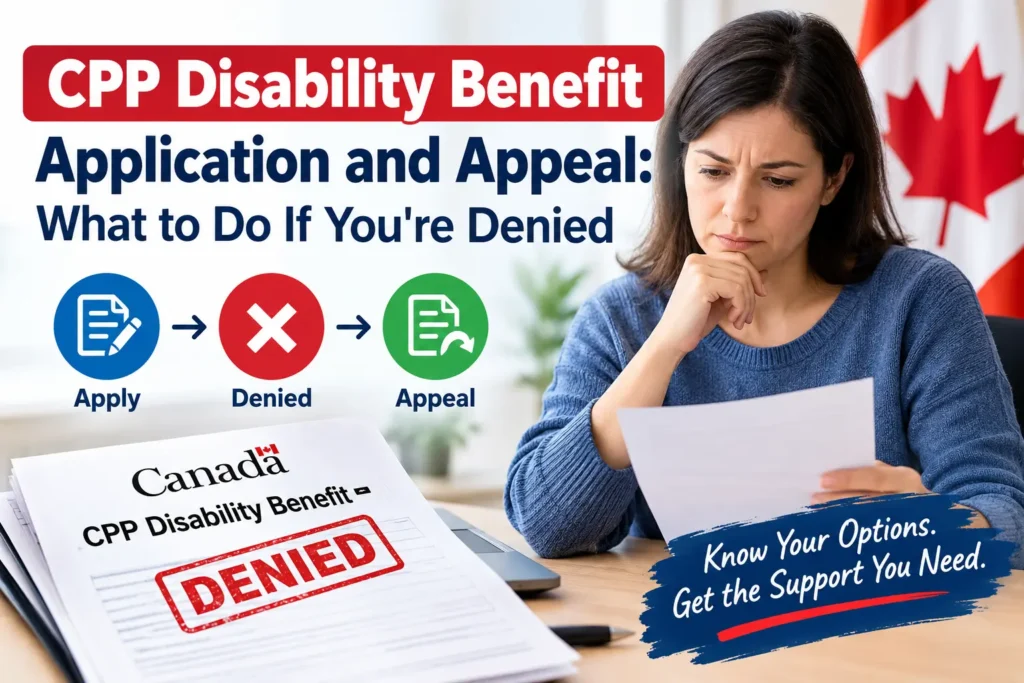
If you’re applying for the CPP Disability Benefit, here’s something worth knowing before you even submit your paperwork: roughly 60% of first-time applications get denied. That’s not meant to discourage you — it’s meant to prepare you, because a denial on your first attempt is common enough that it shouldn’t feel like the end of the road. This guide walks through exactly how the CPP Disability Benefit application process works, why so many claims get rejected initially, and the full appeal process if that happens to you.
Who Qualifies for CPP Disability in the First Place
Before getting into applications and appeals, it’s worth confirming you actually meet the baseline requirements:
- Contribution requirement: You generally need to have contributed to CPP for 4 of the last 6 years, or 3 of the last 6 years if you have at least 25 years of total contributions.
- Medical requirement: Your condition must be both “severe” — meaning it prevents you from regularly doing any substantially gainful work, not just your previous job — and “prolonged,” meaning it’s long-term, indefinite, or likely to result in death.
- Age requirement: You must be under 65, since CPP disability automatically converts to the regular CPP retirement pension at that age.
For the full eligibility breakdown, current payment dates, and monthly amounts, see our guide to CPP Disability Benefits 2026.
Why So Many CPP Disability Applications Get Denied
The single most common reason isn’t that people don’t have a real disability — it’s that the medical evidence submitted doesn’t clearly connect the diagnosis to an inability to work. A doctor’s report that lists a diagnosis without explaining how it limits daily functioning and work capacity is one of the weakest kinds of submission, even for a genuinely disabling condition.
Other frequent reasons for denial include:
- Not meeting the CPP contribution requirement based on your work history
- The reviewer determining you retain the capacity for some type of work, even if not your previous occupation
- Incomplete or inconsistent information across the application and medical forms
- Insufficient specialist evaluations for conditions that typically require one (for example, certain mental health or chronic pain conditions)
How to Apply: Step-by-Step
- Confirm your CPP contribution history through My Service Canada Account before applying, so you know where you stand on the contribution requirement.
- Have your doctor complete the medical report thoroughly. This is the single most important document in your application — ask your doctor to specifically describe how your condition affects your ability to do any type of work, not just detail the diagnosis itself.
- Gather supporting documentation — specialist reports, treatment history, medication records, and any relevant test results strengthen a thin file.
- Submit your application online through My Service Canada Account for the fastest processing, or by mail if you prefer. Keep copies of everything you submit.
- Wait for a decision. Processing typically takes 4 to 6 months on average, though timelines vary.
If You’re Denied: The Full 3-Stage Appeal Process
A denial isn’t the final word — there’s a structured, multi-stage process for challenging it, and a meaningful number of applicants succeed at one of these later stages even after an initial rejection.
Stage 1: Reconsideration
You have 90 days from receiving your decision letter to request a reconsideration. This is a formal request asking Service Canada to review the decision again, submitted through My Service Canada Account, form ISP-1145, or in writing. This is the stage where new evidence matters most — updated medical reports, specialist evaluations, employer statements, vocational assessments, and personal testimonials about how your condition affects daily life can all strengthen your case significantly compared to what was originally submitted.
Stage 2: Appeal to the Social Security Tribunal (General Division)
If your reconsideration is also denied, you can appeal to the General Division of the Social Security Tribunal of Canada (SST), again within 90 days. The SST is an independent body separate from Service Canada, and it requests your full reconsideration file before reviewing your case. Your appeal may be heard in writing, by teleconference, or through an in-person hearing, depending on the circumstances.
Stage 3: Appeal Division and Federal Court
If the General Division also denies your case, you can appeal to the Appeals Division of the SST, but only on the grounds of a legal or procedural error in the previous decision — not simply because you disagree with the outcome. Beyond that, a final option is judicial review through the Federal Court.
| Stage | Who Decides | Deadline |
|---|---|---|
| Initial decision | Service Canada | N/A — sent to you by letter |
| Reconsideration | Service Canada | 90 days from receiving the decision letter |
| Appeal (General Division) | Social Security Tribunal | 90 days from the reconsideration decision |
| Appeal (Appeals Division) | Social Security Tribunal | Based on legal/procedural error grounds only |
| Judicial review | Federal Court | Final option |
The 90-day deadline is the detail people miss most often. It runs from when you actually receive the decision letter, not from whenever you feel ready to respond — so mark the date the moment a letter arrives, rather than setting it aside.
Should You Get Help With Your Appeal?
Many applicants work with a disability lawyer or advocate for the reconsideration or SST stages, and a significant portion of these professionals work on a contingency, no-win-no-fee basis — meaning there’s no upfront cost, and they’re only paid if your case succeeds. This can be worth exploring, particularly if your first application was denied and you’re not confident about strengthening your medical evidence on your own.
What Happens When You Turn 65
If you’re already receiving CPP Disability Benefit and approaching 65, there’s an automatic transition worth planning around: your disability benefit converts to the regular CPP retirement pension, and there’s no application or appeal involved in this switch — it just happens. Since the disability benefit includes a flat-rate component that the retirement pension doesn’t, many people see their monthly payment decrease at that transition, which is worth budgeting for in advance rather than being caught off guard. For the full retirement pension picture, see our CPP Retirement Pension Eligibility 2026 guide.
Working While on CPP Disability
You’re allowed to attempt a return to work while receiving CPP disability, but earning above what’s considered “substantially gainful” income puts your monthly benefit at risk of reassessment. This threshold is published on the official CPP disability page and updated annually, so it’s worth confirming the current figure before taking on significant work rather than assuming a small side income is automatically safe.
CPP Disability vs. the Disability Tax Credit
These two programs are commonly confused, but they’re evaluated independently and don’t automatically grant each other:
- CPP Disability requires sufficient CPP contributions and a qualifying medical condition
- The Disability Tax Credit measures the effects of an impairment itself, independent of your work or contribution history
Someone who never contributed enough to CPP to qualify for the disability benefit can still be approved for the Disability Tax Credit, and vice versa. If you return to work and lose your CPP disability benefit, that doesn’t automatically end your DTC eligibility, since the DTC isn’t income-tested the same way. See our full guide to the CRA Disability Tax Credit for the current application requirements, including the September 2026 form deadline.
How This Connects to the Canada Disability Benefit
An approved Disability Tax Credit certificate — not CPP disability approval itself — is what’s required to qualify for the separate Canada Disability Benefit. If you’re navigating multiple disability-related programs at once, see our guide to the Canada Disability Benefit 2026, including the recent $150 supplemental payment covered in our Canada Disability Benefit $150 Payment guide.
Frequently Asked Questions
What percentage of CPP Disability Benefit applications are denied initially?
Roughly 60% of first-time applications are denied, though a meaningful portion of those are later approved at the reconsideration or appeal stage.
How long do I have to appeal a denied CPP Disability Benefit application?
You have 90 days from the date you receive your decision letter to request a reconsideration, and another 90 days to appeal to the Social Security Tribunal if the reconsideration is also denied.
What’s the most common reason CPP Disability applications are denied?
Insufficient medical evidence — specifically, a doctor’s report that doesn’t clearly explain how the condition limits the applicant’s ability to work, rather than just listing a diagnosis.
Do I need a lawyer to appeal a CPP Disability denial?
No, but many applicants use a disability lawyer or advocate, often on a contingency (no-win-no-fee) basis, particularly for the Social Security Tribunal stages.
What happens to my CPP Disability Benefit when I turn 65?
It automatically converts to your regular CPP retirement pension — no application or appeal is required, though your monthly amount typically decreases since the disability benefit’s flat-rate component doesn’t carry over.
Can I work while receiving CPP Disability Benefits?
Yes, but earning above the “substantially gainful” income threshold can put your benefit at risk of reassessment — check the current threshold before taking on significant work.
This article is for informational purposes only and does not constitute legal advice. For a denied claim, consider consulting a qualified disability lawyer or advocate.
Stay updated with the latest Canada government benefits, payment dates, and CRA news — explore more guides at Benefits Pulse Hub.