With Canada Workers Benefit indexation for 2026, the maximum amount you can receive as a single person increases to $1,665, while for a family it increases to $2,869. The disability supplement increases to $860. The adjustment is based on a 2% increase in the inflation rate. This seems simple, but it’s important to understand the details. The money you receive right now does not use the new figures, so this guide will provide details about the changes.
In particular, I will address what has changed, when you will receive your increased benefit, and the total increase in benefits.
The quickest way to learn about the details is to know the basics of the 2026 inflation rate indexation.
The maximum benefit amounts for single and family claims are now $1,665 and $2,869, respectively, for the 2026 tax year. The disability supplement is now $860. You claim the benefit on your 2026 tax return, which you submit in spring 2027. Advance payments based on the new amounts are expected to begin in July 2027. Payments for the period from July 2026 to January 2027 are still based on the 2025 benefit amounts.
What Is Canada Workers Benefit Indexation 2026?
Inflation erodes purchasing power, so governments adjust benefits periodically to keep up. The Canada Revenue Agency (CRA) adjusted the Canada Workers Benefit (CWB) by 2.0% for the 2026 tax year. This means the benefit amounts, including the thresholds at which benefits start to decline, have adjusted accordingly.
This is the second consecutive year of adjustments to the CWB. The 2025 adjustments were around 2.7% higher than the 2024 values. Although the growth is slower, it is still growth.
If you’re new to the program itself, our Canada Workers Benefit (CWB) payment dates 2026 guide covers the basics and the full payment calendar.
CWB 2026 vs. 2025: What Actually Changed?
The following table compares the benefit amounts and income thresholds for the 2025 and 2026 tax years.
|
Benefit or threshold |
2025 tax year |
2026 tax year |
Change |
|---|---|---|---|
|
Maximum basic CWB for singles |
$1,633 |
$1,665 |
+$32 |
|
Maximum basic CWB for families |
$2,813 |
$2,869 |
+$56 |
|
Maximum disability supplement |
$843 |
$860 |
+$17 |
|
Reduction starts for singles |
$26,855 |
$27,392 |
+$537 |
|
Reduction starts for families |
$30,639 |
$31,251 |
+$612 |
|
Disability supplement reduction threshold, singles |
$37,740 |
$38,495 |
Indexed |
|
Disability supplement reduction threshold, families |
$49,389 |
$50,377 |
Indexed |
These figures illustrate how the benefit amounts and income thresholds change with indexation.
Here are the basics of how the benefit is calculated. You need to earn working income, and the benefit generally builds at a rate of 27% on working income above the qualifying amount of $3,000. Once your adjusted net income exceeds the applicable reduction threshold, the CRA reduces the benefit by 15 cents for every additional dollar.
How the 2026 CWB Indexation Works
The Canada Workers Benefit calculation can be understood in four stages.
1. Phase-In
For every dollar of working income above the first $3,000, you generally receive a tax benefit equal to 27% of that additional income.
For single workers, the benefit reaches its maximum of $1,665 at approximately $9,170 in working income. For families, the maximum is reached at approximately $13,600 in working income.
2. Plateau
Once you reach the maximum benefit, the amount generally remains unchanged until your adjusted net income reaches the applicable reduction threshold.
For the 2026 tax year, these thresholds are $27,392 for singles and $31,251 for families.
3. Phase-Out
Once adjusted net income exceeds the applicable threshold, the benefit begins to decrease.
For every additional dollar above the threshold, the benefit is reduced by 15 cents.
4. Secondary Earner Exemption
For couples with two earners, the CRA excludes up to $16,714 of the lower earner’s working income before calculating the reduction in benefits. This provision helps dual-income households retain more of their benefit.
The CRA has not yet provided the exact income threshold at which the basic CWB becomes zero for 2026. Using the same formulas as for 2025, the estimated point is approximately $38,490 for single households and $50,380 for families.
These are estimates, so check the CRA website for the confirmed figures when they become available.
Why Your CWB Benefit Amounts Aren’t Changing Yet
This is probably the most confusing part of the 2026 indexation. Payments made between July 2026 and January 2027 will continue to use the amounts determined from your 2025 CWB claim because you have not yet filed your 2026 tax return.
Your 2026 CWB claim will be calculated after you file your 2026 income tax return in 2027.
Here is a simplified timeline.
|
Timeframe |
What’s happening |
Amounts being used |
|---|---|---|
|
July 2026–January 2027 |
You receive current CWB advance payments |
2025 amounts: $1,633 for singles and $2,813 for families |
|
February–April 2027 |
You file your 2026 tax return and claim the CWB using Schedule 6 |
2026 amounts: $1,665 for singles and $2,869 for families |
|
July 2027 onward |
The next advance payment cycle begins, based on your assessed return |
Based on your 2026 tax return assessment |
If you are wondering why your October deposit amount has not changed, this is the reason. The updated amounts apply to the 2026 tax year rather than the current advance payment cycle.
Advanced Canada Workers Benefit (ACWB) Payment Schedule
The CRA typically advances up to 50% of an individual’s calculated Canada Workers Benefit through three payments throughout the year.
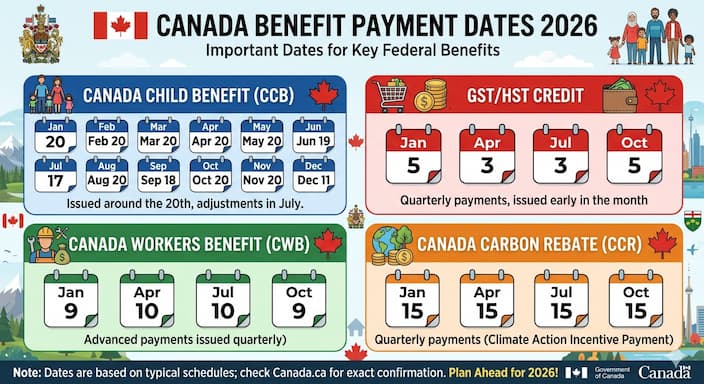
The published 2026 payment dates are:
-
January 12, 2026
-
July 10, 2026
-
October 9, 2026
Canada’s government has not published the full 2027 payment schedule. Historically, the final installment of the annual cycle is paid around January 10. Because January 10, 2027, falls on a Sunday, January 8, 2027, may be a possible payment date. However, this date should be confirmed against the official CRA payment calendar.
For the full list across every benefit, see our Canada benefit payment dates 2026 page.
Estimated Amounts for Maximum Advance Payments
|
Recipient |
2025-based payments |
2026-based payments |
|---|---|---|
|
Single person |
About $272 |
About $278 |
|
Family |
About $469 |
About $478 |
Note: These are estimates calculated using the maximum CWB amount multiplied by 50% and divided by three. Actual payments vary depending on income and family circumstances.
Examples: The Effect of Inflation on CWB Benefit Gains
The following examples illustrate how the indexation may affect benefit amounts. They assume sufficient working income to reach the maximum before any applicable income-based reduction and do not account for the secondary earner exemption.
Example 1: Single Worker Earning $20,000 Annually
With an annual income of $20,000, the worker is below the income threshold where the basic benefit starts to decrease.
-
2025 CWB: $1,633
-
2026 CWB: $1,665
-
Total increase: $32
Example 2: Single Worker Earning $30,000 Annually
In 2025, a worker with a $30,000 income receives approximately $1,161.
Calculation:
$1,633 − (15% × ($30,000 − $26,855)) = approximately $1,161.
In 2026, a worker with the same income receives approximately $1,274.
Calculation:
$1,665 − (15% × ($30,000 − $27,392)) = approximately $1,274.
– Total increase: Approximately $113
Example 3: Family Earning $40,000 Annually
In 2025, a family with an annual income of $40,000 receives approximately $1,409.
Calculation:
$2,813 − (15% × ($40,000 − $30,639)) = approximately $1,409.
In 2026, a family with the same income receives approximately $1,557.
Calculation:
$2,869 − (15% × ($40,000 − $31,251)) = approximately $1,557.
– Total increase: Approximately $148
These examples show that the gains can be greater for people in the phase-out income range than for those receiving the maximum benefit. This is because the income thresholds also increase, meaning less of their income falls above the reduction threshold.
Qualifying for Canada Workers Benefit (CWB) in 2026
To qualify for the Canada Workers Benefit, you generally need to meet the following conditions:
-
Be a resident of Canada throughout the tax year.
-
Be at least 19 years old, or live with a spouse, common-law partner or child.
-
Earn at least $3,000 in working income through employment, business or self-employment.
-
Have adjusted net income below the applicable income limit.
-
Meet the program’s student eligibility rules. Full-time students without eligible dependants generally do not qualify.
Eligibility also depends on your individual circumstances and the applicable CRA rules.
Tips on How to Get the Most Out of Your CWB
There are several steps you can take to make sure you receive the benefit you are eligible for.
1. File Your 2026 Tax Return on Time
Even if your income is low, the CRA needs an assessed tax return to calculate your CWB entitlement.
2. Complete Schedule 6
Most tax software completes Schedule 6 automatically. Make sure the form is included and the calculated amount is reported on line 45300, where applicable.
3. Check Your Direct Deposit Information
Make sure your direct deposit details are up to date in CRA My Account.
If you are unsure about the difference between your CRA account and your Service Canada account, read our My Service Canada Account vs CRA My Account guide.
4. Report Changes in Your Family Situation
Keep the CRA updated about significant changes, such as marriage, separation or having a child. This helps keep your benefit calculations accurate and may prevent overpayments.
5. Check Your Disability Tax Credit Eligibility
If you qualify for the Disability Tax Credit, you may also qualify for the CWB disability supplement, provided you meet the other applicable requirements.
Upcoming: The 2027 Inflation Adjustments
The CRA typically announces the following year’s indexation figures later in the year. Until the official 2027 figures are available, the 2026 amounts are the relevant figures for the 2026 tax year.
The CRA usually announces the next year’s indexation factor in late November, so the 2027 numbers should be public soon. Until then, 2026 is the latest confirmed set. For a wider look at everything rising this year, see our Canada benefit increase 2026 roundup. If you’re also tracking pensions, our CPP payment dates 2026 and OAS payment dates 2026 guides have the monthly schedules, and families can look at the Canada Education Savings Grant 2026.
Conclusion
The Canada Workers Benefit indexation for 2026 increases the maximum basic benefit to $1,665 for single individuals and $2,869 for families. The disability supplement increases to $860, while the income thresholds also rise by approximately 2%.
This is a positive development for eligible workers, particularly those in the phase-out income range. However, the updated amounts will not appear in advance payments until the new payment cycle begins in July 2027.
The key steps are to file your 2026 tax return, complete Schedule 6 and keep your information up to date with the CRA.
Frequently Asked Questions
What Is Canada Workers Benefit Indexation 2026?
It is the 2.0% inflation adjustment to the Canada Workers Benefit for the 2026 tax year. The maximum basic amount increases to $1,665 for singles and $2,869 for families, while the applicable income thresholds also rise.
When Will the Canada Workers Benefit Increase Start?
The updated amounts apply to the 2026 tax return filed in 2027. Advance payments based on the new assessment are expected to begin in July 2027. Payments from July 2026 to January 2027 continue to use the 2025 amounts.
How Much Is the Maximum Canada Workers Benefit in 2026?
The maximum basic CWB for the 2026 tax year is $1,665 for single individuals and $2,869 for families. Eligible recipients may also qualify for a disability supplement of up to $860.
Why Didn’t My October 2026 CWB Payment Increase?
The October 9, 2026, payment belongs to the advance payment cycle based on the 2025 tax year. The updated 2026 amounts apply after the relevant tax return is filed and assessed.
What Are the Advanced Canada Workers Benefit Payment Dates?
The published 2026 dates are January 12, July 10 and October 9. The next installment is expected around January 2027, but the exact date should be confirmed through the CRA’s official payment calendar.
Do I Need to Apply Separately for the CWB?
You generally claim the benefit by filing your income tax return and completing Schedule 6. The CRA calculates your entitlement based on your return and eligibility. Advance payments are subject to the applicable program rules.
Who Benefits Most From CWB Indexation?
Eligible workers whose adjusted net income falls within the phase-out range may see a larger increase than those receiving the maximum benefit. The revised income thresholds can reduce the amount by which their benefit is phased out.
Stay updated with the latest Canada government benefits, payment dates, and CRA news — explore more guides at Benefits Pulse Hub.