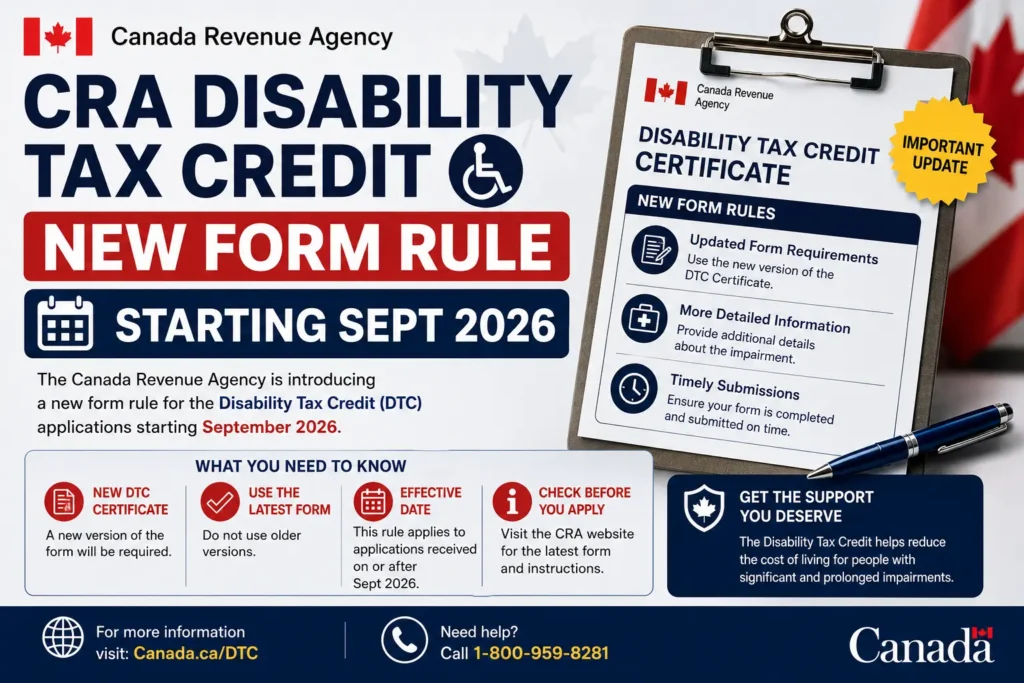
If you’re planning to apply for the CRA Disability Tax Credit using a paper form, there’s a deadline you can’t afford to miss. The CRA has confirmed it will stop accepting outdated versions of Form T2201 starting September 8, 2026 (some CRA-sourced reports cite September 6) — and a separate change already restricted how applicants can submit CRA Disability Tax Credit documents online, effective back in July. This guide covers exactly what’s changing, why, what to do if you have an old form sitting around, and how the Disability Tax Credit fits into the wider landscape of federal disability support in 2026.
This is a procedural update — for the complete Disability Tax Credit eligibility guide, amounts, and how to apply from scratch, see our Disability Tax Credit Canada 2026 guide.
What’s Changing With the CRA Disability Tax Credit
The Canada Revenue Agency updated the Disability Tax Credit application form, Form T2201, and confirmed it will stop accepting versions dated before 2023 starting in September 2026. This is part of a broader push to speed up processing times and cut down on incomplete or outdated submissions clogging the system. Two separate procedural changes are involved, on two different timelines:
1. Submit Documents Restriction — Already in Effect (July 14, 2026)
Since July 14, 2026, applicants can no longer use the general “Submit Documents” section inside CRA My Account to send new DTC applications or supporting materials, unless the CRA has specifically requested more information from them directly. If you’re applying for the DTC now, you’ll need to use the dedicated online DTC application form inside CRA My Account, or submit a paper application by mail instead. This change alone has already caught out a number of applicants who were used to the older, more flexible upload process.
2. Pre-2023 Form T2201 Rejected (September 2026)
Starting on the confirmed cutoff date, the CRA will stop accepting any paper Form T2201 published before 2023. The publication year appears in brackets in the bottom-left corner of the form — for example, T2201E (23). If you submit an outdated version after the deadline, your application won’t be accepted, and you’ll need to start over with the current version, which can add weeks or months to your approval timeline.
Why the CRA Is Making These Changes
Both changes are aimed at the same underlying problem: too many incomplete or outdated DTC submissions were slowing down processing for everyone. The pre-2023 forms don’t reflect updated certification language and sections that align with current medical and legislative requirements, so applications submitted on them frequently needed to be sent back for correction — creating delays for the applicant and additional workload for CRA staff reviewing submissions. By enforcing a hard cutoff and centralizing document intake through a dedicated online form, the CRA is aiming to reduce back-and-forth and get more applications processed correctly the first time.
What to Do If You Have an Old Form
- Check the version year printed in the bottom-left corner of your copy of Form T2201.
- Discard anything printed before 2023 — before the deadline, the CRA has generally been returning outdated forms for revision, which adds delay; after the deadline, they won’t be processed at all.
- Download the current version directly from canada.ca rather than reusing a saved copy from your computer, since older saved PDFs are exactly what’s being phased out.
- Apply online through CRA My Account where possible — the digital DTC application always uses the current version automatically, so this issue doesn’t apply if you’re applying digitally. If you haven’t set up your account yet, see our CRA My Account 2026 guide for step-by-step registration instructions.
- If you’re helping a family member apply, make sure any medical practitioner completing the form on their behalf is also working from the current version — clinics sometimes have older printed stock on hand.
A Refresher: What the CRA Disability Tax Credit Actually Is
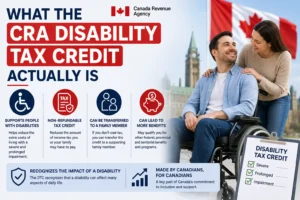
The CRA Disability Tax Credit is a non-refundable tax credit designed to reduce the amount of income tax that people with a severe and prolonged physical or mental impairment — or their supporting family member — may have to pay. To qualify, a medical practitioner must certify on Form T2201 that the applicant has an impairment that meets the criteria set out under the Income Tax Act: the impairment must be severe, and it must be prolonged, generally meaning it has lasted or is expected to last for a continuous period of at least 12 months.
Qualifying impairments generally fall into categories such as:
- Vision
- Speaking
- Hearing
- Walking
- Eliminating (bowel or bladder functions)
- Feeding
- Dressing
- Mental functions necessary for everyday life
- Life-sustaining therapy
You don’t need to have a single, specific diagnosis on an approved list to qualify — what matters is how significantly the impairment restricts your ability to perform basic activities of daily living, as assessed and certified by your medical practitioner.
2026 Disability Tax Credit Amounts
Separate from these procedural changes, the DTC dollar value is indexed annually for inflation. For the 2026 tax year:
| Component | 2026 Amount |
|---|---|
| Federal base amount | $10,341 |
| Maximum federal tax reduction | Up to $1,448 |
| Under-18 supplement | $6,032 |
| Under-18 additional credit | Up to $844 |
| Federal credit rate | 14% |
Most provinces and territories also offer a parallel provincial disability amount, which is claimed alongside the federal credit and calculated separately using each province’s own rate and base amount — so your total tax relief is typically higher than the federal figures alone suggest. If a household includes more than one DTC-approved family member, each qualifying individual generally has their own separate claim, and unused portions of the credit can sometimes be transferred to a supporting spouse, common-law partner, or parent when the person with the disability doesn’t have enough taxable income to use the full credit themselves.
Retroactive Claims: You May Be Owed More Than You Think
One of the most underused aspects of the DTC is retroactive adjustment. If your application is approved and your medical practitioner certifies that your impairment existed in previous years, the CRA can automatically reassess up to 10 previous tax years, potentially triggering a significant lump-sum refund. This is worth keeping in mind if you’re applying now for a condition that’s existed for years but was never formally certified — don’t assume the credit only applies going forward.
A Streamlined Process Is Also Coming for Some Conditions
Beyond the form-version deadline, a proposed reform would streamline certification for individuals with one of more than 40 formally diagnosed, long-lasting medical conditions — including Alzheimer’s disease, dementia, Down syndrome, advanced Parkinson’s disease, and ALS. Under the current system, a medical practitioner must complete a detailed form explaining exactly how the condition affects daily living, even when the impact is medically self-evident. Under the proposed streamlined route, a practitioner for a listed condition would only need to certify the diagnosis itself, without detailing severity or daily-living impact — expected to meaningfully speed up approvals for tens of thousands of applicants once fully in effect. A related, separate change also expands which healthcare professionals can certify certain sections of the form starting in 2027, including podiatrists, occupational therapists, physiotherapists, and speech-language pathologists for conditions within their scope of practice.
Common Reasons DTC Applications Get Rejected
Understanding why applications get denied can help you avoid a lengthy resubmission process:
- Insufficient detail from the medical practitioner — a diagnosis alone isn’t enough; the form needs to clearly describe how the impairment restricts daily functioning.
- Impairment doesn’t meet the “prolonged” threshold — conditions expected to resolve in under 12 months typically don’t qualify.
- Using an outdated form version — increasingly relevant given the September 2026 cutoff discussed above.
- Incomplete sections — missing signatures, dates, or practitioner licensing information can stall an otherwise valid application.
- The impact described doesn’t meet the legislated severity threshold, even if the underlying condition is genuine and significant to the applicant’s daily life.
If your application is denied, you have the right to request a review or file a formal objection — a denial isn’t necessarily final, particularly if the original submission was thin on detail.
Why Getting Your DTC Approved Matters Beyond the Tax Credit Itself
An approved DTC certificate isn’t just a tax credit on its own — it’s the key that unlocks eligibility for several other programs:
- The Canada Disability Benefit, which also introduced a new $150 one-time supplemental payment starting September 1, 2026 to help offset the cost of getting a DTC certificate in the first place — see our full breakdown in Canada Disability Benefit: $150 Supplemental Payment Starting September 1, 2026
- The Registered Disability Savings Plan (RDSP), a long-term savings vehicle with matching government grants and bonds available only to DTC-approved individuals
- The Canada Child Disability Benefit, for families with a child who has an approved DTC certificate
- The Canada Workers Benefit disability supplement, for working individuals with an approved certificate — see our Canada Workers Benefit (CWB) Payment Dates 2026 guide for how this supplement fits into the broader CWB program
- The Medical Expense Tax Credit, which some DTC-approved individuals can combine with additional eligible expenses — see our Medical Expense Tax Credit Canada 2026 guide
For the full eligibility rules, amounts, and how the base application process works, see our guide to the Disability Tax Credit Canada 2026.
How This Fits With Other Disability-Related Programs
If you’re navigating multiple disability-related benefits at once, it’s worth understanding how they connect, since the programs are administered separately despite frequently overlapping for the same household:
- The Canada Child Disability Benefit is a separate monthly payment for families raising a child with a disability — see our Canada Child Disability Benefit (CDB) 2026 guide.
- If your disability affects your ability to work and you’ve contributed to CPP, you may also qualify for a separate program entirely — see our CPP Disability Benefits 2026 guide for those eligibility rules.
- The core Canada Disability Benefit monthly payment has its own separate eligibility criteria beyond simply holding a DTC certificate — see our Canada Disability Benefit 2026 guide for the full picture.
Keeping Your CRA Disability Tax Credit Account Details Current While You Apply
Since DTC processing and any resulting refunds flow through your regular CRA account, it’s worth making sure your details are accurate before you submit. An outdated address can delay mailed correspondence about your application status, and outdated banking information can delay a retroactive refund once approved. See our guides on changing your address with the CRA and changing your banking information with the CRA if either needs an update. If you run into access issues while checking your application status online, our Common CRA Login Problems in 2026 guide covers the most frequent fixes.
Frequently Asked Questions
What is the CRA Disability Tax Credit form deadline for 2026?
The CRA will stop accepting Form T2201 versions dated before 2023 starting September 8, 2026 (reported by some CRA sources as September 6).
Can I still use my old copy of Form T2201?
Before the September cutoff, the CRA has generally returned outdated forms for revision. After the deadline, pre-2023 versions won’t be accepted at all — you’ll need the current version.
Do I need to worry about this if I apply through CRA My Account?
No. The digital DTC application inside CRA My Account always uses the current version automatically.
What changed on July 14, 2026?
The CRA restricted the general “Submit Documents” section in CRA My Account for DTC applications — you now need the dedicated online DTC form or a paper submission instead, unless the CRA specifically requested more documents from you.
Has CRA Disability Tax Credit eligibility itself changed?
No. The core eligibility rules haven’t changed — these updates affect the application process and paperwork, not who qualifies.
Will the streamlined certification process affect my current application?
Only if your condition is on the eventual approved list of 40+ long-lasting conditions, and only once that reform is fully implemented — it’s separate from the September form-version deadline.
Can I claim the CRA Disability Tax Credit for past years if I’m approved now?
Yes, if your medical practitioner certifies that your impairment existed in prior years, the CRA can reassess up to 10 previous tax years and issue a retroactive refund.
What happens if my CRA Disability Tax Credit application is denied?
You can request a review or file a formal objection — many denials stem from insufficient detail in the original submission rather than genuine ineligibility.
Conclusion
The CRA Disability Tax Credit remains one of the most valuable tax credits available to Canadians with disabilities, but the September 2026 form deadline means the paperwork side matters just as much as your eligibility. Check your Form T2201 version now, apply online through CRA My Account where possible, and don’t overlook the retroactive claim option if your impairment predates today’s application.
Stay updated with the latest Canada government benefits, payment dates, and CRA news — explore more guides at Benefits Pulse Hub.
This article is for informational purposes only. Always confirm current requirements and download the latest Form T2201 directly from canada.ca before applying.