
Last Updated: August 2026
Planning your retirement income around the Canada Pension Plan (CPP) starts with knowing exactly when your payment lands, how much you can expect, and how the numbers are actually calculated behind the scenes. This guide covers the confirmed 2026 CPP payment schedule, current contribution rates, maximum and average monthly amounts, how your start age changes your payment for life, survivor and disability benefits, and how to apply — all checked against official Government of Canada figures.
CPP Payment Dates 2026 (Confirmed Schedule)
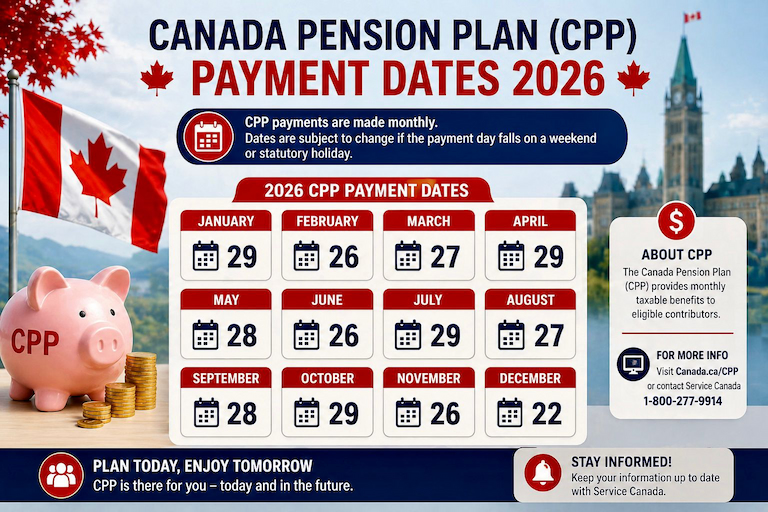
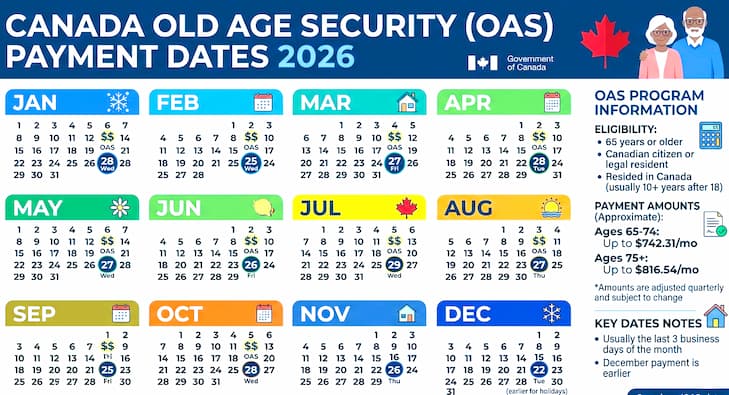
CPP is paid monthly, on the third-to-last business day of each month — the same day as Old Age Security (OAS) and the Guaranteed Income Supplement (GIS).
| Month | Payment Date (2026) |
|---|---|
| January | January 28, 2026 |
| February | February 25, 2026 |
| March | March 27, 2026 |
| April | April 28, 2026 |
| May | May 27, 2026 |
| June | June 26, 2026 |
| July | July 29, 2026 |
| August | August 27, 2026 |
| September | September 25, 2026 |
| October | October 28, 2026 |
| November | November 26, 2026 |
| December | December 22, 2026 |
December arrives earlier than usual to account for the holiday period.
👉 Direct deposit is the fastest and safest way to receive your payment. If you haven’t set it up yet, our CRA Direct Deposit Setup Guide 2026 walks you through it. If you’ve recently switched banks, see our guide on updating your banking information.
CPP Payment Amounts in 2026
- Maximum monthly CPP (starting at age 65): $1,507.65
- Average monthly CPP (new recipients at 65): $925.35
- Maximum annual CPP: $18,091.80
Very few people receive the maximum. Reaching it requires close to 39 years of contributions at or above the earnings ceiling. Most Canadians land closer to the average — roughly 58–65% of the maximum — because of career gaps, part-time work, lower-earning years, or starting CPP before turning 65.
CPP Increase in 2026
CPP benefits already being paid rose by exactly 2.0% in January 2026, tied to the Consumer Price Index (CPI). This adjustment is applied automatically — no application or action needed if you’re already collecting CPP.
How CPP Contributions Actually Work in 2026
Understanding what comes off your paycheque explains why your eventual pension is what it is. CPP has two layers in 2026:
Base CPP (CPP1):
- Contribution rate: 5.95% each for employee and employer
- Applies to earnings between the $3,500 basic exemption and the Year’s Maximum Pensionable Earnings (YMPE) of $74,600
- Maximum employee/employer contribution: $4,230.45 each
- Self-employed workers pay both portions (11.9% combined), maxing out at $8,460.90
Enhanced CPP2:
- Introduced in 2024, applies to earnings between the YMPE ($74,600) and the Year’s Additional Maximum Pensionable Earnings (YAMPE) of $85,000
- Contribution rate: 4% each for employee and employer (8% combined for self-employed)
- Maximum employee/employer contribution: $416 each
Combined 2026 maximum: An employee earning $85,000+ pays up to $4,646.45 total; a self-employed person pays up to $9,292.90.
👉 Note for Quebec residents: CPP does not apply in Quebec — workers there contribute to the Quebec Pension Plan (q pp) instead, administered separately by Retraite Québec. q pp rates and amounts are broadly similar but not identical to CPP.
How Your CPP Pension Is Actually Calculated
Your monthly amount isn’t a flat formula applied to your final salary — it’s based on your average earnings across your entire contributory period (generally age 18 to when you start CPP), adjusted through a few protective provisions:
- General “17% drop-out”: CPP automatically excludes up to 8 years (17%) of your lowest-earning months from the calculation, as long as more than 120 months of earnings remain. You don’t need to apply — it’s automatic.
- Child-rearing provision (CRDO): If you were the primary caregiver for a child under age 7, those low-or-no-income years can be excluded from your calculation. Unlike the general drop-out, you must apply for this — it is not automatic, and many parents (mostly mothers) miss out simply by not requesting it when they apply for CPP.
- Disability drop-out: Months during which you received a CPP disability pension are also excluded from your retirement pension calculation, so a period of disability doesn’t permanently drag down your eventual retirement amount.
These provisions are applied in order — child-rearing and disability drop-outs first, then the general 17% drop-out on whatever remains.
How Your Start Age Changes Your Payment
| Start Age | Maximum Monthly Amount | Change vs. Age 65 |
|---|---|---|
| Age 60 | $964.90 | −36% |
| Age 65 (standard) | $1,507.65 | Full amount |
| Age 70 | $2,140.86 | +42% |
- Before 65: reduced by 0.6% for every month you start early (7.2% per year)
- After 65: increased by 0.7% for every month you delay (8.4% per year), up to age 70
👉 If you keep working while collecting CPP and are under 70, your ongoing contributions earn a Post-Retirement Benefit (PRB), added each following January — up to $54.69/month for a full year of maximum contributions.
Who Is Eligible for CPP?
- Minimum age: 60
- At least one valid CPP contribution during your working years, from employment or self-employment income earned in Canada
- No minimum number of contribution years is required to qualify at all — but more years at higher earnings raise your monthly amount
CPP vs OAS: Quick Comparison
| Feature | CPP | OAS |
|---|---|---|
| Based on | Your contributions | Years of Canadian residency |
| Funded by | Workers & employers | General government revenue |
| Minimum start age | 60 | 65 |
| 2026 maximum (standard age) | $1,507.65/month | $751.97/month (ages 65–74) |
Most retirees qualify for both. For a full comparison, see Canada OAS Payment Dates 2026, and if you’re applying for the first time, check our step-by-step OAS application guide.
OAS Clawback: How CPP Affects It
CPP counts as taxable income toward the OAS clawback (Recovery Tax) threshold — $95,323 to $154,708 in net income for ages 65–74 in 2026, and up to $160,647 for ages 75+. Because CPP pushes up your total taxable income, the timing of your CPP start date can indirectly affect how much OAS you keep. Read our full OAS Clawback 2026 guide for strategies to manage this.
CPP Disability, Survivor, and Death Benefits
CPP isn’t only a retirement pension — it also provides support if you become disabled or if a contributor dies.
CPP Disability Benefit: Available if you’re under 65, have contributed in at least 4 of the last 6 years, and your condition is both “severe” (prevents any substantially gainful work) and “prolonged” (long-term or likely to result in death). Estimates for the 2026 maximum monthly amount vary by source (roughly $1,600–$1,740, combining a flat-rate portion and an earnings-related portion) — check your exact entitlement through My Service Canada Account. See our full CPP Disability Benefits 2026 guide for eligibility details.
CPP Survivor’s Pension: Paid monthly to the legal spouse or common-law partner of a deceased contributor. The amount depends on the survivor’s age and how much the deceased had contributed. Important rule: if you’re already receiving your own CPP retirement pension, your combined retirement + survivor benefit is capped at the maximum CPP retirement amount ($1,507.65/month in 2026) — you don’t simply add the two together without limit.
CPP Children’s Benefit: A flat monthly payment for dependent children of a deceased or disabled contributor — $307.81/month in 2026 — payable to children under 18, or under 25 if attending school full-time (in which case, for ages 18–25, the payment goes directly to the child rather than the parent).
CPP Death Benefit: A one-time lump-sum payment (historically $2,500) paid to the estate of a deceased contributor. See our full Canada Survivor Benefits 2026 guide for the complete breakdown and application process.
How to Apply for CPP
- Sign in to My Service Canada Account (MSCA)
- Complete the online CPP application
- Upload required documents
- Submit — processing generally takes several weeks
👉 Apply about 6 months before you want payments to start, to avoid delays.
Important: CPP Uses My Service Canada Account, Not CRA My Account
This is a common point of confusion. My Service Canada Account (MSCA) handles CPP, OAS, EI, and SIN. CRA My Account handles income tax, GST/HST credit, and Canada Child Benefit. The two are linked for convenience, but address changes are not automatically shared between them — you must update each separately. See our full guide: How to Change Your Address With CRA in 2026.
Receiving CPP Outside Canada
CPP continues even if you move abroad permanently. Payments can be sent by direct deposit to an eligible international bank account, and Canada has tax treaties with many countries that help prevent double taxation on your pension income.
CPP vs Personal Savings: Why It’s Rarely Enough Alone
CPP, even at the maximum, replaces roughly a third of pre-retirement income for a typical earner (the CPP enhancement phased in since 2019 raised this from 25% toward 33% over time). For most retirees, CPP and OAS together form a floor, not a full retirement income — supplementing with an RRSP, TFSA, or workplace pension is usually necessary to maintain your standard of living.
Common CPP Mistakes to Avoid
- Starting at 60 without running the break-even math first
- Not checking your Statement of Contributions in MSCA for errors before applying
- Forgetting to apply for the child-rearing drop-out provision (it is not automatic)
- Applying too close to your intended start date, which can delay your first payment
- Forgetting CPP is fully taxable income at your marginal rate
Smart Tips to Maximize Your CPP
- Review your Statement of Contributions in MSCA periodically for missing or incorrect employer reporting
- If you were a primary caregiver, apply for the child-rearing provision when you file your CPP application
- If you can afford to wait, delaying past 65 permanently increases your monthly amount
- Continue contributing while working past 65 (if under 70) to build Post-Retirement Benefits
Frequently Asked Questions
When are CPP payments in 2026?
CPP is paid monthly on the third-to-last business day — see the full schedule above.
What is the maximum CPP payment in 2026?
$1,507.65/month for someone starting at age 65 with a full contribution history. The average new recipient gets $925.35/month.
How much CPP contribution do I pay in 2026?
Employees pay 5.95% on earnings between $3,500 and $74,600 (max $4,230.45), plus 4% CPP2 on earnings up to $85,000 (max $416) — a combined maximum of $4,646.45.
Can I work while receiving CPP?
Yes, and if you’re under 70, continued contributions can boost your pension through the Post-Retirement Benefit.
Is CPP taxable?
Yes, CPP is fully taxable income.
What happens to CPP if I die?
A one-time death benefit is paid to your estate, a survivor’s pension may go to your spouse or common-law partner, and dependent children may qualify for the CPP Children’s Benefit.
Does changing my address update both CRA and Service Canada?
No. You need to update your address separately with each — see our CRA address change guide.
For the full picture of what’s arriving and when this year, see our Canada Benefit Payment Dates 2026 overview.
Pingback: GIS Payment Dates 2026: Full Schedule | Benefits Pulse Hub
Pingback: Canada Benefit Increase 2026 | Benefits Pulse Hub
Pingback: CRA Direct Deposit Setup Guide 2026 | Benefits Pulse Hub
Pingback: CPP Disability Benefits 2026 | Benefits Pulse Hub
Pingback: Cpp Payments 2026: The Future of Fast, Secure, and Intelligent Digital Transactions – benefitspulsehub
Pingback: Canada Survivor Benefits 2026: CPP Death Benefit Guide
Pingback: OAS Clawback 2026: Income Limits & How to Avoid It
Pingback: Guaranteed Income Supplement (GIS) Eligibility 2026
Pingback: OAS Payment Increase October 2026: New Amounts for Seniors
Pingback: CPP Retirement Pension Eligibility Explained in Canada
Pingback: GIS Income Limit 2026: Up to $1,138.90 Monthly + Eligibility