
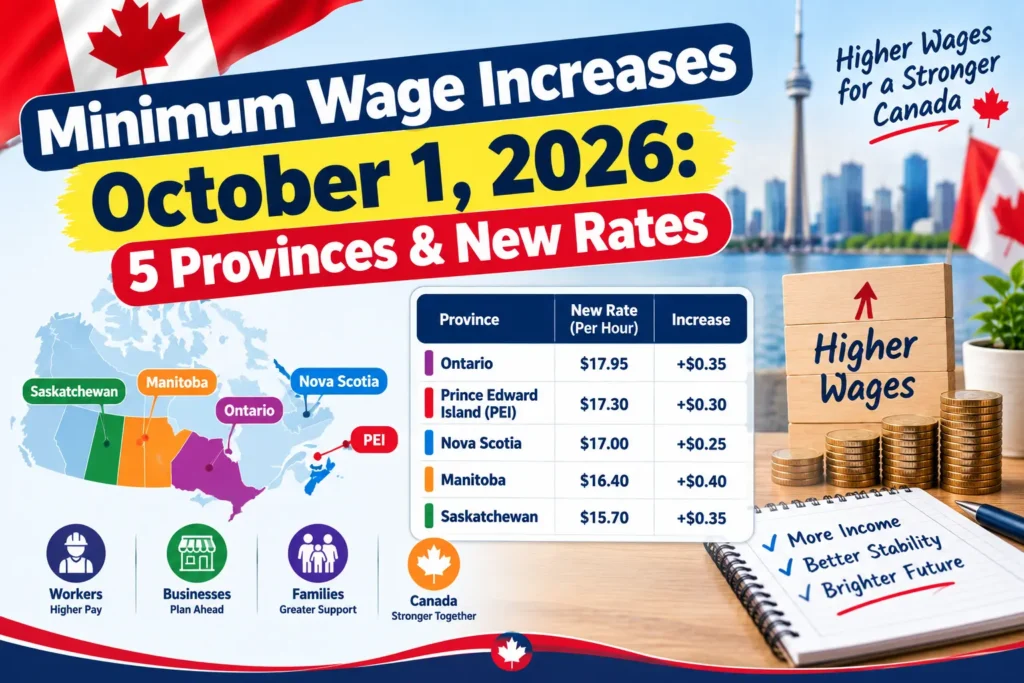
Canada’s minimum wage landscape is changing again in October 2026. On October 1, 2026, five provinces increased their general Minimum Wage Increases rates, giving thousands of workers a higher legal minimum for their hourly earnings.
The five provinces affected are Ontario, Prince Edward Island, Nova Scotia, Manitoba and Saskatchewan. The increases range from 25 cents to 40 cents per hour, depending on the province.
For employees, these changes could mean higher gross earnings and a little more room in their household budgets. For employers, the new rates mean payroll systems, employee wages and overtime calculations may need to be updated.
In this guide, we explain the October 1, 2026 minimum wage increases, the new rates in all five provinces, how much workers could earn, and what employees and employers should know.
Minimum Wage Increases October 1, 2026: Quick Overview
Here are the five provinces that increased their general minimum wage on October 1, 2026:
| Province | Previous Rate | New Rate | Increase |
|---|---|---|---|
| Ontario | $17.60 | $17.95/hour | $0.35 |
| Prince Edward Island | $17.00 | $17.30/hour | $0.30 |
| Nova Scotia | $16.75 | $17.00/hour | $0.25 |
| Manitoba | $16.00 | $16.40/hour | $0.40 |
| Saskatchewan | $15.35 | $15.70/hour | $0.35 |
These increases mean that minimum-wage workers in the five provinces will receive higher hourly pay beginning October 1.
1. Ontario Minimum Wage Increases to $17.95
Ontario’s general minimum wage increased from $17.60 to $17.95 per hour on October 1, 2026.
The Ontario government says the annual minimum wage adjustment is tied to the Ontario Consumer Price Index.
Ontario minimum wage 2026
- Previous rate: $17.60 per hour
- New rate: $17.95 per hour
- Increase: $0.35 per hour
- Effective date: October 1, 2026
For someone working 40 hours per week for 52 weeks, the $0.35 increase could equal approximately $728 more in gross annual wages.
Ontario also has different minimum wage rates for certain categories of employees, including students and homeworkers. Therefore, employees should check which minimum wage category applies to them.
2. Prince Edward Island Minimum Wage Rises to $17.30
Prince Edward Island also increased its minimum wage on October 1.
The general minimum wage moved from $17.00 to $17.30 per hour.
PEI minimum wage 2026
- Previous rate: $17.00 per hour
- New rate: $17.30 per hour
- Increase: $0.30 per hour
- Effective date: October 1, 2026
A full-time worker earning the minimum wage could see approximately $624 more in gross annual earnings, assuming 2,080 paid hours.
PEI has also announced another scheduled increase for 2027, so workers should continue checking for future changes.
3. Nova Scotia Minimum Wage Reaches $17.00
Nova Scotia’s minimum wage increased from $16.75 to $17.00 per hour on October 1, 2026.
This represents a 25-cent hourly increase.
Nova Scotia minimum wage 2026
- Previous rate: $16.75
- New rate: $17.00
- Increase: $0.25
- Effective date: October 1, 2026
For a full-time employee working 2,080 hours annually, the increase represents approximately $520 more in gross yearly earnings.
Workers should remember that gross earnings are different from take-home pay because taxes, CPP contributions, EI premiums and other deductions may apply.
4. Manitoba Minimum Wage Increases to $16.40
Manitoba recorded the largest hourly increase among these five provinces.
The province’s general minimum wage increased from $16.00 to $16.40 per hour on October 1, 2026.
Manitoba minimum wage 2026
- Previous rate: $16.00
- New rate: $16.40
- Increase: $0.40
- Effective date: October 1, 2026
For a full-time employee working 2,080 hours, the $0.40 increase could add approximately $832 in gross annual earnings.
This makes Manitoba’s increase particularly significant for workers who earn the minimum wage and work full-time hours.
5. Saskatchewan Minimum Wage Rises to $15.70
Saskatchewan’s minimum wage increased from $15.35 to $15.70 per hour on October 1, 2026.
Saskatchewan minimum wage 2026
- Previous rate: $15.35
- New rate: $15.70
- Increase: $0.35
- Effective date: October 1, 2026
A full-time minimum-wage worker could earn approximately $728 more per year before deductions, assuming 2,080 paid hours.
Saskatchewan uses an indexation formula involving changes in the Consumer Price Index and average hourly wages.
How Much More Can Minimum Wage Workers Earn?
The actual increase depends on the number of hours an employee works.
For comparison, assuming 40 hours per week and 52 weeks per year, the approximate gross increase would be:
| Province | Hourly Increase | Estimated |
|---|---|---|
| Annual Increase | ||
| Ontario | $0.35 | $728 |
| PEI | $0.30 | $624 |
| Nova Scotia | $0.25 | $520 |
| Manitoba | $0.40 | $832 |
| Saskatchewan | $0.35 | $728 |
These figures are estimates and do not represent take-home pay.
Someone working part-time would receive a smaller annual increase, while overtime or additional paid hours could change the calculation.
How Minimum Wage Increases Could Affect Household Budgets
For workers earning minimum wage, even a relatively small hourly increase can make a difference over an entire year.
Additional gross income may help households manage expenses such as:
- Groceries
- Rent
- Utilities
- Transportation
- Childcare
- Debt payments
- Savings
- Emergency expenses
However, minimum wage is only one part of a household’s overall financial situation.
Eligible low-income workers may also qualify for other government support. For example, the Canada Workers Benefit can provide tax-related financial assistance to eligible workers.
👉 Read more: Canada Workers Benefit 2026: Payment Dates & Eligibility
This makes the CWB guide a useful resource for workers who want to understand how employment income and government benefits may fit together.
Canada Benefit Increases Can Also Affect Household Income
Minimum wage isn’t the only financial change Canadians should watch in 2026.
Government benefit amounts can also change because of inflation adjustments, eligibility rules and annual program updates. Depending on their circumstances, Canadians may receive benefits that supplement employment income.
If you’re tracking changes to Canadian government benefits alongside your wages, check our complete guide to Canada Benefit Increase 2026:
👉 Explore the latest benefit changes: Canada Benefit Increase 2026
Understanding both wage changes and benefit changes can give households a clearer picture of their overall income for the year.
Check Canada Benefit Payment Dates 2026
Workers who receive government benefits may also want to keep track of payment schedules.
Payment dates can be especially important for households that combine employment income with government benefits. Knowing when expected payments are scheduled can make monthly budgeting easier.
For a broader calendar of Canadian government benefit payments, see:
👉 Check the Canada Benefit Payment Dates 2026: Canada Benefit Payment Dates 2026
This can help readers plan around benefit payments, employment income and other household expenses.
Does a Minimum Wage Increase Mean Everyone Gets a Raise?
No.
A minimum wage increase does not automatically mean every employee receives a raise.
The minimum wage is the legal wage floor for covered employees. If an employee already earns more than the new minimum wage, their employer generally does not have to increase their pay simply because the minimum wage changed.
For example, an employee earning $22 per hour would not automatically receive an additional $0.35 per hour because Ontario’s minimum wage increased by $0.35.
However, an employee whose wage was below the new legal minimum must generally receive at least the applicable minimum wage.
Special rules can also apply to particular occupations and categories of workers.
What Happens If Your Pay Period Crosses October 1?
This is an important issue for employees who receive weekly or biweekly paycheques.
Suppose a pay period starts in September and continues into October.
The employer may need to calculate wages based on the applicable minimum wage for the hours worked before and after the effective date.
For example:
- September 28–30 → previous applicable rate
- October 1 onward → new applicable rate
Employees should therefore look at the hours worked, not simply the date printed on the paycheque.
If something appears incorrect, keep your pay stub and time records and check the employment standards rules in your province.
What Employers Need to Do
Employers in the five provinces should review their payroll systems following the October 1 changes.
Businesses should check:
- Employee hourly rates
- Payroll software
- Overtime calculations
- Pay-period calculations
- Employment contracts
- Wage tables
- Job advertisements
- Commission arrangements
- Payroll budgets
Employers should also review provincial employment standards rules because minimum wage requirements can interact with overtime, vacation pay, holiday pay and other workplace standards.
What About Alberta?
Alberta is not one of the five provinces receiving a general minimum wage increase on October 1, 2026.
This is important because the October 1 changes do not apply across all of Canada.
Each province and territory has its own employment standards rules and minimum wage schedule. Some jurisdictions have increases that take effect on different dates.
Therefore, employees should always check the minimum wage that applies specifically to their province and employment situation.
Federal Minimum Wage vs. Provincial Minimum Wage
Canada does not have one single minimum wage that applies to every worker in the country.
There is a federal minimum wage for employees working in federally regulated sectors, while most other workers are covered by provincial or territorial employment standards.
Federally regulated industries can include areas such as banking, telecommunications and interprovincial transportation.
This means that determining the correct minimum wage requires knowing which jurisdiction regulates your employment.
What Should Minimum Wage Workers Do After October 1?
If you’re working in one of the five provinces affected by the October 2026 changes, consider these steps:
1. Check your hourly wage
Make sure your rate reflects the new applicable minimum.
2. Review your pay stub
Check the hours, hourly rate and gross earnings.
3. Check overtime
If you worked overtime, make sure the applicable overtime rules were followed.
4. Keep your records
Save your pay stubs and work-hour records.
5. Review available benefits
If your income is relatively low, check whether you may qualify for programs such as the Canada Workers Benefit.
6. Check future wage changes
Minimum wage rates can change again, so employees should stay updated with their province’s employment standards information.
Frequently Asked Questions
Which provinces increased minimum wage on October 1, 2026?
The five provinces are Ontario, Prince Edward Island, Nova Scotia, Manitoba and Saskatchewan.
What is Ontario’s minimum wage in October 2026?
Ontario’s general minimum wage is $17.95 per hour beginning October 1, 2026.
What is Manitoba’s minimum wage in October 2026?
Manitoba’s minimum wage is $16.40 per hour beginning October 1, 2026.
What is Saskatchewan’s minimum wage in October 2026?
Saskatchewan’s minimum wage is $15.70 per hour beginning October 1, 2026.
What is Nova Scotia’s minimum wage in October 2026?
Nova Scotia’s minimum wage is $17.00 per hour beginning October 1, 2026.
What is PEI’s minimum wage in October 2026?
Prince Edward Island’s minimum wage is $17.30 per hour beginning October 1, 2026.
Does the minimum wage increase apply to every worker?
No. Minimum wage rules apply to covered employees who are subject to the applicable employment standards legislation. Some occupations and worker categories may have different rules or rates.
How much more will minimum wage workers earn?
For a full-time schedule of 40 hours per week and 52 weeks per year, the estimated gross annual increase ranges from approximately $520 to $832, depending on the province.
Final Thoughts
The October 1, 2026 minimum wage increases are an important change for workers and employers in Ontario, Prince Edward Island, Nova Scotia, Manitoba and Saskatchewan.
The new general rates are:
- Ontario — $17.95/hour
- PEI — $17.30/hour
- Nova Scotia — $17.00/hour
- Manitoba — $16.40/hour
- Saskatchewan — $15.70/hour
For full-time minimum-wage employees, these increases could mean hundreds of dollars in additional gross earnings over a year.
At the same time, workers should look beyond their hourly wage and consider other sources of financial support. The Canada Workers Benefit, government benefit increases and scheduled payment dates can all be important when planning a household budget.
For that reason, readers can also explore the Canada Workers Benefit 2026 guide, Canada Benefit Increase 2026 guide and Canada Benefit Payment Dates 2026 guide for additional information.
Important: Minimum wage rules can vary according to province, occupation and worker category. Always verify the applicable employment standards requirements before making payroll or employment decisions.
Stay updated with the latest Canada government benefits, payment dates, and CRA news — explore more guides at Benefits Pulse Hub.