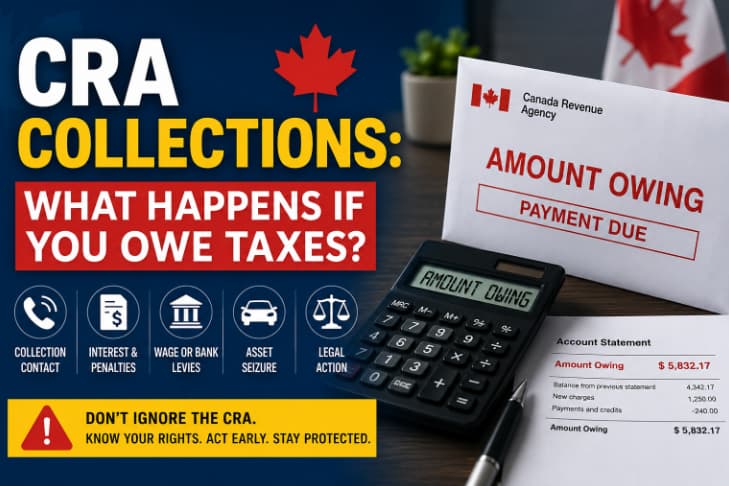
Owing money to the Canada Revenue Agency (CRA) can feel really stressful, especially when you are not completely sure what happens next. CRA Collections: What Happens If You Owe Taxes? is a question a lot of Canadian taxpayers ask when they get a tax bill they cannot pay all at once. Many people worry about things like persistent collection calls, wage garnishments, bank accounts that might get frozen, and sometimes even legal action. The CRA does have pretty strong powers to recover unpaid taxes, though if you know the way the collections process works, you can jump in earlier. That way you can try options to settle your tax debt before it starts getting more serious.
This guide, CRA Collections: What Happens If You Owe Taxes? walks through how the CRA collections system operates, what steps the agency typically takes when a balance stays unpaid, and what choices taxpayers have when they can’t pay the full amount right away.
Whether you owe personal income tax, self employment taxes, GST/HST, payroll deductions, or other amounts managed by the government, knowing the way CRA collections operate can help you protect your finances and resolve your tax debt more effectively.
What Is CRA Collections?
CRA Collections is basically the section in charge of recovering unpaid tax debts that are owed to the Government of Canada.
If a taxpayer does not pay their tax balance by the deadline , the CRA may start collection work to get back the still owing amount.
These collection actions can go from straightforward reminder notices, and phone calls, to more heavy measures like wage garnishments, freezing a bank account, or even taking the matter to court.
The goal of collections is not really to shame or punish anyone. It is to make sure the outstanding tax debts are repaid, in line with Canadian tax rules.
When does the CRA start collections?
The collections usually kick in after:
- a tax return has been assessed
- a balance stays unpaid after the due date
- several payment reminders have been sent
- no payment plan or arrangement has been agreed
The precise timing can vary, depending on the amount involved and the taxpayer’s personal situation.
Many taxpayers mistakenly assume the CRA will wait months before it even looks into anything. In real life, collection efforts can start pretty quickly once the payment deadline has passed.
The First thing: CRA payment reminders
Before the CRA goes ahead with more aggressive collection steps, it usually tries to reach you first.
You might get:
- Reminder letters
- Collection notices
- Electronic messages through CRA My Account
- Phone calls from CRA representatives
These messages typically outline:
- Your balance that is still owing
- The interest amount being added
- The payment cut-off dates
- Payment choices that are still available
If you ignore these reminders, it often leads to stronger collection measures later.
CRA Collections: What Happens If You Owe Taxes?: Interest keeps building up
One of the most important points people should grasp is that an unpaid tax amount keeps collecting interest.
Interest usually:
- Builds day by day
- Applies to anything still unpaid
- Keeps going until the whole debt has been paid
So the longer that balance sits, the more the total debt grows, and it can get surprising fast.
Before contacting collections, maybe just check your account balance first by going through our guide How to Read Your CRA Account Statement so you can get a clearer view of the taxes, penalties, and interest that appear on your file.
CRA Collections: What Happens If You Owe Taxes?: What Happens If You Ignore CRA Collection Notices
Ignoring CRA collection notices tends to be one of the more serious errors a taxpayer can make.
The CRA has wide legal authority to recover unpaid tax debts.
When the usual communication attempts do not work, the CRA can move ahead with tougher collection steps and stronger enforcement.
In many cases, the agency prefers voluntary repayment, but it can take action without always needing a court judgment.
CRA Collections: What Happens If You Owe Taxes?: CRA Collections Officers
Once your account is placed into active collections, you may end up with a collections officer assigned to your matter.
This collections officer might
- Reach out by phone
- Ask for financial details
- Talk through repayment options
- Go over your income and expenses
- Set up or review payment arrangements
The officer is trying to figure out how that debt can be dealt with, resolved somehow.
If you are being cooperative , it usually helps you get more flexible repayment options, even if at first it feels rigid.
Payment arrangements can help
A lot of taxpayers simply cannot cover their whole tax debt right away.
In those situations, the CRA may approve a payment arrangement, that lets you pay back over time.
This kind of payment arrangement is normally based on:
- Income
- Expenses
- Assets
- Your ability to pay
If you are a taxpayer struggling with an outstanding balance, you should read our article on CRA Payment Arrangements Explained, to understand how payment plans can help avoid collection action.
CRA Collections: What Happens If You Owe Taxes?: Wage garnishment
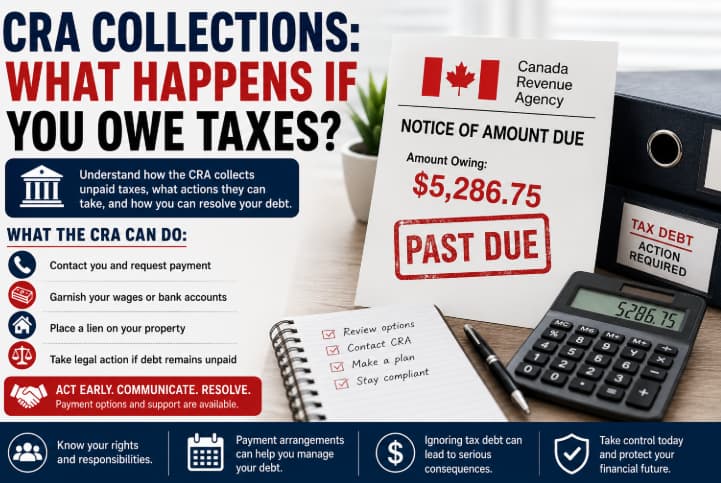
One of the more serious collection actions the CRA can use is wage garnishment.
With a garnishment, the CRA can require your employer to send a portion of your wages directly to the government.
In many cases, the CRA can issue a legal requirement to pay, without needing a separate court order.
Possible consequences include:
- Reduced take-home pay
- Ongoing deductions
So, there can be financial hardship if this is not handled quickly, because wage garnishments often just keep running until the debt is paid in full, or until some different arrangement gets approved.
CRA Collections: What Happens If You Owe Taxes?: Bank account garnishment
The CRA can also direct financial institutions to turn over money held in your bank account.
This may cause a few things, like:
- Frozen funds
- Limited or restricted account access
- The ability to withdraw only what is left, or sometimes not at all
- Major disruption to personal finances in general
Most taxpayers first realize what is happening when they try to log in or access their account, then discover they cannot get the money they expected.
Seizure of tax refunds and benefits
If you owe taxes, the CRA may take upcoming amounts that would otherwise go to you, and apply them to your balance owed.
That can include:
- Income tax refunds
- GST/HST credits
- Other qualifying government payments
Instead of sending the payment to you first the CRA might use those amounts to reduce your outstanding balance.
Liens on property
In certain cases the CRA may register a lien against property.
A lien is a legal claim against assets, such as:
- Homes
- Land
- Certain business property can be involved, maybe even indirectly
This action can mess with your ability to
- Sell property, refinance a mortgage, obtain financing
- Liens are usually used in more serious collection situations where there is quite a bit of tax debt involved
Can the CRA seize assets?
In the most severe cases, yes
If collection efforts do not work and the tax debt still stays unpaid, the CRA may move toward seizing assets
You might see examples like:
- Vehicles
- Investment holdings
- Business assets
- Other valuable property
Typically, asset seizure happens after several collection attempts have already been made and didn’t get results
What happens if you cannot afford to pay?
Financial hardship does not automatically remove a tax debt
Even so, the CRA does acknowledge that some taxpayers are dealing with real financial strain
If you cannot pay:
- Reach out to the CRA right away
- Explain what your situation looks like
- Share financial information if they ask for it
- Talk through repayment options
Usually waiting makes everything harder later on
Taxpayer relief provisions
In a few certain situations, taxpayers might be able to get relief from penalties and interest , even though it feels a bit confusing at first.
For example, this can happen with:
- Serious illness
- Natural disasters
- Financial hardship
- Extraordinary circumstances that are beyond your control
Taxpayer relief does not erase the original tax debt itself , but it can lower the extra charges that get added later.
Every request is checked on its own, so one outcome is not automatically the same for everyone.
How Long Can the CRA Collect a Tax Debt?
The CRA usually has legal time limits for collection work , however there are multiple factors that can shift these timelines.
Things that can make collection periods last longer include:
- Payment arrangements
- Legal proceedings
- Acknowledgment of the debt
- Some collection actions
Since the limitation rules can be intricate, people who owe a meaningful amount may want to talk with a professional adviser before they act.
How to Avoid CRA Collections
The simplest way to avoid collections is to deal with tax problems early , before they become louder.
A practical approach is to:
File Your Tax Returns on Time
Even if you cannot pay right away, sending things in on time can lessen penalties, sometimes by a noticeable amount
Respond to CRA Notices
If you ignore communications, it often escalates faster than people think, and then it becomes more complicated.
Make Partial Payments
Any payment counts, it can reduce interest costs and the balance that is still owed, even if it is only a smaller amount.
Request a Payment Arrangement
Talking first is a strong sign that you want to resolve the debt in good faith, and it can slow down the process.
Keep Future Tax Obligations Current
Staying compliant helps stop new balances from stacking up later, instead of letting the situation snowball.
CRA Collections: What Happens If You Owe Taxes?: Common Mistakes Taxpayers Make
A lot of collection problems become worse because people:
- Ignore CRA letters
- Avoid making phone calls
- Fail to file returns
- Miss payment arrangement deadlines
- Assume the debt will disappear
- Wait until enforcement action begins
When tax debt gets addressed early, the results usually end up better, with more options available.
Frequently Asked Questions
Can the CRA garnish wages?
Yes. The CRA can require employers to remit a portion of wages directly toward unpaid tax debt.
Can the CRA freeze my bank account?
The CRA can send legal requirements that might lead to money being taken from your bank accounts, yeah it can happen.
Will the CRA take my tax refund ?
Yes. Tax refunds and some government payments may be used to clear unpaid tax debts.
Can I stop CRA collections?
In a lot of situations, collection actions can be prevented or lowered if you reach out to the CRA, and arrange a payment plan.
Does the CRA charge interest on unpaid taxes?
Yes. Interest keeps accruing each day until the full amount is paid.
Final Thoughts
Understanding CRA Collections: What Happens If You Owe Taxes? is important for anyone dealing with a tax balance that is still outstanding. Even if the CRA has strong collection tools, the agency usually prefers working with taxpayers who talk openly and make real efforts toward repaying what they owe.
The most unfortunate approach is often just ignoring CRA notices, and acting like the issue will fade. Meanwhile interest keeps growing, collection actions can move up a notch, and enforcement actions may become more severe with time.
If you owe taxes and you cannot pay right away, contact the CRA as soon as you can. Then review your repayment options, and think about putting in place a payment arrangement. Taking action early may help you avoid wage garnishments, bank account seizures, and other collection measures while you work on fixing your tax debt in a responsible way.