
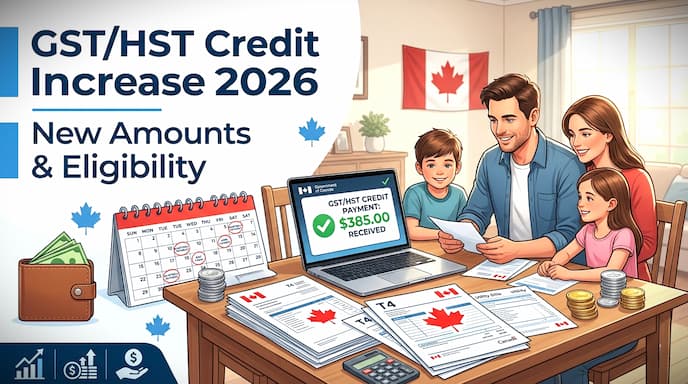
The GST/HST Credit is one of the most important tax-free benefits available to Canadians. Designed to help individuals and families offset the cost of the Goods and Services Tax (GST) or Harmonized Sales Tax (HST), this quarterly payment provides financial relief to millions of low- and modest-income households across the country. With the rising cost of living, many Canadians are wondering whether the GST/HST Credit will increase in 2026 and how much they may receive. Fortunately, the credit is adjusted regularly to reflect inflation, meaning eligible recipients may see higher payments over time.
In this guide, you’ll learn everything you need to know about the GST/HST Credit Increase 2026, including new payment amounts, eligibility rules, payment dates, how to apply, and tips to ensure you receive your payments without delay.
What Is the GST/HST Credit?
The GST/HST Credit i s a tax-free quarterly payment from the Canada Revenue Agency (CRA). Basically, it is meant to help low- and modest-income Canadians offset, or even reduce, the GST or HST they end up paying on everyday purchases.
Compared with certain other supports, there is no particular “must spend it this way” rule. Recipients are free to put the amount toward groceries, rent, utility bills, transportation, or other domestic costs.
Also, the GST/HST Credit is not taxable, so you do not need to list it as income on your tax return.
Will the GST/HST Credit Increase in 2026?
Yes, the GST/HST Credit is generally adjusted every year to reflect inflation.
As a result, payment amounts for 2026 are expected to be slightly higher than in previous years, helping Canadians cope with increasing living expenses.
Although the federal government and the CRA determine the exact amounts, annual adjustments are based on inflation data and are typically announced before the start of the benefit year.
Therefore, eligible Canadians should monitor official updates to stay informed about any increases.
Expected GST/HST Credit Amounts for 2026
What you end up receiving depends on a few things, like:
- Your family income
- Marital status
- Number of children who are under 19
- Annual benefit adjustments
In general, the GST/HST Credit tends to include:
Single Individuals
Single Canadians can qualify for a base amount, and then there are extra amounts based on their income level.
Married or Common-Law Couples
For couples, you might see a base amount for each spouse or partner, plus additional payments for eligible children.
Families with Children
Many families receive bigger GST/HST payments because the credit covers extra help for dependent children under 19.
So, in practice, households with children may notice a more noticeable rise if the payment amounts increase in 2026.
Who Is Eligible for the GST/HST Credit in 2026?
To qualify for the GST/HST Credit, you generally have to check a few boxes, and yes, there’s a bit of fine print. Here’s what usually matters:
1. Be a Canadian Resident
To qualify for the GST/HST Credit, you must live in Canada and meet the residency requirements for income tax purposes.
2. Be at Least 19 Years Old
You generally need to be 19 years old or older, or else you meet one of these conditions:
- You have a spouse or a common-law partner
- And You are a parent living with your child
3. Meet Income Requirements
The GST/HST Credit uses an income test. So the amount you get, and whether you qualify at all, depends on things like:
- Your family’s net income
- your marital situation
- How many children do you have
As your income goes up, the credit payment typically eases down, gradually.
Does Employment Affect Eligibility?
Yes, but having a job does not automatically disqualify you.
In fact, many working Canadians qualify for GST/HST Credit payments.
The key factor is:
Family Net Income
If your income remains within the eligibility range, you may continue receiving quarterly payments.
Therefore, even if you are employed full-time, it is still worth checking your eligibility.
How Is the GST/HST Credit Calculated?
The CRA calculates your credit using information from your tax return.
Important factors include:
- Adjusted family net income
- Marital status
- Number of eligible children
- Inflation adjustments
Consequently, filing your taxes every year is extremely important.
Even if you have little or no income, filing a tax return ensures the CRA can determine whether you qualify.
GST/HST Credit Payment Dates 2026
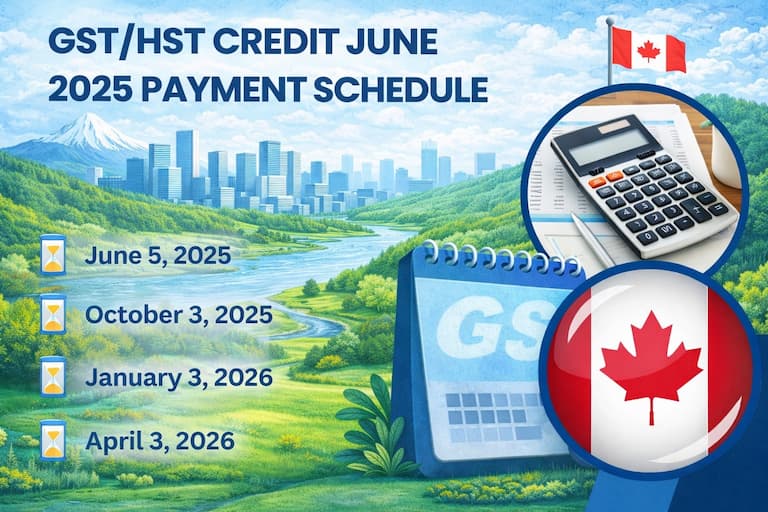
The GST/HST Credit is often handed out four times per year; it just happens like that.
Those payments are usually issued in:
- January
- April
- July
- October.
If a payment date falls on a weekend or holiday, the CRA usually sends the payment on the previous business day.
Also, people who are enrolled in direct deposit often get the funds earlier and with better reliability.
To stay updated on quarterly benefit payments, check our GST/HST Credit Payment Dates 2026 guide for the complete payment schedule.
How to Apply for the GST/HST Credit
The good news is that most Canadians don’t really have to submit a separate application, at least for the standard thing.
Instead, it’s more like this
File your Income Tax Return
The CRA will automatically decide whether you qualify based on your yearly tax return. So, making sure you file on time is pretty essential, because otherwise it can mess up the whole process.
New Residents to Canada
If you’ve recently moved to Canada, you might need to send extra forms to get set up for benefits.
After your information gets processed, the CRA will then review and figure out your eligibility.
Direct Deposit for GST/HST Payments
Direct deposit is, like, the quickest and also safest way to get your GST/HST Credit payments.
Some of the perks, yeah, with direct deposit include things like:
- Faster payments
- More secure transfers
- Less worry about lost cheques
- Easy account management
And, on top of that, you can update your banking details through your CRA account.
If you haven’t enrolled yet, follow our CRA Direct Deposit Setup Guide 2026 to learn how to receive government benefits directly in your bank account.
What Happens If Your Income Changes?
Your GST/HST Credit amount might change if:
- Your income increases
- Also, your marital status changes, or perhaps shifts unexpectedly
- You have a child, and the timing matters too
- Your family circumstances change, even a small adjustment could count
So it’s a good idea to keep your details up to date with the CRA.
If you don’t report major changes, it can lead to:
- Incorrect payments
- Delays, sometimes quite a bit
- Overpayments that you will have to repay
GST/HST Credit and Other Government Benefits
One of the larger benefits of the GST/HST Credit is that it can be mixed with other government supports, you know, and in some cases it does work that way
Getting the GST/HST Credit does not, in a straight-up way, stop you from receiving:
- Canada Child Benefit (CCB)
- Canada Housing Benefit
- GIS Benefits
- CPP Benefits
- OAS Benefits
- Canada Dental Benefit
So basically, a lot of Canadians end up with more than one benefit happening around the same period of time, at the same time, too, sometimes.
GST/HST Credit and Canada Housing Benefit
Low- and modest-income households often qualify for more than one assistance program.
For example, Canadians receiving GST/HST payments may also qualify for housing support depending on:
- Income
- Family size
- Provincial requirements
In addition to GST/HST payments, eligible households may also benefit from the Canada Housing Benefit 2026: Eligibility, Payment Amounts & How to Apply guide to explore rent assistance and housing support programs.
GST/HST Credit and Canada Benefit Increases
Many government benefits get adjusted quite a bit to keep up with inflation. As a consequence, Canadians should keep an eye on the yearly changes that may influence:
- GST/HST credit
- OAS
- CPP
- GIS
- Other federal supports
To learn which federal benefits are increasing this year, read our Canada Benefit Increase 2026: Which Payments Are Going Up? guide.
GST/HST Credit and Families
Families with little ones often end up using more than one government program, kind of patching together the monthly costs, to keep the household from tipping. So yeah, when you combine benefits, it can really boost financial stability and make things feel a bit less fragile.
In many cases, people also get programs that come around with GST/HST, like
- Canada Child Benefit
- help with housing
- dental supports
- provincial assistance programs
Common Mistakes to Avoid
Not Filing Taxes
This is one of the most common reasons Canadians end up missing GST/HST payments.
Even if you make very little income, you should still file your return.
Forgetting to Update Marital Status
Getting married, separating, or getting divorced can change what you pay or what you receive.
So, let the CRA know right away, prompt actually.
Incorrect Banking Information
If your banking details are old, it can slow down or stop payments from landing on time.
So it’s a good idea to keep your direct deposit info current at all times.
Ignoring CRA Notices
CRA letters often include important details about
- Eligibility
- Possible payment changes
- and also account updates
Always go through official notices carefully; do not just skim.
Can Seniors Receive the GST/HST Credit?
Yes.
A lot of seniors do end up qualifying for the GST / HST Credit payments, even if it’s not always obvious at first glance.
In the end, the whole eligibility thing usually hinges on things like their income, their marital status, and also their residency. Not just one piece by itself, you know.
So retirees who receive CPP, OAS, or GIS might still qualify, as long as their income level falls within the set eligibility range.
Seniors may also qualify for other support programs. Learn more in our Top Government Benefits for Seniors in Canada (2026 Guide) and stay updated with OAS Payment Dates 2026 and GIS Payment Dates 2026.
Frequently Asked Questions
Is the GST/HST Credit considered taxable?
No.
It is basically a tax-free kind of payment.
So you don’t have to count it as taxable income, or anything like that.
How often does the GST/HST Credit get sent?
In general, payments are issued in:
- January
- April
- July
- October
Do I need to do a separate application?
Most times, no.
Just filing your yearly income tax return is usually enough, so the CRA can figure out if you qualify.
Can you receive the GST/HST Credit and the Canada Housing Benefit at the same time?
Yes.
A lot of Canadians can qualify for both if they meet the requirements.
Can seniors receive the GST/HST Credit?
Yes.
If seniors are within the eligible income levels, they may also get GST/HST payments, alongside other retirement benefits, sometimes.
Final Thoughts
The GST/HST Credit Increase 2026 is pretty welcome news for a lot of Canadians dealing with higher living costs. Since the credit is tax-free and it gets updated from time to time for inflation, it still gives that solid, practical support to low and modest-income households, you know.
Also, it’s not like you have to chase it down, because your eligibility is generally worked out automatically using your tax return. That makes it simpler for Canadians to get the benefit without doing a separate application or extra forms.
Whether you’re a senior, or you’re part of a family with children, or just an individual trying to manage everyday expenses, it helps to keep up with the GST/HST payment amounts, the eligibility rules, and the payment dates. In the end, being up to date can help you maximize the financial help that’s available to you.
For the latest updates and official eligibility requirements, readers can visit the Government of Canada’s GST/HST Credit page to access accurate and up-to-date information directly from the source.
Pingback: Canada Food Inflation Relief 2026: Benefits & Support
Pingback: How to Report a Change of Income to CRA (2026 Guide)
Pingback: CRA 2% Indexation 2026 - Benefits Pulse Hub