
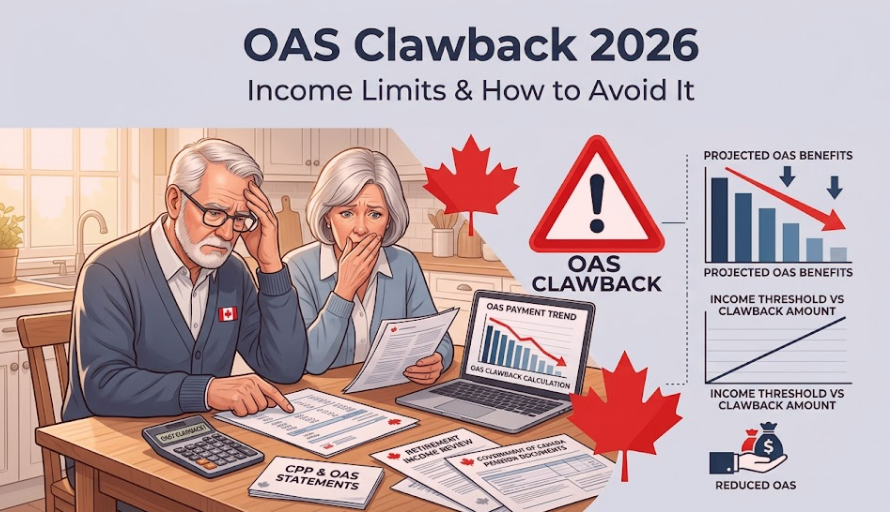
For many Canadian seniors, receiving the monthly Old Age Security (OAS) pension is a major source of retirement income. Still, if your income becomes too high, you may need to repay a part or even all of your OAS benefits through what people commonly call the OAS Clawback 2026.
It’s officially called the OAS Recovery Tax, and this guideline affects thousands of retirees each year. So, knowing how the clawback works, which income counts, and ways to reduce or bypass it, can help you keep more of what you earned for your later years.
In this guide, you’ll see the 2026 OAS clawback income limits, how the recovery tax gets calculated, real-life style scenarios, and practical tax-planning moves that can lower the impact.
What is the OAS clawback?
The OAS Clawback 2026 is a repayment mechanism that reduces your Old Age Security pension if your annual net income goes above a specific limit, kind of.
In other words, seniors with higher incomes might end up repaying part, or even all, of their OAS benefits through the tax system. The government calls this repayment the OAS Recovery Tax officially, though it’s really the same idea in plain terms.
OAS Clawback 2026 vs CPP: What’s the Difference?
Many Canadians confuse OAS with CPP.
| OAS | CPP |
|---|---|
| Funded through government tax revenues | Based on CPP contributions |
| Income-tested | Not income-tested |
| Subject to clawback | No clawback |
| Available from age 65 | Can start as early as age 60 |
Therefore, even if you receive both CPP and OAS, only OAS is subject to the recovery tax.
Unlike CPP, Old Age Security is income-tested and may be reduced if your income exceeds certain limits. To understand how CPP works alongside OAS, check our CPP Payment Dates 2026 guide.
OAS clawback income limits for 2026
So the OAS clawback starts once your net world income is above the yearly threshold, not before. For the income year 2026, the recovery tax basically kicks in at
✅ $95,323
If you remain below that number, then you keep your full OAS pension, and nothing is reduced.
But if your income is above the threshold, your OAS payments start to shrink, and the amount goes down over time.
Full OAS claw-back limits
When OAS is completely removed, it hinges on your age, and yeah, that income level changes.
Ages 65 to 74
- Clawback begins: $95,323
- Full clawback amount: roughly $154,753
Ages 75 and up
- Clawback begins: $95,323
- Full clawback amount: around $160,696
The higher threshold for seniors 75 and older makes sense because there is an extra 10% OAS uplift available to them.
What Is the OAS Recovery Tax Rate?
The recovery tax rate is
15%
So basically, you repay 15 cents per 1 dollar of what you earn above the threshold, and that keeps coming, yes, it does.
The math looks like this
(Net Income – Income Threshold) × 15%
Your recovery amount is usually subtracted from later OAS payments, so you might see it reduced in future checks or filings, depending on your situation.
OAS Clawback 2026 Example 1
Lets assume
- Annual income = $100,000
- Threshold = $95,323
Income over threshold:
$100,000 – $95,323
= $4,677
Recovery tax calculated as,
$4,677 × 15%
= $701.55
So, your OAS payments would be decreased by around $701.55 each year.
OAS Clawback Example 2
Let’s suppose your income looks like this:
$115,000
The amount that counts above the threshold is:
$115,000 – $95,323
= $19,677
Then the recovery tax is worked out as:
$19,677 × 15%
= $2,951.55
So, in the end, about $3,000 of your OAS payments might be clawed back by the government.
What Income Falls Into the OAS Clawback 2026?
A lot of retirees are caught off guard by the fact that the clawback is measured by net world income, not only by employment income, or anything as narrow. It is one of those rules that feels wider than it sounds.
In general, these kinds of income count toward it
Employment Income
If you keep working past retirement, your wage or salary counts.
- CPP Benefits
- CPP retirement benefits are included in the calculation.
- RRSP and RRIF Withdrawals
Withdrawals from:
- RRSPs
- RRIFs
are taxable, and they add to your income.
Company Pension Income
Employer pension income and retirement annuities are included, too. This can be full pension payments, plus some related benefits.
Investment Income
Investment income typically includes:
- Interest income
- Dividends
- Capital gains
- Rental income
So, even a retiree with a modest pension might end up triggering the clawback if they also have meaningful investment earnings, in a way that pushes their net world income upward.
What Income Doesn’t Count?
Good news, some income sources do not matter for the OAS clawback, at least not in the usual way.
These include, in practical terms:
TFSA Withdrawals
Money taken out of a Tax-Free Savings Account isn’t taxable.
So, TFSA withdrawals do not raise your clawback exposure.
Principal Residence Sale
When you sell your main home, it generally does not count as taxable income.
Certain Non-Taxable Benefits
Some provincial benefits, and tax-free federal programs too, may be left out of the calculation, completely excluded in many cases.
Is the OAS Clawback Based on Family Income?
No.
This is one of the most common misunderstandings; people repeat it too often.
The OAS recovery tax is based on :
Individual income
Not :
- Household income
- Combined spouse income
- Family income
Because of that, one spouse could get hit by the clawback, while the other spouse still receives the full OAS pension.
Which income year gets used?
Another area of confusion has to do with timing, and it feels a bit backwards sometimes.
The government uses the previous year’s income
For example:
- OAS payments from July 2026 to June 2027 are based on 2025 income
- OAS payments from July 2027 to June 2028 are based on 2026 income
So, careful retirement planning today can influence future OAS payments
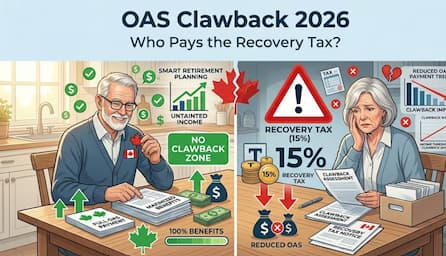
Why are more seniors getting hit by the OAS Clawback 2026
There are several reasons why more Canadians are ending up in that clawback zone, not just one thing. It looks like a mix of bigger money movements and steady life choices, sometimes even small shifts that stack over time.
- Larger RRIF withdrawals, year after year, can push income levels up
- Higher investment income, dividends and interest can quietly add up
- Continued employment after retirement, additional pay keeps counting
- Rising pension income, both public and private benefits, can climb
- Inflation-adjusted earnings, even if the real story feels unchanged
Because of this, retirement income planning has become more essential than ever before.
How to Avoid the OAS Clawback
Totally avoiding the clawback isn’t possible for everybody, but there are some ways to make it hit less hard, or at least delay the damage a bit.
Push TFSA Contributions as Much as You Can
The TFSA is one of the strongest instruments for retirees.
Why does it matter?
Because growth stays tax-free, and withdrawals are also tax-free. Plus, those TFSA withdrawals do not change OAS calculations.
So, focusing on TFSA savings could help reduce your taxable retirement income, even when other amounts move up.
Look at Pension Income Splitting
Some seniors can split certain pension income with their partner.
That can:
- Reduce each person’s taxable amount
- Lower OAS clawback exposure
- Improve tax efficiency overall
This is particularly helpful when one spouse brings in much more income than the other, or when the gap tends to stay large.
Be Careful With RRIF Withdrawals
Bigger RRIF withdrawals can suddenly raise your income above the clawback line, even if that wasn’t the intention.
So, retirees may want to
- Spread withdrawals across multiple years
- Coordinate withdrawals with the plan, not randomly
- Think about taking income earlier in a controlled way
This strategy may help smooth out your taxable income a bit.
Delay CPP or OAS when it makes sense
A few seniors decide to push those benefits out.
Depending on your retirement plan, delaying CPP or OAS can :
- Boost future payments
- Create better tax efficiency
- Lower clawback risk during those high-income years
That said, the best move depends on your own situation, and not just general timing.
If you’re planning retirement income carefully, you should also review our CPP Payment Dates 2026 guide to understand how CPP fits into your retirement strategy.
Keep an eye on investment income
Many retirees pay attention mostly to pension income.
Still, things like:
- Capital gains
- Dividends
- Interest income
may also come into play and affect the clawback. So it can help to review your investment approach regularly, in order to avoid unpleasant surprises at tax time.
OAS Clawback for People Who Keep Working Past 65
More Canadians are choosing to stay employed beyond age 65.
That can boost retirement cash flow, but it might also kick in the OAS clawback.
For instance:
A retiree getting:
- OAS
- CPP
- Employer pension
- Employment income
may end up above the annual threshold pretty fast.
Because of that, working seniors should keep an eye on their yearly earnings, really closely.
OAS Clawback 2026 and GIS
The Guaranteed Income Supplement (GIS) is aimed at lower-income seniors.
Since GIS is income-tested, people who receive GIS usually are not hit by the OAS clawback.
In practice,
GIS supports seniors with less income.
Meanwhile, the OAS clawback mainly impacts seniors with higher incomes.
So, these programs basically cover different income groups.
Seniors receiving low retirement income may qualify for GIS instead of worrying about the OAS recovery tax. Learn more in our Top Government Benefits for Seniors in Canada (2026 Guide).
Common Mistakes Seniors Often Make
Ignoring RRIF withdrawals
Big RRIF withdrawals can unexpectedly set off the clawback, so it is not just “withdraw and done”.
Forgetting about investment income
Capital gains and dividends still count toward net income, even if the cash felt invisible at first.
Waiting too long for tax planning
Retirement income moves tend to work way better when they are lined up years in advance, not after the fact.
Not using a TFSA
Tax-free withdrawals can help protect OAS eligibility, and that matters more than people think.
Frequently Asked Questions
What is the OAS clawback threshold for 2026?
The clawback starts once net world income goes past $95,323 for the 2026 income year.
How much is the OAS recovery tax?
The recovery tax is:
15% of the amount over the threshold.
Is OAS clawback based on household income?
No, it is not.
It is based on:
Individual net income only.
Do TFSA withdrawals affect OAS?
No.
TFSA withdrawals are tax-free and do not get counted in the clawback math.
Can working seniors lose the OAS Clawback 2026?
Yes.
If your total income tops the yearly threshold, OAS might be reduced, or in some cases removed entirely.
Final Thoughts
The OAS Clawback 2026, officially called the OAS Recovery Tax, is a pretty important retirement planning issue for Canadian seniors. Even though this clawback only hits higher-income retirees, it still helps to understand the income thresholds, the way taxable income is treated, and how the recovery math gets worked out. With that knowledge, you can make more sensible financial choices sooner, not later.
Good news: there are practical approaches, like using a TFSA, managing RRIF withdrawals in a deliberate way, pension income splitting, and generally planning retirement income with more care. These actions may lessen the clawback, or in some situations, prevent it completely.
If you are nearing retirement, or you already receive OAS, keeping up with the income limits and tax planning opportunities can make a real difference. It may help you protect more of the retirement income you worked hard to earn.
Pingback: Cpp Oas Payment Dates 2026 – benefitspulsehub