If you’ve been wondering whether your CPP, OAS, Canada Child Benefit, or other government payments are actually going up in 2026, the good news is these numbers are already confirmed — not vague projections. The Canada benefit increase 2026 picture is clear across every major program, and this guide breaks down the confirmed amounts, effective dates, and what you actually need to do to receive them.
Canada Benefit Increase 2026: Confirmed Amounts at a Glance
| Benefit | 2026 Increase | Effective Date |
|---|---|---|
| CPP (Canada Pension Plan) | 2% | January 2026 |
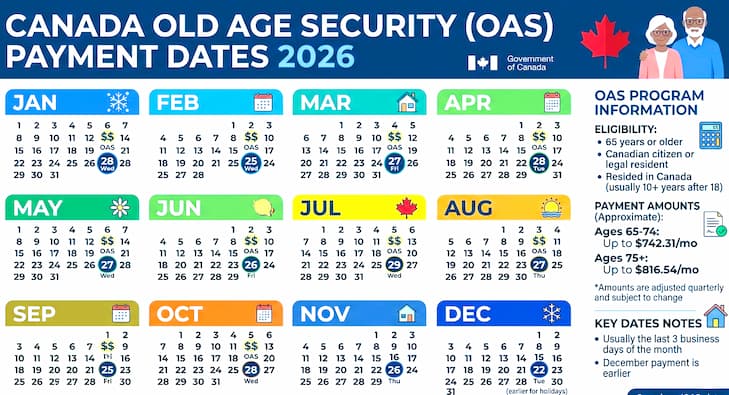
| OAS (Old Age Security) | 1.2% (Q3) then 1.4% (Q4) | Quarterly, reviewed each January, April, July, October |
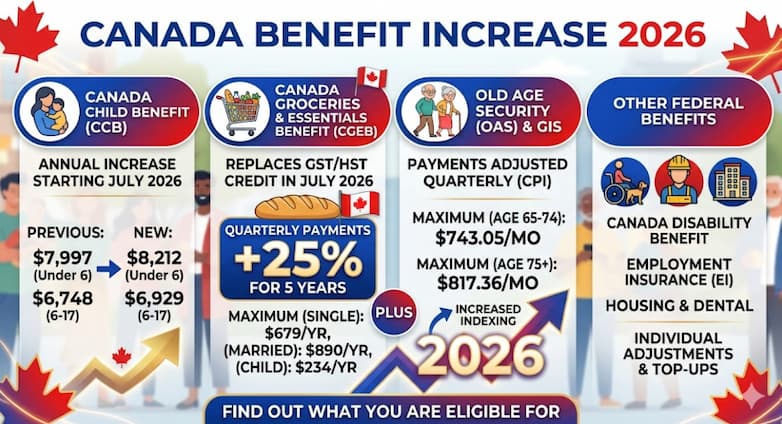
| CCB (Canada Child Benefit) | 2% | July 20, 2026 |
| CGEB (replaced GST/HST Credit) | 25% permanent increase | July 3, 2026 |
| CWB (Canada Workers Benefit) | Indexed annually | Ongoing |
| CDB (Canada Disability Benefit) | $150 one-time supplement | September 1, 2026 |
| Canada Carbon Rebate | Discontinued | No 2026 payments |
CPP Increase 2026: What Actually Changed
Unlike OAS, CPP is indexed only once a year, every January, based on the 12-month average Consumer Price Index. The confirmed 2% increase took effect January 2026, setting the maximum CPP retirement pension at age 65 to $1,507.65 per month. Most people don’t receive the maximum — the average monthly amount for new beneficiaries starting at 65 is closer to $925.35, since the full amount requires close to 39 years of contributions at or above the earnings ceiling.
This January-set rate stays fixed all year and won’t change again until January 2027. For the complete monthly payment schedule, see our CPP Payment Dates 2026 guide, and our CPP Retirement Pension Eligibility 2026 guide if you’re still deciding when to start your pension.
OAS Increase 2026: Confirmed Quarterly Adjustments
OAS works differently from CPP — it’s reviewed every quarter (January, April, July, October) against the Consumer Price Index, rather than once a year. The confirmed October-December 2026 quarter carried a 1.4% increase, the largest single jump of the year, pushing the maximum monthly amount past $762 for seniors aged 65 to 74, and above $838 for those 75 and older. For the full breakdown of how this compares to earlier 2026 quarters, see our OAS Payment Increase October 2026 guide.
CCB Increase 2026: Confirmed New Amounts
The Canada Child Benefit received its standard 2% indexation increase with the July 20, 2026 payment, raising the maximum annual amounts to:
- $8,157 for each child under 6
- $6,883 for each child aged 6 to 17
These maximums apply to families with adjusted family net income (AFNI) below $37,487, phasing out gradually above that threshold. For the full payment calendar, see our Canada Child Benefit Payment Dates 2026 guide.
GST/HST Credit Is Gone — Replaced by the CGEB
This is the biggest structural change for 2026, and a gap in a lot of older coverage: the GST/HST Credit no longer exists as a standalone program. It was replaced starting July 3, 2026 by the Canada Groceries and Essentials Benefit (CGEB), which pays a permanent 25% higher amount than the old credit, locked in for five years through 2031. For the July 2026–June 2027 benefit year, based on your 2025 tax return, you could receive:
- $679 for a single individual
- $890 for a married or common-law couple
- $234 per eligible child under 19
If you’re still seeing “GST/HST Credit” referenced anywhere, that’s outdated information — the program now operates under the CGEB name. See our complete guide to the Canada Groceries and Essentials Benefit (CGEB) 2026 for full eligibility and payment dates.
CWB Increase 2026: Confirmed Amounts
The Canada Workers Benefit is indexed annually, with current 2026 maximums reaching:
- $1,590 to $1,633 for single individuals
- $2,739 to $2,813 for families
- Up to an additional $784 to $843 for the disability supplement
The CWB is paid partly through advance instalments during the year (ACWB), rather than waiting until tax time for the full amount. See our full Canada Workers Benefit (CWB) Payment Dates 2026 guide for the complete schedule and eligibility rules.
Canada Disability Benefit: A New $150 Supplement, Not a Rate Increase
Rather than a percentage increase, the Canada Disability Benefit saw a different kind of change for 2026: a new one-time $150 supplemental payment, effective September 1, 2026, issued automatically to anyone who has ever received a CDB payment, with no separate application required. See our full breakdown in Canada Disability Benefit: $150 Supplemental Payment.
The Canada Carbon Rebate Is NOT Increasing — It’s Discontinued
If you’re still expecting a Canada Carbon Rebate payment in 2026, it’s worth knowing this program has been discontinued, with the last payments issued in early 2025. There is no 2026 Carbon Rebate deposit, quarterly or otherwise. This is a common point of confusion for anyone relying on older payment calendars.
How GIS Fits Into the Picture
The Guaranteed Income Supplement is indexed on the same quarterly schedule as OAS, since GIS is paid alongside OAS for eligible low-income seniors. If you’re trying to understand how these two work together, along with CPP, see our OAS vs CPP vs GIS Comparison guide.
Will Everyone See a Bigger Payment?
Not necessarily. Most of these increases are income-tested, meaning higher-income households see reduced amounts or phase out of eligibility entirely, regardless of the headline percentage increase. Your specific amount depends on:
- Your household income from your most recent tax return
- Your province or territory
- Your family size and the ages of any children
- Whether you’ve filed your taxes on time
How to Make Sure You Actually Receive Your Increased Benefits
A surprising number of Canadians miss out on increases simply due to outdated information on file, not ineligibility. A few essentials:
- File your taxes every year, on time — even with no income, since nearly every benefit on this list is calculated from your tax return.
- Set up or confirm direct deposit through CRA My Account, which is faster and more reliable than mailed cheques.
- Keep your address, marital status, and dependant information current with the CRA.
- Check CRA My Account regularly for notices about your specific payments and amounts.
If you haven’t set up your account yet, our CRA My Account 2026 guide covers registration and every major feature.
Why Indexation Varies So Much Between Programs
Not every benefit moves at the same rate or on the same schedule, and that’s by design. CPP adjusts once a year in January; OAS adjusts quarterly; CCB and the CRA’s other annual programs typically update every July. For the full technical breakdown of how 2026’s indexation was calculated across every major program, see our CRA 2% Indexation 2026 roundup.
See Every Payment Date in One Place
For the complete monthly calendar showing exactly when each of these increased amounts lands in your account, see our Canada Benefit Payment Dates 2026 guide.
Frequently Asked Questions
Is CPP increasing in 2026?
Yes, by 2%, effective January 2026, bringing the maximum monthly retirement pension at 65 to $1,507.65.
Is OAS increasing in 2026?
Yes. OAS is reviewed quarterly; the October-December 2026 quarter carried a confirmed 1.4% increase, the largest of the year.
Is the GST/HST Credit still being paid in 2026?
No. It was replaced by the Canada Groceries and Essentials Benefit (CGEB) starting July 3, 2026, which pays a permanent 25% higher amount.
Is the Canada Carbon Rebate increasing in 2026?
No. The Canada Carbon Rebate was discontinued, with its last payment issued in early 2025. There is no 2026 Carbon Rebate payment.
Did the Canada Child Benefit increase in 2026?
Yes, by 2%, effective with the July 20, 2026 payment, bringing maximum amounts to $8,157 per child under 6 and $6,883 per child aged 6-17.
Do I need to apply to receive these increases?
No. Most increases are applied automatically based on your filed tax return — the main exception is new applicants to programs you aren’t already enrolled in.
This article is for informational purposes only. Confirm your specific payment amounts through CRA My Account or My Service Canada Account.
Stay updated with the latest Canada government benefits, payment dates, and CRA news — explore more guides at Benefits Pulse Hub.