
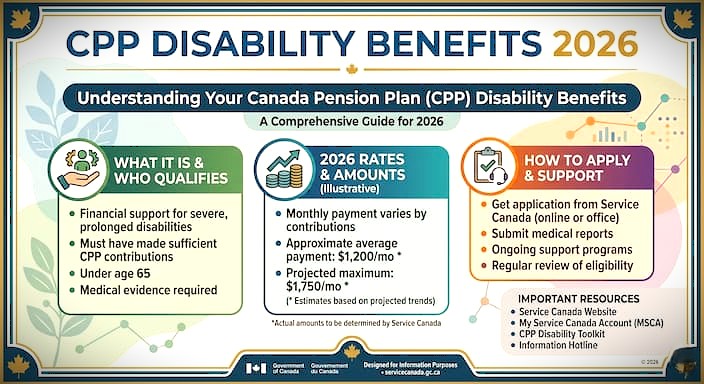
The Canada Pension Plan (CPP) Disability Benefit is one of the most important financial support programs around for Canadians who can’t keep working because of a severe and ongoing disability. In 2026, rising living costs and higher healthcare expenses still make disability support programs feel essential for lots of families across Canada. The CPP Disability Benefits provide monthly financial assistance to people who worked and contributed to the Canada Pension Plan but can no longer maintain regular employment due to a medical condition. Every year, millions of Canadians look for details on who qualifies, how much they might receive, the approval requirements, and how to apply successfully.
This full guide covers everything you should know about CPP Disability Benefits in 2026, such as eligibility criteria, payment amounts, application steps, payment dates, rules about work, how to appeal, and the most common blunders applicants should avoid.
What Is the CPP Disability Benefit?
The CPP Disability Benefit is a monthly, taxable amount that comes through the Canada Pension Plan for people who can not work regularly because of a disability. The Government of Canada and Service Canada run this program.
Compared with provincial social help programs, CPP Disability leans on your earlier CPP contributions while you were working.
“Looking for the general CPP monthly payment schedule instead of disability-specific information? See our full CPP Payment Dates 2026 guide.”
Who Can Qualify for CPP Disability Benefits in 2026?
To be accepted for CPP Disability Benefits in 2026, you have to satisfy both the medical part and the CPP contribution part, and yes, they both matter.
Medical eligibility requirements
CPP disability is based on whether your disability is considered in the right way.
It must be:
Severe
When we say severe, it means your condition blocks you from working regularly at any substantially gainful job. Like, not just a difficult week, but consistently, you cannot do the work.
This can involve:
- Physical disabilities,
- Chronic illnesses
- Mental health conditions
- Neurological disorders
- Severe injuries
Prolonged
Your disability also has to be prolonged, meaning it is
- Long-term
- Ongoing indefinitely
- Or expected to lead to death
Temporary medical situations usually do not qualify, even if they feel urgent.
CPP contribution requirements
Besides the medical side, you also need to have paid into the Canada Pension Plan enough during your working years.
In most cases, that looks like you have
- Contributed to CPP in 4 out of the last 6 years
- Or 3 out of the last 6 years, if you contributed for at least 25 years overall
Age requirements
There are also basic age rules
In general, you must be:
- Under age 65,
- And between 18 and 65 years old
When you turn 65, CPP Disability Benefits usually start converting into regular CPP retirement benefits
Medical conditions that may qualify
Eligibility depends more on how the condition affects your ability to work, rather than just the diagnosis itself
Some examples that may qualify include:
- Cancer
- Multiple sclerosis
- Severe depression
- Bipolar disorder
- Chronic pain
- Arthritis
- Stroke complications
- Heart disease
- Severe anxiety disorders
- Spinal injuries
- Neurological disorders
Service Canada reviews each file individually, so every claim is assessed on its own merits.
CPP Disability Benefits Amount in 2026
CPP Disability Benefits provide a monthly taxable income, and for some people, it feels like a steady cash flow, I guess.
The payment amount is based on a few things, like:
- Your CPP contribution history
- Your earnings during your working years
- Annual benefit adjustments, which are reviewed each year
Maximum CPP Disability Amount 2026
For 2026, the maximum monthly CPP Disability Benefit is roughly:
- $1,741.20 per month
Average CPP Disability Payment 2026
Also, the Average CPP Disability Payment for 2026 is usually less than that top figure, mainly because new beneficiaries tend to receive a lower amount.
- Recent estimates suggest average monthly payments of around $1,190–$1,210 for people just starting.
Your actual payment depends on your contribution record; that part matters the most.
How CPP Disability Payments Are Calculated
The monthly payment includes:
- Fixed basic amount
A standard monthly base payment.
- A portion tied to earnings
An extra amount based on how much you contributed to CPP during the time you were working.
People who worked longer and paid more into CPP may get higher payments.
CPP Disability Payment Dates 2026
CPP Disability payments are usually sent monthly.
Official 2026 payment dates include:
| Month | Payment Date |
|---|---|
| January | January 28, 2026 |
| February | February 25, 2026 |
| March | March 27, 2026 |
| April | April 28, 2026 |
| May | May 27, 2026 |
| June | June 26, 2026 |
| July | July 29, 2026 |
| August | August 27, 2026 |
| September | September 25, 2026 |
| October | October 28, 2026 |
| November | November 26, 2026 |
| December | December 22, 2026 |
For more information, read CPP Payment Dates 2026

When CPP Disability Payments Start
If approved, payments usually start:
- about 4 months after your disability is officially judged as severe and prolonged
Some people may also get retroactive payments, and it can feel a bit unexpected
Retroactive CPP Disability Payments
You might receive benefits from as far back as:
- 11 months before the date you applied, in certain situations
Retroactive payments can lead to large lump sum deposits
How to Apply for CPP Disability Benefits in 2026
Applicants have to send an official application to Service Canada. The process is pretty straightforward, but preparing the right information and medical documentation can make the application easier. For a detailed step-by-step guide, see our CPP Disability Benefit: How to Apply and Win Your Appeal guide.
Documents that are usually asked for, if needed, include:
- Social Insurance Number (SIN)
- Medical records and related reports
- Reports from your doctor(s)
- Work history
- Banking details
- CPP contribution history
Step-by-Step CPP Disability Application Process
Step 1: Gather Medical Information
Your healthcare provider must complete medical forms explaining:
- Your condition
- Limitations
- Prognosis
- Work restrictions
Strong medical documentation is extremely important.
Step 2: Complete Application Forms
Applicants must complete the required Service Canada forms.
This may include:
- Personal information
- Employment history
- Medical condition details
Step 3: Submit Application
Applications may be submitted:
- Online
- By mail
- Through Service Canada offices
Step 4: Wait for Review
Service Canada reviews:
- Medical evidence
- Contribution history
- Work capacity
- Eligibility rules
CPP Disability Processing Time
Processing times can vary, yes.
A lot of applicants end up saying they wait:
- From several weeks to several months
Service Canada is aiming to move many applications along within roughly 120 days.
What Happens After Approval?
If approved, you will receive:
- A decision letter,
- Monthly payment information
- Payment start date
- Benefit amount details
Payments are usually sent through direct deposit.
CRA Direct Deposit Setup Guide 2026
What If Your Application Is Denied?
Many Canadians are initially denied CPP Disability Benefits.
However, applicants may request reconsideration or appeal the decision.
CPP Disability Appeal Process
If denied, you may:
- Request reconsideration
- Submit additional medical evidence
- Appeal further if necessary
Applicants generally have:
- 90 days to request reconsideration after receiving a decision letter.
Common Reasons for CPP Disability Denials
Applications may be denied because:
- Insufficient medical evidence
- Not enough CPP contributions
- Condition not considered severe enough
- Ability to perform some type of work
- Incomplete forms
Strong medical documentation improves approval chances significantly.
Can You Work While Receiving CPP Disability?
Some limited work activity might still be allowed, I think, or at least in certain situations.
2026 Earnings Limits
In 2026, Earnings below roughly $7,400 before tax may not affect benefits. If you earn more than that, it can trigger review sessions.
Substantially Gainful Employment
Service Canada might decide you no longer qualify if your earnings show you can work regularly, and yes, consistently.
The substantially gainful threshold for 2026 is about
- $20,971 a year before tax
Three-Month Work Trial
If some recipients are returning to work, they may be eligible for a
- 3-month work trial period,
So it can help them judge whether the return to employment is really sustainable, long-term, permanent, etc.
CPP Disability and Other Benefits
Lots of Canadians ask if they can end up receiving CPP Disability together with other things, like other benefits, basically at the same time.
Programs That May Work Together
You might still be able to qualify for, or keep:
- Private disability insurance
- Provincial disability support
- Survivor benefits
- Canada Disability Benefit
- GST/HST Credit
Still, a few of these programs can lower or adjust your payments based on CPP Disability income, so it can feel a little mixed, depending on the situation.
CPP Disability vs Canada Disability Benefit
These are separate programs.
| CPP Disability | Canada Disability Benefit |
|---|---|
| Based on CPP contributions | Income-tested federal support |
| Requires work contribution history | Based largely on income eligibility |
| Managed through CPP system | Separate federal disability support program |
Many Canadians confuse the two programs.
CPP Disability for Parents
Parents unable to work because of disability may also qualify for:
- Canada Child Benefit
- Child Disability Benefit
Families with disabled children may also qualify for the Canada Child Disability Benefit 2026
CPP Disability for Seniors Approaching Retirement
Once recipients turn 65:
- CPP Disability usually converts to regular CPP retirement benefits
Some individuals may receive lower retirement income if they started CPP early.
You must read: Top Government Benefits for Seniors in Canada (2026 Guide)
Common Mistakes Applicants Should Avoid
- Applying Without Strong Medical Evidence
Medical records really matter. - Missing Contribution Requirements
Some people do not satisfy the CPP contribution requirements.
- Incomplete Forms
When fields are missing, processing can get delayed, or worse, the application can be harmed.
- Waiting too long before you apply
Those slowdowns can shrink how much is paid back retroactively.
- Not reporting work activity
If you get benefits, you need to report meaningful earnings; otherwise its a problem.
Tips to Improve Approval Chances
Work closely with your doctor, but don’t rush it
Detailed medical reports really matter a lot.
Include Functional Limitations kind of up front
Make clear how your condition influences:
- Work
- Mobility
- Daily tasks
- Mental functioning, and also focus
Keep copies of every document
Have organized records ready, especially if an appeal happens later
Respond quickly to any requests
Service Canada might ask for more information, so watch for it and send it fast.
Rising Interest in Disability Benefits
Canadians are increasingly searching for disability support because of:
- Rising living costs
- Healthcare challenges
- Economic uncertainty
- Increased awareness of government programs
Online discussions also show confusion between various disability programs.
Frequently Asked Questions (FAQ)
How much is CPP Disability in 2026?
The maximum monthly amount is approximately $1,741.20 in 2026.
Can mental illness qualify for CPP Disability?
Yes. Severe mental health conditions may qualify if they prevent regular employment.
How long does a CPP Disability approval take?
Processing may take several weeks or months, depending on application complexity.
Can you work while receiving CPP Disability?
Limited earnings may be allowed, but recipients must report work activity.
Is CPP Disability taxable?
Yes. CPP Disability payments are taxable income.
Final Thoughts
CPP Disability Benefits in 2026 are still giving essential financial support to Canadians who can’t work because of severe and long-lasting disabilities. With monthly payments, inflation adjustments, and healthcare-related costs coming up again and again, this program stays one of Canada’s most important disability income supports, even when budgets feel stretched.
Figuring out the eligibility rules, the contribution expectations, the payment amounts, and the application process can really make a difference to whether someone gets approved. People applying should collect solid medical documentation, submit their paperwork as early as you can, and keep checking Service Canada updates, because details can shift.
For a lot of families, CPP Disability Benefits help bring some financial steadiness during some of the hardest stretches of life, especially when medical issues collide with employment barriers.

Pingback: CPP Disability Payment Dates 2026 – benefitspulsehub
Pingback: CPP Disability Payment Dates 2026 – benefitspulsehub